
ClariFi
Financial intelligence and decision support for Kenyan MSMEs.
- Directors
- PAYE
- Tax Intelligence
- Kenya
Opening
When money leaves your company, what exactly is it?
A director needs money.
The company has cash.
A transfer is made.
The reason may feel obvious at the time — school fees, a family expense, a company bill paid personally, a temporary advance, a reimbursement.
That is the lens through which the Wamuri tax dispute becomes useful for Kenyan directors — not as a scare story, but as a case study in transaction identity.
Visual concept
The company account is not a personal wallet
Money leaving the company is one event. The tax identity of that money is another. The risk begins when the transfer happens before the transaction is defined and documented.
Company account
KES OUT
Bank transfer cleared
School fees
What is this for tax purposes?
Salary? Personal withdrawal?
Groceries
What is this for tax purposes?
Personal use?
Company tax
What is this for tax purposes?
Reimbursement? Company expense?
Supplier payment
What is this for tax purposes?
Business expenditure?
Director loan
What is this for tax purposes?
Recoverable? Documented?
Dividend
What is this for tax purposes?
Distribution? Declared?
SAME BANK ACCOUNT.
VERY DIFFERENT TRANSACTION IDENTITIES.
Diagram: company account cash outflow branches into school fees, groceries, company tax, supplier payment, director loan and dividend — each with an unresolved tax-identity question.
The assessment
One company. Four tax heads. One control environment.
Wamuri Limited — private limited company letting out residential units — faced additional assessments for 2019 to 2023 covering Corporation Tax, VAT, PAYE and Withholding Tax.
Additional assessment
KES 69,750,460
Inclusive of interest and penalties — audit findings letter of 12 March 2025
Corporation Tax
KES 1,356,300
Appellant’s characterisation of the income-tax head (incl. penalties/interest as pleaded)
VAT
KES 12,877,020
Appellant’s characterisation of the VAT head (incl. penalties/interest as pleaded)
PAYE
KES 55,432,786
Appellant’s characterisation — largest pleaded head (incl. penalties/interest)
Withholding Tax
Included in total
Confirmed with Corp Tax, VAT and PAYE; separate pleaded quantum not isolated in the narrative
- Audit verification notice under Section 59(1) of the Tax Procedures Act
- Audit findings raising additional assessments for 2019–2023 (KES 69,750,460)
- Company lodges objection
- Objection Decision fully rejects the objection and confirms the assessments
- Appeal filed at the Tax Appeals Tribunal
- Tribunal judgment — appeal partially allowed
Case facts are restated from the Kenya Law judgment DOCX for Wamuri Ltd v Commissioner of Domestic Taxes [2026] KETAT 163 (KLR), cross-checked against the Academy of Tax Law summary. Party pleadings are labelled separately from Tribunal findings.
Signature framework
The Withdrawal Identity Test
Documentation determines whether a withdrawal keeps its intended identity. If your records cannot answer these questions, the tax authority may answer them for you.
- 01
Money leaves company
A bank transfer clears in seconds.
- 02
Who received it?
Name the recipient — director, supplier, agent, or other.
- 03
Why?
State the commercial purpose in plain language.
- 04
What authorised it?
Board resolution, contract, expense policy, payroll instruction — whatever applies.
- 05
Is repayment expected?
If it is a loan or advance, say so — and record the terms.
- 06
How was it accounted for?
Matching ledger entry, not an unexplained suspense balance.
- 07
What tax treatment follows?
PAYE, WHT, deductible expense, dividend, or none — choose deliberately.
- 08
What documents prove it?
Invoice, receipt, bank trail, tax slip, reconciliation — primary records.
Control framework
Director Transaction Matrix
Compare how common director cash movements differ in commercial meaning, documentation, accounting, tax questions and audit evidence.
| Type | Commercial meaning | Expected documentation | Accounting | Tax questions | Audit evidence |
|---|---|---|---|---|---|
| Salary | Remuneration for employment services under a payroll arrangement. | Employment contract, payroll run, payslip, PAYE returns | Staff cost / PAYE liability | PAYE and related employment taxes | Payroll records, bank payroll remittance, iTax filings |
| Director’s fee | Fee for director services, often distinct from employment salary. | Board resolution, fee schedule, invoice where used | Director fees expense | Often PAYE / withholding depending on facts | Resolution, payment trail, tax deduction evidence |
| Director loan | Advance expected to be repaid on agreed terms. | Loan agreement, board authority, repayment schedule | Receivable from director | May raise fringe-benefit or related questions if informal | Signed terms, ledger receivable, repayments |
| Expense reimbursement | Company repays a director for a company cost paid personally. | Invoice/receipt in company name or clearly for company purpose | Expense / clearing of director receivable | Generally not PAYE if genuinely company expenditure | Invoice, proof of payment, approval, matching entry |
| Company investment | Funds placed for the company’s account (e.g. authorised investment). In Wamuri, directors claimed KES 76,400,000 in treasury bonds for the company. | Board authority, ownership evidence, broker/custody records, trust deed if nominees used | Investment asset on company books | Depends on instrument and income characterisation | Title in company name, statements, reconciliations — nominee routes need clear trust proof |
| Dividend | Distribution of profits to shareholders after proper declaration. | Board/shareholder resolution, dividend voucher | Retained earnings distribution | Dividend tax / withholding as applicable | Resolution, payment trail, withholding evidence |
| Personal withdrawal | Money taken for personal use without a defined company purpose. | Often none — which is the control failure | Often drawings / director current account if recorded at all | High risk of emolument / PAYE characterisation if unsupported | Without primary support, tax identity is contested |
Salary
- Commercial meaning
- Remuneration for employment services under a payroll arrangement.
- Expected documentation
- Employment contract, payroll run, payslip, PAYE returns
- Accounting
- Staff cost / PAYE liability
- Tax questions
- PAYE and related employment taxes
- Audit evidence
- Payroll records, bank payroll remittance, iTax filings
Director’s fee
- Commercial meaning
- Fee for director services, often distinct from employment salary.
- Expected documentation
- Board resolution, fee schedule, invoice where used
- Accounting
- Director fees expense
- Tax questions
- Often PAYE / withholding depending on facts
- Audit evidence
- Resolution, payment trail, tax deduction evidence
Director loan
- Commercial meaning
- Advance expected to be repaid on agreed terms.
- Expected documentation
- Loan agreement, board authority, repayment schedule
- Accounting
- Receivable from director
- Tax questions
- May raise fringe-benefit or related questions if informal
- Audit evidence
- Signed terms, ledger receivable, repayments
Expense reimbursement
- Commercial meaning
- Company repays a director for a company cost paid personally.
- Expected documentation
- Invoice/receipt in company name or clearly for company purpose
- Accounting
- Expense / clearing of director receivable
- Tax questions
- Generally not PAYE if genuinely company expenditure
- Audit evidence
- Invoice, proof of payment, approval, matching entry
Company investment
- Commercial meaning
- Funds placed for the company’s account (e.g. authorised investment). In Wamuri, directors claimed KES 76,400,000 in treasury bonds for the company.
- Expected documentation
- Board authority, ownership evidence, broker/custody records, trust deed if nominees used
- Accounting
- Investment asset on company books
- Tax questions
- Depends on instrument and income characterisation
- Audit evidence
- Title in company name, statements, reconciliations — nominee routes need clear trust proof
Dividend
- Commercial meaning
- Distribution of profits to shareholders after proper declaration.
- Expected documentation
- Board/shareholder resolution, dividend voucher
- Accounting
- Retained earnings distribution
- Tax questions
- Dividend tax / withholding as applicable
- Audit evidence
- Resolution, payment trail, withholding evidence
Personal withdrawal
- Commercial meaning
- Money taken for personal use without a defined company purpose.
- Expected documentation
- Often none — which is the control failure
- Accounting
- Often drawings / director current account if recorded at all
- Tax questions
- High risk of emolument / PAYE characterisation if unsupported
- Audit evidence
- Without primary support, tax identity is contested
This is a practical business-control framework, not legal or tax advice and not a substitute for professional advice.
Where this article moves beyond Tribunal findings into control frameworks or boardroom lessons, that content is Kinako / KAN Consultants business analysis — not a judicial finding.
What the company argued. What KRA saw.
On PAYE, the dispute turned on whether director withdrawals were personal emoluments or money used for company purposes — and whether the records could prove the difference.
The Wamuri argument
Company framing
- Directors did not refute withdrawals of KES 136,577,811 — but said much of it was for company purposes
- KES 76,400,000 of advance rent was said to be invested in treasury bonds (via directors, later transferred to the company)
- A director paid company taxes of KES 12,688,624 that should be deducted from the drawings
- Charging PAYE on the residual was argued to create unfair / double taxation concerns
Party contentions from the appeal record — not Tribunal conclusions in themselves.
What KRA saw
Emolument characterisation
- Money left the company and directors received it
- Treasury-bond story lacked trust deed and financial recognition when reviewed
- Supporting invoices were not provided for the residual drawings
- Bank support and corresponding accounting entries were missing
- Unsupported drawings characterised as emoluments subject to PAYE
KRA pathway: money left → directors received it → insufficient support → PAYE
Case facts are restated from the Kenya Law judgment DOCX for Wamuri Ltd v Commissioner of Domestic Taxes [2026] KETAT 163 (KLR), cross-checked against the Academy of Tax Law summary. Party pleadings are labelled separately from Tribunal findings.
Tribunal outcome — PAYE
Evidence split the assessment
Documentation determines whether a withdrawal keeps its intended identity. The Tribunal accepted one well-supported limb and rejected the unsupported remainder.
Admitted withdrawals
KES 136,577,811
Appellant’s director did not refute withdrawals from the company bank account in this sum
Accepted
KES 12,688,624
Tribunal accepted that the director paid KES 12,688,624 in taxes on the company’s behalf; PAYE assessment excessive to that extent
Evidence: Payment slips and the director’s bank statement
Rejected
Remaining unsupported drawings
Balance of directors’ drawings found unsupported and unstructured; treatment as emoluments upheld
Missing: invoices · proper accounting entries · clear link to company expenses
Appellant also pleaded a residual of KES 47,489,187 after its claimed explanations (Appellant’s pleaded residual after its claimed explanations — not a separately quantified Tribunal finding).
Primary evidence problem
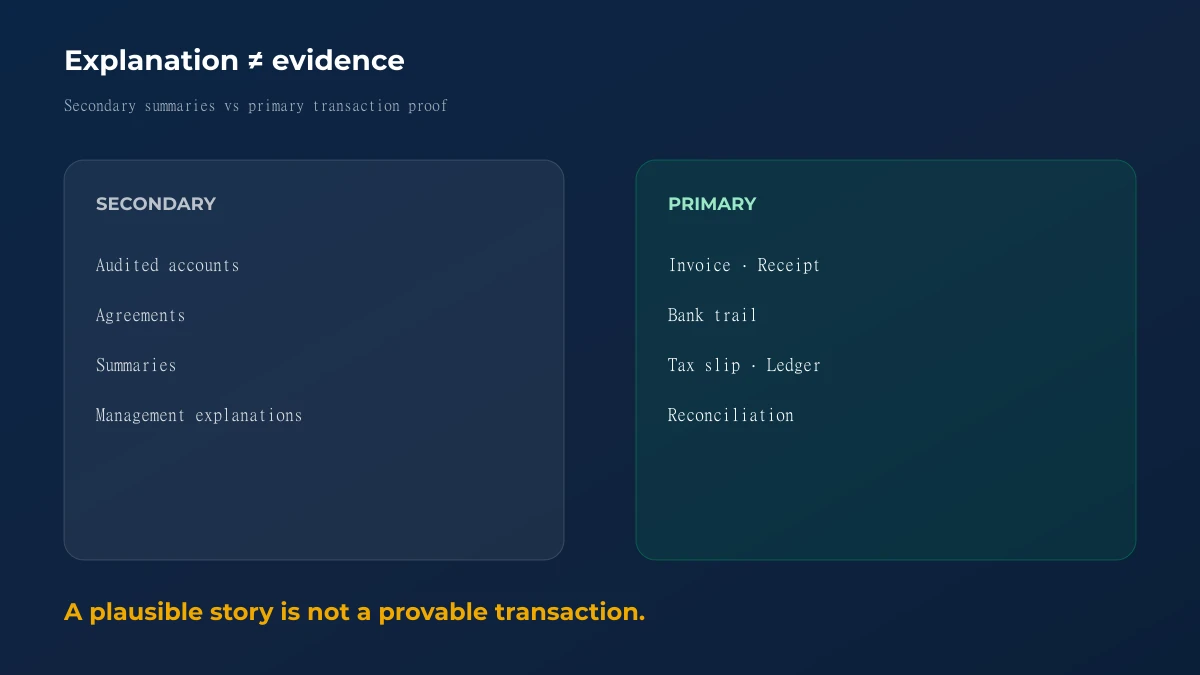
Explanation ≠ evidence
A plausible story is not the same thing as a provable transaction. The Tribunal treated audited financial statements as secondary documents that, standing alone, were insufficient to discharge the evidential burden on the management-fee claim.
Secondary / supporting information
- Audited financial statements
- Agreements and contracts
- Management summaries
- Plausible explanations
Useful context — not automatic proof that a specific sum was incurred and paid.
Primary transaction evidence
- Invoice
- Receipt
- Bank trail
- Payment schedule
- Tax payment slip
- Ledger entry
- Reconciliation
Transaction-level proof that reconstructs who, why, when and how much.
Dashboard
One company, four taxes
Poor transaction classification can hit more than one tax head. Tax control cannot be managed in silos when the same underlying business creates several exposures.
Company
Wamuri Limited
Residential letting · 2019–2023 assessments
Management-fee deductibility
Corporation Tax
KES 2,740,000 commission / management fees for 2019 — agreement alone did not prove the specific sum was incurred and paid. Appellant put the income-tax head at KES 1,356,300 incl. penalties/interest.
Advance rent
VAT
Vivo Energy advance rent: KES 9,579,527 assessed for 2023 (quantum not objected to); credit sought KES 7,184,807. Appellant put the VAT head at KES 12,877,020 incl. penalties/interest.
Director withdrawals
PAYE
Admitted withdrawals KES 136,577,811. Only evidenced company-tax payments of KES 12,688,624 reduced the assessment; remainder of unsupported drawings upheld as emoluments. Appellant put PAYE at KES 55,432,786 — the largest pleaded head.
Payments to professionals
Withholding Tax
Assessment on professional payments under Section 35(3) ITA stood unrebutted when no contesting evidence was led.
VAT
Advance rent and the VAT reconciliation
Timing and reconciliation both matter. The Tribunal found the Respondent justified in bringing commercial rent to charge for 2023, but not justified in confirming that VAT without crediting payments already made.
- 01Vivo Energy
Vivo Energy
New lease — advance rent received by Wamuri
- 02VAT timing question
VAT timing question
Commercial rent brought to charge under Section 12 VATA
- 03Payments over time
Payments over time
Taxpayer sought credit for VAT paid monthly in 2023–2025 totalling KES 7,184,807
- 04Reconcile actual VAT paid
Reconcile actual VAT paid
For 2023, Tribunal required credit by reference to the general ledger; 2024–2025 outside assessed period
Corporation Tax
Agreement ≠ automatically proof of payment
The company claimed commission / management fees of KES 2,740,000 for 2019 under a rent collection agency agreement with Hearth and Home Limited. The Tribunal upheld the disallowance: the agreement did not of itself prove the specific sum was computed, paid, and bore attendant withholding tax.
Alone
Agreement
Insufficient as sole proof
Needed
Proof of payment
Incurred · paid · supported
Stronger evidence position
Outcome in the case: corporation tax assessment for 2019 assessment upheld. Business lesson: reconciliations between returns, ledgers and bank trails close the gap agreements leave open.
Operational self-assessment
Take the Wamuri Test
Pick one director withdrawal. Can your finance team produce each of the following?
🔴 0/10 items evidenced
0–5 — potential PAYE / tax exposure if challenged
HIGH TRANSACTION-IDENTITY RISK
- 9–10 → Stronger control environment
- 6–8 → Documentation gaps
- 0–5 → High transaction-identity risk
This is an operational diagnostic, not a tax opinion.
Editorial interlude
A DIRECTOR'S BANK ACCOUNT IS NOT A SUSPENSE ACCOUNT.
- If a director pays a company bill personally, record it properly.
- If the company lends a director money, document it.
- If the company reimburses the director, support it.
- If money is remuneration, classify it correctly.
- If money is invested for the company, evidence the ownership and authority.
- If nobody knows what a payment is, that ambiguity itself is a control risk.
A boardroom scene
Ownership of the company does not erase the need to define what a payment is.
CEO
“I own the company.”
Finance Manager
“Yes.”
CEO
“So I can take money out whenever I need it.”
Tax Advisor
“You can move the money.”
Every withdrawal has a tax identity
Tax is not just a number on a return. It is an interpretation of the transaction — money, supply, geography, liability, withdrawal and evidence.
01 · MU-BEI
Money identity
Whose money?
Client funds vs business revenue — can you prove the distinction?
Read the companion →02 · SENDY
Supply identity
Whose sale?
Platform GMV vs platform commission — who actually supplied?
Read the companion →03 · AIRFLO
Geographic identity
Where is the value consumed?
Physical performance vs economic destination — which map does VAT ask about?
Read the companion →04 · BRISTOL ESTATE
Liability identity
Whose liability?
Company dissolution vs surviving tax obligation.
Read the companion →05 · WAMURI· reading now
Withdrawal identity
Why did the money leave?
Company cash vs personal wallet — can you prove the transaction’s tax identity?
You are here
06 · MINET
Consideration identity
What was the retained amount paying for?
Discount label vs facility, advantage or licensed-activity fee — can the records prove it?
Read the companion →07 · KUTUMA
Licence identity
What was the software payment buying?
End-user SaaS access vs copyright — and which year’s royalty definition applies?
Read the companion →08 · CHAIRMANIA × SAVLA
Evidence identity
Can the transaction be reconstructed?
A tax invoice is evidence—not immunity. Can the file prove the supply actually happened?
Read the companion →09 · RANEN × NGULLI × TRANSFLEET
Process identity
Can you prove the handoff?
Created, submitted, received, validated, reconciled, refiled — can you prove each gate?
Read the companion →Hub
CAN YOUR RECORDS PROVE YOUR BUSINESS STORY?
Whose money? Whose sale? Where is the value consumed? Whose liability? Why did the money leave? What was the retained amount paying for? What was the software payment buying? Can the transaction be reconstructed? Can you prove the handoff? The common test is evidence — not slogans.
Transaction intelligence
This is also a transaction-intelligence problem
The bank statement may show KES 500,000 OUT. The business needs to know the story behind the movement — not only that cash moved.
Better financial visibility means knowing not only what moved, but what the movement meant. This is the kind of transaction intelligence modern businesses increasingly need.
CONCEPTUAL ILLUSTRATION — NOT NECESSARILY AN EXISTING CLARIFI FEATURE
- Transaction ID
- DIR-2026-00482
- Amount
- KES 500,000
- Recipient
- Director
- Purpose
- Company tax payment
- Classification
- Reimbursement
- Supporting evidence
- Payment slip · Bank record · Board authority
- Tax review
- Complete
- Reconciliation
- Matched
- Evidence status
- Strong
Any ClariFi-style dashboard in this article is a conceptual illustration, not a claim that the screen ships today.
BEFORE THE NEXT DIRECTOR WITHDRAWAL
BEFORE YOU MOVE THE MONEY, DEFINE THE TRANSACTION.
A transfer from the company account may take seconds. But once the money leaves, the business should already know who received it, why, what authorised it, whether it must be repaid, how it should be recorded, what tax treatment follows — and what evidence will prove that position years later.
Review your director & shareholder transaction controls
KAN Consultants can help review director drawings, shareholder transactions, reimbursements, loans, payroll treatment, tax documentation and the controls that connect company money to its proper business purpose.
See where business money goes — and why
Explore how stronger financial visibility can help businesses understand the story behind every material cash movement.
THE BANK TRANSFER TAKES SECONDS. THE TAX CONSEQUENCE CAN LAST YEARS.
YOUR COMPANY ACCOUNT MAY HOLD YOUR MONEY. IT IS STILL NOT YOUR WALLET.
This article is provided for general business and tax education only and does not constitute legal, accounting or tax advice. The tax treatment of director and shareholder transactions depends on the specific facts, documentation and applicable law. Businesses should obtain professional advice for their circumstances.
Sources
- Kenya Law — Wamuri Ltd v Commissioner of Domestic Taxes [2026] KETAT 163 (KLR) (13 July 2026)
- Academy of Tax Law — Wamuri Ltd v Commissioner of Domestic Taxes [2026] KETAT 163 (KLR) case summary
Case facts are restated from the Kenya Law judgment DOCX for Wamuri Ltd v Commissioner of Domestic Taxes [2026] KETAT 163 (KLR), cross-checked against the Academy of Tax Law summary. Party pleadings are labelled separately from Tribunal findings.