ClariFi
Financial intelligence and decision support for Kenyan MSMEs.
- Corporate Exit
- Tax Intelligence
- Kenya
Visual autopsy
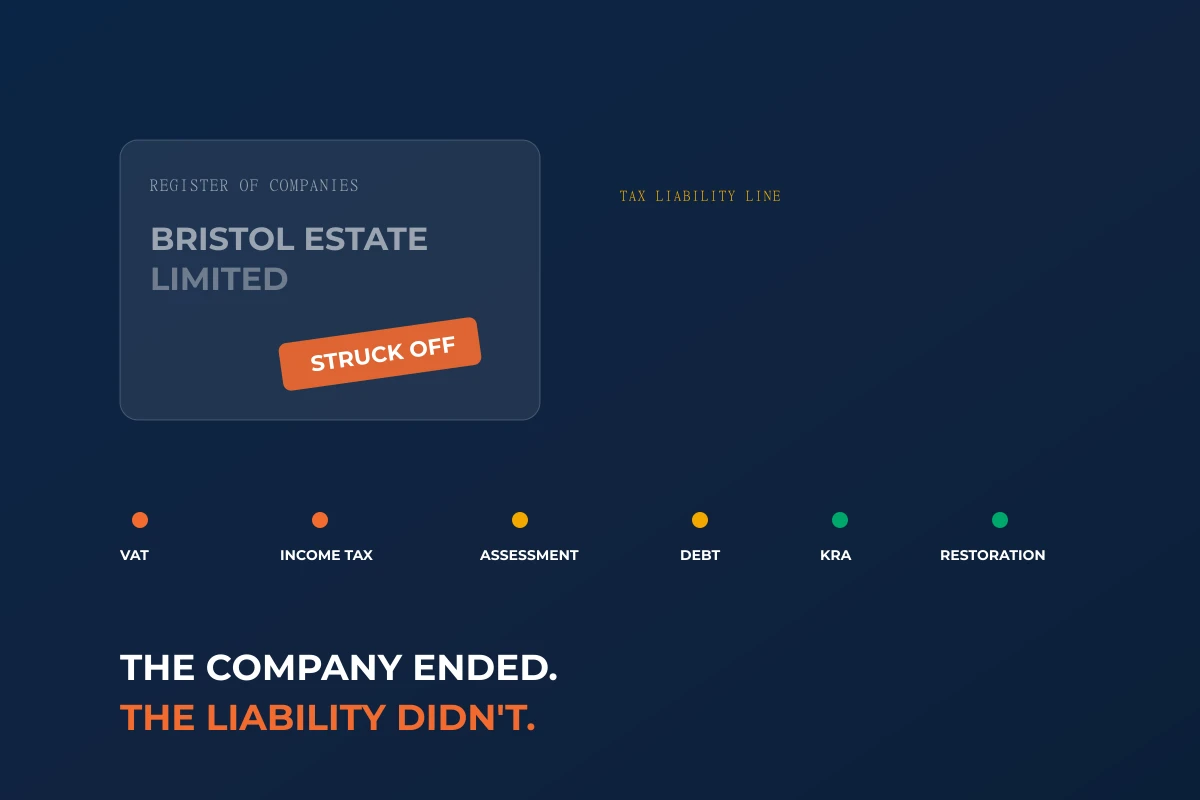
A company can die. A tax story may not.
Bristol Estate is not a morality play about tax. It is a timing story: corporate death on one clock, unresolved liability on another — and a court asked to reconnect them.
- Act I01
The company dies
On the register, Bristol Estate Limited disappears. Trading stops. The corporate form is struck off — reported as a voluntary application under the Companies Act.
- Act II02
Years pass
For ordinary observers, the story looks finished. No active directors' meetings. No fresh filings. A name that used to mean a legal person becomes a historical entry.
- Act III03
KRA asks the court to bring it back
In Miscellaneous Application E049 of 2023, Kenya Revenue Authority seeks restoration — not to revive a trading business, but to pursue a tax recovery pathway against liabilities that, on the reported iTax ledger, never left.
- Act IV04
The High Court restores the company
Secondary case notes report that the High Court of Kenya restored the company to the Register so outstanding tax liabilities could be pursued — treating unpaid tax as a debt due to the Government and KRA as a creditor entitled to seek restoration.
Source note
At publication research time, the full judgment could not be retrieved from Kenya Law. Facts below rely on dual-sourced secondary reports (law-firm case notes and business press). Re-verify against Kenya Law before treating any citation as official.
Reported holdings (secondary sources): KRA as creditor · Creditor notice defective · Liabilities survive dissolution · Company restored.
Dual timelines
One line ends when the company leaves the register. The other can keep moving — assessment, debt, creditor standing, restoration — long after the corporate form is gone.
Company life
- 1Incorporated
- 2Trades
- ✕Struck Off
Ends at the register.
Tax liability
- 1Taxable event
- 2Due
- 3Assessment
- 4Debt
- 5Recovery pathway
May continue →

The reported ledger
What was on the tax story when the company left?
KRA’s reported outstanding tax position on the company’s iTax ledger at dissolution — uncontroverted in the High Court application according to secondary case notes. The restoration ruling clears a recovery pathway; it does not finally adjudicate quantum.
Reported principal position
KES 475.8 million
KES 475,870,227.30
exclusive of accruing interest and penalties
Income tax (as reported)
KES 372.6 million
VAT (as reported)
KES 103.3 million
Press-reported only: a Tax Procedures Act s.81 penalty of KES 1 million appears in some coverage but was not confirmed in the dual-sourced CM Advocates summary — omitted from the principal figure above.
Tax amounts reflect KRA’s reported ledger position as summarised in secondary sources. The High Court restoration ruling does not finally determine that the company owes that exact quantum.
Secondary sources: CM Advocates LLP case note / PDF · Business Daily report · Kenyan Wall Street report
Three clocks
Founders often treat “we closed the company” as one event. In practice, corporate existence, accounting closure and tax resolution are three different timelines.
Corporate clock
When does the company legally cease to exist?
- 01Incorporated
- 02Active
- 03Strike-off process
- 04Dissolved
Accounting clock
When are the books actually closed?
- 01Final transactions
- 02Accruals
- 03Final accounts
- 04Reconciliation
- 05Closure
Tax clock
When are tax obligations actually resolved?
- 01Taxable event
- 02Return
- 03Assessment
- 04Objection
- 05Appeal
- 06Settlement
- 07Recovery
- 08Closure
Struck off is not a synonym for finished
In plain English: stopping operations, applying for striking off, being dissolved, and clearing every creditor are different events. Confusing them is how exits get improvised.
Operations cease
The business stops trading. Staff leave. Customers move on. That is operational reality — not the same as legal dissolution.
Voluntary striking off
Directors apply to remove the company from the Register. Process and notices matter. Skipping a creditor can make the exit non-compliant.
Dissolution
The company ceases to exist as a legal person on the register. That does not automatically settle every claim that accrued while it was alive.
Unresolved liabilities
Tax assessments, disputes and debts can still exist as a recovery story — even when the corporate name looks "closed."
KRA WAS ALSO A CREDITOR
Founders often list banks and suppliers when they think about creditors. Bristol Estate puts a sharper question on the table: if unpaid tax is a debt due to the Government, who else must know the company is leaving?
Creditor circle
- Bank
- Supplier
- Employee
- Landlord
- Lender
- Shareholder
- KRA / statutory creditor
The dissolution door
Think of dissolution as a door. Before you walk through it, every checkpoint on the frame should be green. Leave one unresolved — especially tax — and you may be carrying EXIT RISK into a process that looks administrative.
Door
DISSOLUTION
- Final Accounts
- Tax Returns
- Bank Reconciliation
- VAT
- PAYE
- WHT
- Tax Ledger
- Assessments
- Objections
- Creditors
- Statutory Notices
- Supporting Records
If unresolved
EXIT RISK
The corporate exit stack
Dissolution sits at the top of a stack — not at the bottom of a to-do list. Skip a layer and the exit becomes a bet that nobody will ask later.
- Layer 1
Operations
Stop trading responsibly.
- Layer 2
Accounting
Close and reconcile the books.
- Layer 3
Tax
Determine and document the final tax position.
- Layer 4
Disputes
Resolve assessments, objections, appeals and payment matters.
- Layer 5
Creditors
Identify and notify affected creditors.
- Layer 6
Statutory process
Complete Companies Act requirements.
- Layer 7
Evidence
Create permanent exit documentation.
- Layer 8
Dissolution
Only then should corporate closure become the final layer.
Dissolution should be the last step.
Governance framework
Exit evidence pack
When someone asks later — a new director, an auditor, a lawyer, or a tax authority — what permanent pack would let the final tax position speak for itself?
- Final financial statements
- General ledger
- Trial balance
- Final bank reconciliations
- VAT returns
- Income / corporation tax returns
- PAYE records
- Withholding-tax records
- eTIMS reconciliation
- Tax-ledger reconciliation
- Assessment correspondence
- Objections
- Appeal records
- Settlement / payment evidence
- Creditor schedule
- Creditor notices
- Directors’ resolutions
- Shareholder approvals where relevant
- Registrar documents
- Legal advice
- Tax advice
- Asset-disposal documentation
- Final supplier / customer balances
- Final supporting schedules
Not every item is required for every company. Use this as a governance checklist: if an item is irrelevant, document why. If it is relevant and missing, treat that as an exit gap — not a paperwork afterthought.
Operational self-assessment
Take the Bristol Estate Test
Before you treat dissolution as administrative, check every item you can answer YES to as an affirmative readiness signal. For assessments, objections and appeals, YES means resolved or cleared — not merely “we know they exist.”
🔴 0/14 YES answers
0–7 YES — close the ledger and liabilities first
DO NOT TREAT DISSOLUTION AS ROUTINE
- 12–14 YES → Higher exit readiness
- 8–11 YES → Exit gaps
- 0–7 YES → Do not treat dissolution as routine
This is an operational self-assessment, not legal or tax advice.
The tax story can survive the company
The precise lesson is not that tax debt lasts forever in every case. It is that corporate death does not automatically end tax liability — and that unresolved positions, defective notices and incomplete evidence can reopen a path the board thought it had closed.
Restoration, recovery and dispute outcomes still depend on law, procedure and facts. What Bristol Estate dramatises is the mismatch: the register can stop while the ledger keeps asking questions.
The tax identity of a transaction
Tax is an interpretation of the transaction — money, supply, geography, liability, withdrawal and evidence.
01 · MU-BEI
Money identity
Whose money?
Client funds vs business revenue — can you prove the distinction?
Read the companion →02 · SENDY
Supply identity
Whose sale?
Platform GMV vs platform commission — who actually supplied?
Read the companion →03 · AIRFLO
Geographic identity
Where is the value consumed?
Physical performance vs economic destination — which map does VAT ask about?
Read the companion →04 · BRISTOL ESTATE· reading now
Liability identity
Whose liability?
Company dissolution vs surviving tax obligation.
You are here
05 · WAMURI
Withdrawal identity
Why did the money leave?
Company cash vs personal wallet — can you prove the transaction’s tax identity?
Read the companion →06 · MINET
Consideration identity
What was the retained amount paying for?
Discount label vs facility, advantage or licensed-activity fee — can the records prove it?
Read the companion →07 · KUTUMA
Licence identity
What was the software payment buying?
End-user SaaS access vs copyright — and which year’s royalty definition applies?
Read the companion →08 · CHAIRMANIA × SAVLA
Evidence identity
Can the transaction be reconstructed?
A tax invoice is evidence—not immunity. Can the file prove the supply actually happened?
Read the companion →09 · RANEN × NGULLI × TRANSFLEET
Process identity
Can you prove the handoff?
Created, submitted, received, validated, reconciled, refiled — can you prove each gate?
Read the companion →Hub
CAN YOUR RECORDS PROVE YOUR BUSINESS STORY?
Whose money? Whose sale? Where is the value consumed? Whose liability? Why did the money leave? What was the retained amount paying for? What was the software payment buying? Can the transaction be reconstructed? Can you prove the handoff? The common test is evidence — not slogans.
The business–tax lifecycle
Exit readiness is not a final-week project. It is the last visible node of a chain that started when the company was created.
- CREATE
- TRANSACTION
- REVENUE
- TAXABLE EVENT
- RETURN
- ASSESSMENT
- LIABILITY
- PAYMENT / DISPUTE
- EVIDENCE
- EXIT
Tax architecture begins when the business begins.
A boardroom scene
Four voices. One exit. Notice which question lands last.
CEO
“We're done trading. Let's strike the company off and move on.”
Company Secretary
“We can prepare the registrar documents. Have we mapped every creditor who must be notified?”
CFO
“Final accounts are almost ready. Bank reconciliations are clean. I'm less sure the tax ledger tells the same story.”
Tax Advisor
“Before the company disappears, show me the open assessments, objections, appeals and the evidence that supports the final position.”
Five questions for the board
Put these on the agenda before the striking-off resolution — not after the Gazette notice.
01
What tax liabilities exist?
02
What tax liabilities are disputed?
03
What tax liabilities have crystallised?
04
What evidence supports our position?
05
Who must be notified before we disappear?
The problem is information continuity
Companies do not only fail exits because directors are careless. They fail because the people who knew the tax story leave, the folders fragment, and nobody can reconstruct what was owed when the entity still existed.
Visibility
See money, obligations and open items in one place — so exit conversations start from a shared picture, not tribal knowledge.
Reconciliations
Bank, cash and transaction trails that can be reconstructed later — the difference between a claim and a defendable position.
Evidence
Retain the documents and schedules that explain the final tax story after people leave and systems change.
Exit readiness at a glance
Boards need a single picture before they authorise disappearance. The card below is an educational illustration of the kinds of statuses an exit review might surface — not a live ClariFi product screen.
Exit readiness
Conceptual illustration
Status
NOT YET READY
Sample company · illustrative gaps only
- Tax ledger vs booksMismatch
- VAT periods reconciledPartial
- Open assessments2 open
- Creditor noticesIncomplete
- Final accounts packDraft
- Evidence retentionGaps
Conceptual illustration — not an existing ClariFi dashboard.
BEFORE YOU CLOSE THE COMPANY
CLOSE THE LEDGER. CLOSE THE LIABILITIES. THEN CLOSE THE COMPANY.
A strike-off application should not be the first time a business asks whether its tax affairs are complete. Before the company disappears from the register, make sure you can explain every material transaction, every tax return, every open assessment, every creditor, every unresolved liability — and the evidence supporting the final position.
KAN Consultants can help review the company's tax position, unresolved assessments, reconciliations, statutory obligations and documentary readiness before dissolution.
Explore how ClariFi helps businesses build stronger financial visibility and decision intelligence.
DON'T LET YOUR COMPANY DIE BEFORE ITS RECORDS CAN SPEAK FOR IT.
This article is educational commentary on publicly reported legal developments. It is not legal, tax or accounting advice. Corporate exit and tax decisions require professional advice tailored to your facts.
Sources
Primary judgment text was not retrieved from Kenya Law at research time. Re-verify citations against Kenya Law before relying on them in formal advice.