
ClariFi
Financial intelligence and decision support for Kenyan MSMEs.
- Tax Intelligence
- Kenya
- Software Payments
Opening
The ledger said software. The assessment said royalty.
A Kenyan operator pays a monthly fee for email, hosting, maps, messages and cloud tools. The ledger says software expense. The invoice says subscription. Then an assessment arrives that calls the same payment a royalty.
That is the tax-identity problem in Kutuma Kenya Limited v Commissioner of Domestic Taxes. The dispute was not whether the company used technology. It was whether, in 2020, 2021 and 2022, those subscription payments were consideration for the use of copyright, and therefore withholding tax on royalties, or payments for hosted access to copyrighted products.
A later statute can change the definition. It cannot rewrite the year in which the money moved. The useful board question is therefore not “is software taxable?” It is: what did this payment buy, in which period, under which definition, and can the file prove it?
The 30-second brief
Six cards. One period problem.
01 · Arrangement
Off-the-shelf tools on a food-delivery ledger
Kutuma Kenya Limited operates a food-delivery business in Kenya. It subscribed to off-the-shelf digital products: data storage and web hosting, email and workspace tools, security, analytics, messaging, OTP and notifications, geo-location, integrations and other cloud-computing products. It recorded the spend as software licences.
02 · Kutuma’s position
Hosted access, not copyright
The products were commoditised end-user tools, typically billed monthly. The licences were limited, non-exclusive, non-transferable and royalty-free. They did not grant source code or the right to reproduce, modify, distribute or commercially exploit copyright. The payments were for access to hosted services, not for copyright.
03 · KRA’s position
A royalty for using another person’s literary work
The Commissioner treated the payments as royalties: consideration for the use of, or the right to use, copyright in another person’s literary work. On that view, withholding tax applied under section 35 of the Income Tax Act whether the software was for resale or for own use.
04 · Tribunal outcome
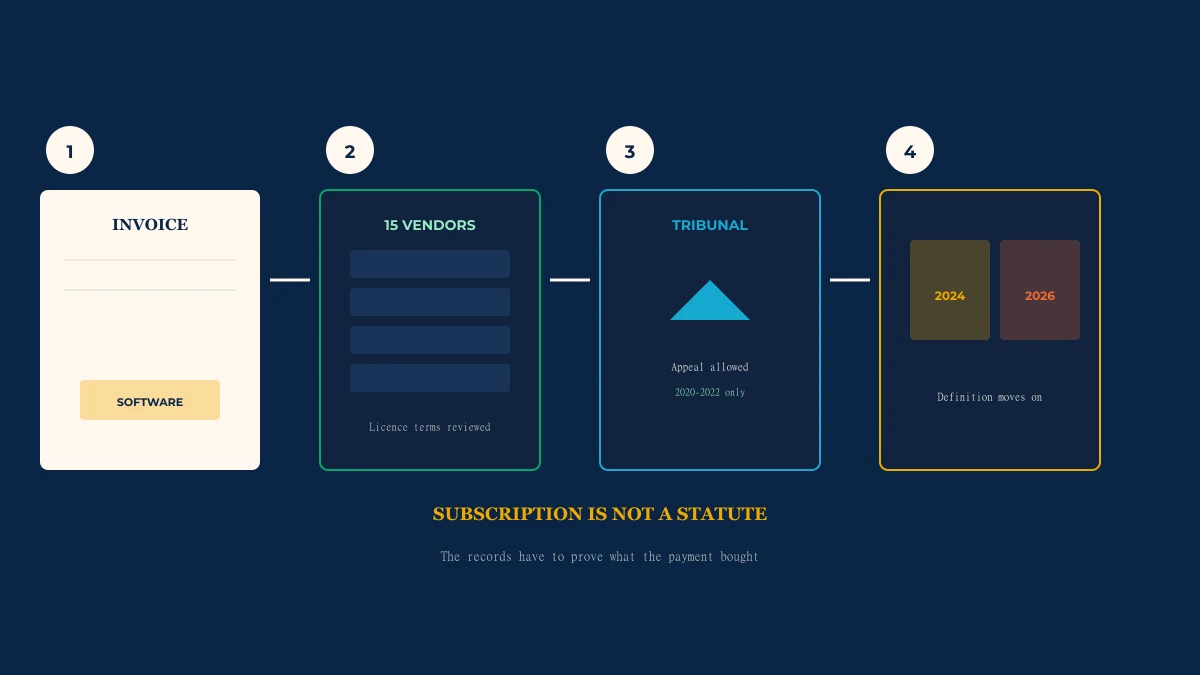
Appeal allowed for 2020–2022
On 30 June 2026 the Tax Appeals Tribunal allowed the appeal and set aside the objection decision of 12 May 2025. It held that withholding tax was not applicable to Kutuma’s software-licence payments for 2020, 2021 and 2022.
05 · Later statutes
The definition moved after the years in dispute
Parliament later widened the statutory definition of royalty. The software limb commenced on 27 December 2024. A further card-network expansion generally commenced on 1 July 2026. Those amendments do not decide the 2020–2022 years that were before the Tribunal.
06 · Business lesson
Name the rights. Name the date.
Name the rights actually granted. Name the date of the payment. Then read the royalty definition that was in force on that date. A ledger label is not the transaction.
Three legal periods
Label every file with the period of law
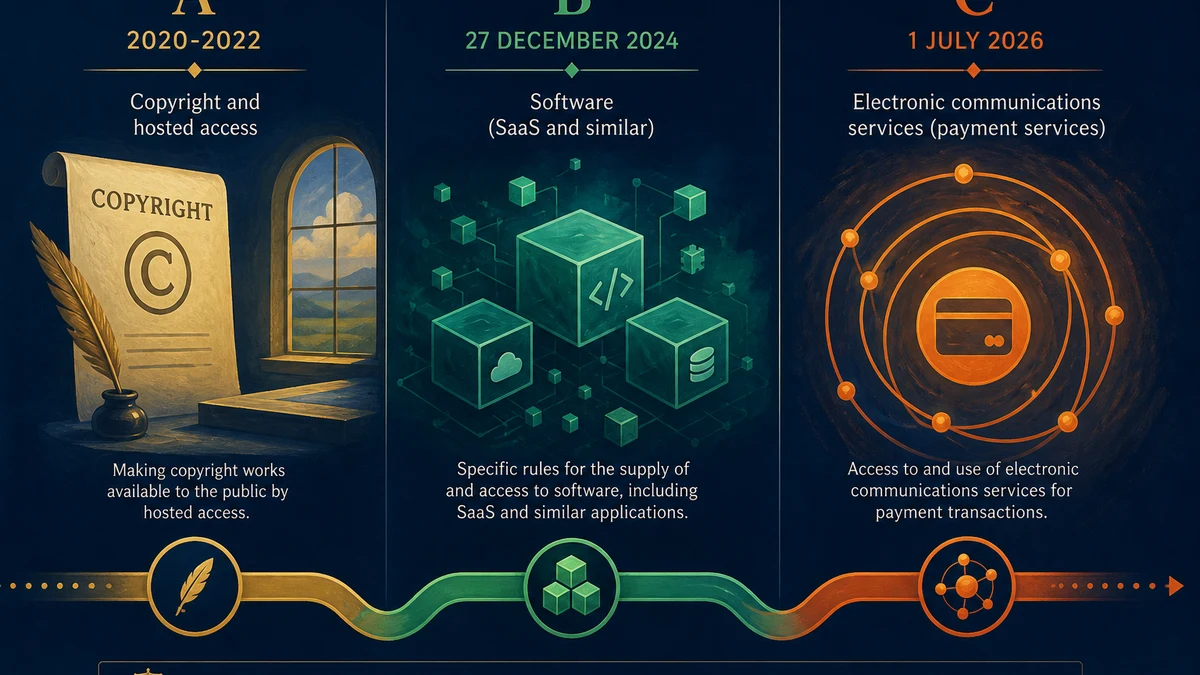
Do not blend these periods. Kutuma decides Period A. Periods B and C are later statutes.
Period A
Kutuma years
Income Tax Act royalty definition then in force: consideration for the use of, or the right to use, any copyright of a literary, artistic or scientific work, together with the High Court’s copyright / copyrighted-article analysis in Seven Seas.
Kutuma is a decision about these years. WHT was not applicable to these software-licence payments on these terms.
Period B
Software limb
Tax Laws (Amendment) Act, 2024 (No. 12 of 2024). Assent: 11 December 2024. Commencement: 27 December 2024. Section 2 of the Income Tax Act was amended by deleting the definition of royalty and substituting a new definition that includes: “any software, proprietary or off-the-shelf, whether in the form of licence, development, training, maintenance or support fees.”
Kutuma’s assessment years ended before this commencement. Kutuma does not decide Period B.
Period C
Card-network expansion
Finance Act, 2026 (No. 19 of 2026). Kenya Law records general commencement of the royalty substitution on 1 July 2026. The Act again deleted and substituted the section 2 definition. Enacted limb (g) covers “a proprietary digital payment card network or platform, including access, participation or usage rights in such system through a card, whether the consideration is periodic or transaction-based and whether or not the payment is described as a service fee, transaction fee, network fee, assessment fee, processing fee or similar charge.” The Tribunal quoted the same limb. Kutuma recorded assent as 23 June 2026; Kenya Law’s document history currently lists assent as 23 July 2026. Period C follows the 1 July 2026 commencement.
Kutuma does not decide Period C. Card-network litigation is a separate line of cases.
Procedural history
From compliance check to Tribunal
Kutuma Kenya Limited is a food-delivery business in kenya. The withholding-tax assessments covered 2020, 2021 and 2022.
- 1
Compliance check notice
The Commissioner notified Kutuma of an intended compliance check.
- 2
Pre-assessment notice
A pre-assessment notice was issued on iTax. That date sits beside, but is not, the 27 December 2024 commencement of the software limb. The assessments still concerned 2020–2022 payments.
- 3
Assessment notice
Tax assessment notice for 2020, 2021 and 2022 withholding tax on the balance of software-licence payments.
- 4
System-generated assessments
System-generated assessments referred to in the objection.
- 5
Objection
Kutuma objected to the entire withholding-tax assessments.
- 6
Objection decision
Objection decision confirming the withholding-tax assessments in their entirety.
- 7
Notice of Appeal
Notice of Appeal. Memorandum of Appeal dated the same day and filed 30 June 2025 (Tribunal Appeal E694 of 2025).
- 8
Tribunal judgment
Tax Appeals Tribunal judgment: appeal allowed; objection decision set aside; each party to bear its own costs.
- 9
Kenya Law publication
Kenya Law publication date of the judgment (not the decision date).
Facts and findings are restated from [2026] KETAT 156 (KLR). Party submissions are labelled separately from judicial holdings. Short statutory expressions are used; longer passages are paraphrased. The Tribunal’s quotation of Finance Act, 2026 is labelled as such. The software limb of Tax Laws (Amendment) Act, 2024 is taken from the Act. The enacted Finance Act, 2026 (No. 19 of 2026) card-network limb matches the Tribunal’s quotation.
Controlling figures
Keep every amount attached to its stage
Do not present any figure as Kutuma’s final substituted tax. The Tribunal set aside the objection decision and did not replace it with a computed withholding-tax amount.
| Stage | Figure | Treatment |
|---|---|---|
| Disputed assessment as described by Kutuma | KES 5,097,193 | Principal tax, penalty and interest on the software-licence withholding-tax dispute, as described by the Appellant. This is not a Tribunal-imposed final bill. |
| Respondent’s 2021 software-licence base | KES 12,457,981 | Kutuma said the correct 2021 figure was KES 8,447,611, and that KES 4,010,370 had already been counted in 2020. |
| Cost bases the Tribunal used after finding unrebutted computational error, 2020 | KES 4,010,370 | These are licence-cost bases discussed in the judgment, not withholding-tax bills. The Tribunal set aside the objection decision and did not replace it with a computed withholding-tax amount. |
| Cost bases the Tribunal used after finding unrebutted computational error, 2021 | KES 8,447,611 | These are licence-cost bases discussed in the judgment, not withholding-tax bills. The Tribunal set aside the objection decision and did not replace it with a computed withholding-tax amount. |
| Cost bases the Tribunal used after finding unrebutted computational error, 2022 | KES 7,722,795 | These are licence-cost bases discussed in the judgment, not withholding-tax bills. The Tribunal set aside the objection decision and did not replace it with a computed withholding-tax amount. |
Disputed assessment as described by Kutuma
KES 5,097,193
Principal tax, penalty and interest on the software-licence withholding-tax dispute, as described by the Appellant. This is not a Tribunal-imposed final bill.
Respondent’s 2021 software-licence base
KES 12,457,981
Kutuma said the correct 2021 figure was KES 8,447,611, and that KES 4,010,370 had already been counted in 2020.
Cost bases the Tribunal used after finding unrebutted computational error, 2020
KES 4,010,370
These are licence-cost bases discussed in the judgment, not withholding-tax bills. The Tribunal set aside the objection decision and did not replace it with a computed withholding-tax amount.
Cost bases the Tribunal used after finding unrebutted computational error, 2021
KES 8,447,611
These are licence-cost bases discussed in the judgment, not withholding-tax bills. The Tribunal set aside the objection decision and did not replace it with a computed withholding-tax amount.
Cost bases the Tribunal used after finding unrebutted computational error, 2022
KES 7,722,795
These are licence-cost bases discussed in the judgment, not withholding-tax bills. The Tribunal set aside the objection decision and did not replace it with a computed withholding-tax amount.
Each amount is attached to its procedural stage. Figures are not added together. No amount is presented as a Tribunal-substituted final withholding-tax liability. Principal, penalty and interest are not separated beyond what the judgment itself separates.
Separate the record
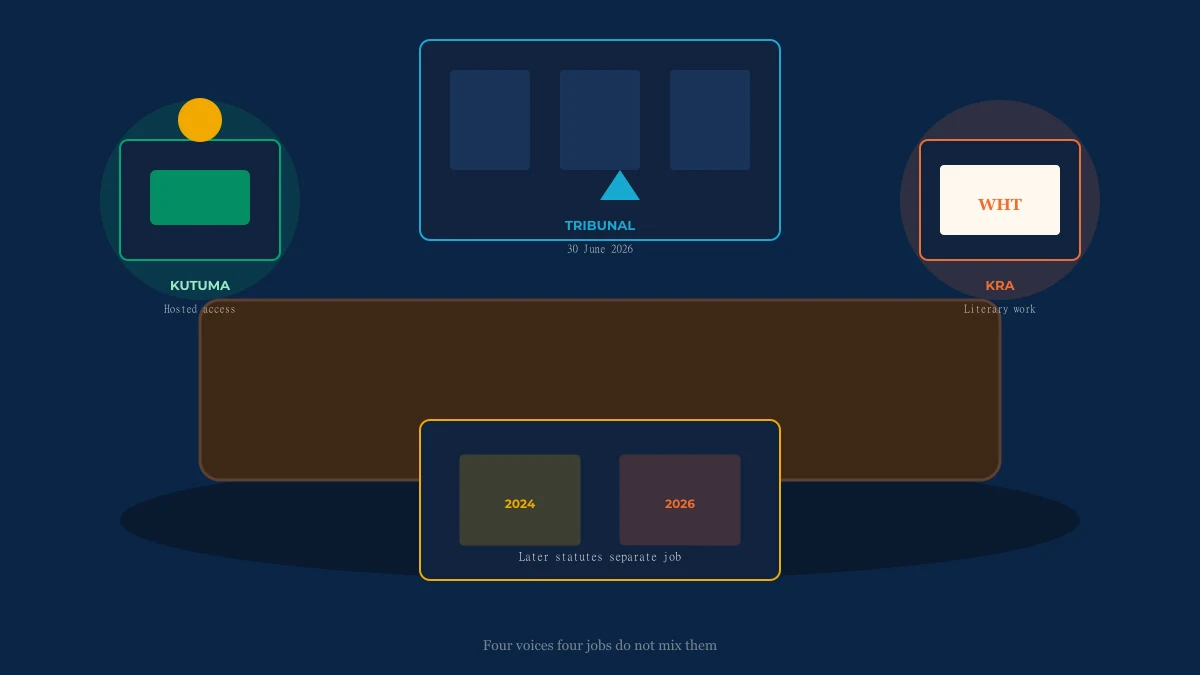
Four voices. Four jobs. Do not mix them.
A party’s submission is not a finding. A later statute is not a 2020–2022 holding. Keep those voices distinct when a classification dispute is reconstructed from the file.
What Kutuma argued
Party submissions
- The products were off-the-shelf end-user tools, typically billed monthly.
- Licences were royalty-free and did not grant source code or exclusive copyright rights.
- Digital Service Tax, where applicable, is an obligation of the digital service provider under the DST framework.
- Seven Seas, Dynasoft and related authorities treat limited operational access as a copyrighted-article or service payment rather than a royalty.
- OECD Commentary supports that reading.
- KRA’s Digital Economy Office had pointed the Medium Taxpayers’ Office to Seven Seas and the OECD/UN commentaries.
- The 2021 cost base, the blanket 20% rate, and the absence of reasons on those computational points were also challenged.
What KRA argued
Party submissions
- Payment for software was royalty because it was consideration for the use and right to use digital products that are another person’s literary work.
- Withholding tax applied whether the software was for resale or own use.
- Using copyright-protected intellectual property was enough.
- Software is neither a good nor a service but intellectual property.
- Kutuma had not discharged the burden of proving the decision incorrect.
- High Court software decisions had been appealed and were not entirely similar because this case concerned software-licence payments.
What the Tribunal decided
30 June 2026 holdings
- The issue was whether withholding tax was applicable to Kutuma’s payments for software licences for 2020, 2021 and 2022.
- The Tribunal found merit in Kutuma’s unrebutted showing that the 2021 base was excessive and that a blanket 20% rate ignored residency and treaty facts. It then analysed withholding tax on the corrected cost bases.
- Following Seven Seas, subscription for a licence does not by itself prove a royalty. The question was whether the payments were consideration for the use of, or the right to use, copyright.
- After reviewing the 15 sets of terms, the Tribunal held they were consideration for access to hosted services, not for copyright. None of the 15 subscription payments satisfied the Period A royalty definition.
- OECD Commentary on Article 12 concerning software copies, internal-use licences, distributors and cloud access was treated as interpretive guidance consistent with Seven Seas, not as a Kenyan statute.
- The Tribunal quoted the Finance Act, 2026 royalty substitution and said the later widening of the definition supported the conclusion that, in the years assessed, the transactions fell outside royalty as it then stood. The Tribunal did not cite the Tax Laws (Amendment) Act, 2024.
- Orders: appeal allowed; objection decision dated 12 May 2025 set aside; each party to bear its own costs.
What later statutes did
Period B and Period C
- Software was first inserted into the Income Tax Act royalty definition by the Tax Laws (Amendment) Act, 2024, with effect from 27 December 2024.
- Finance Act, 2026 (No. 19 of 2026) later substituted the definition again, restating the software limb and adding the proprietary digital payment card network or platform limb, generally from 1 July 2026.
- Those texts apply to later periods. They do not reverse the Tribunal’s orders on 2020–2022.
- Kutuma quoted Finance Act, 2026. This article keeps that quotation and the 2024 commencement both in view.
Facts and findings are restated from [2026] KETAT 156 (KLR). Party submissions are labelled separately from judicial holdings. Short statutory expressions are used; longer passages are paraphrased. The Tribunal’s quotation of Finance Act, 2026 is labelled as such. The software limb of Tax Laws (Amendment) Act, 2024 is taken from the Act. The enacted Finance Act, 2026 (No. 19 of 2026) card-network limb matches the Tribunal’s quotation.
The Tribunal’s file
The 15 vendors the Tribunal reviewed
The Tribunal recorded that it perused the licence terms of all 15 vendors in the assessment period. Across those terms it found hosted or limited-access arrangements, with intellectual property retained by the vendor, no source-code access, and no grant of reproduction, distribution or derivative-work rights.
- Google Inc
- HostAfrica EAC
- Intuit-QB
- 3 Degrees
- GoDaddy/WebFaction
- DigitalOcean
- Tookan (JungleWorks)
- Wingubox
- Africa’s Talking
- Appfigures
- Approval Donkey
- Twilio (SendGrid & Segment)
- Intuit-Mailchimp
- Hawkstone-Instabug
- WAMA Cloud
This list is a record of what the Tribunal reviewed in Kutuma. It is not a classification of anyone else’s contract, and it is not a Period B or Period C holding.
Screening framework
Copyright, copyrighted article, hosted access
This table is Kinako / KAN Consultants’ screening map of the Period A dispute. It is not a statutory test for Period B or Period C.
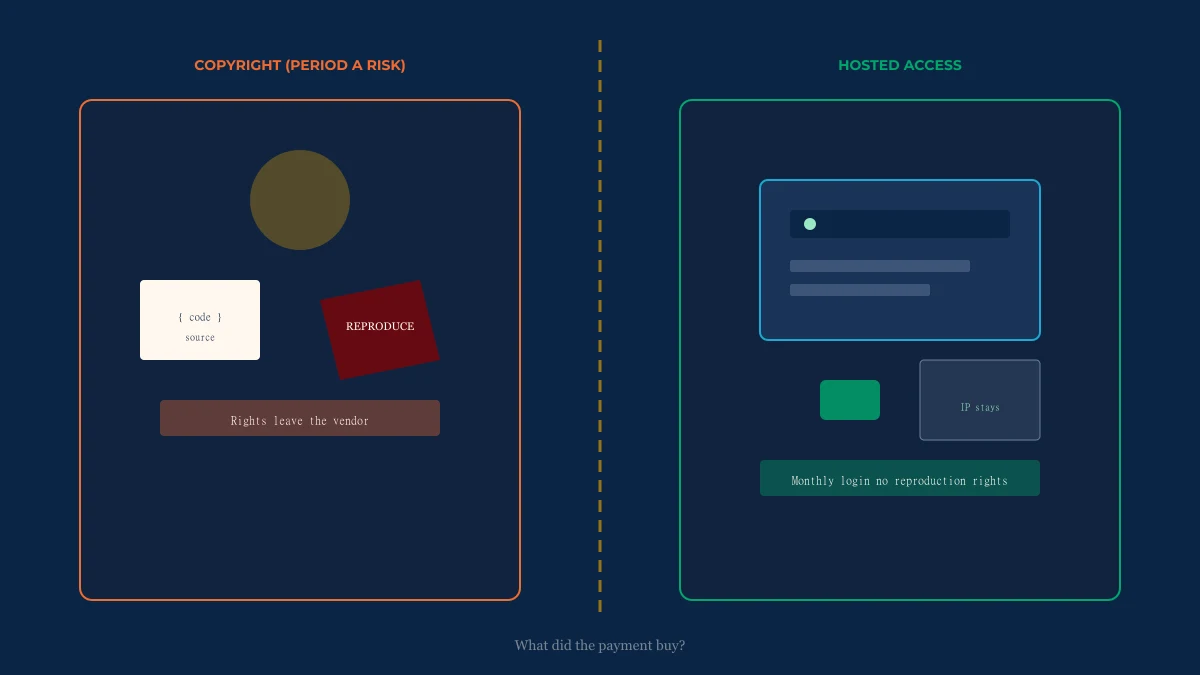
| Question | Copyright (Period A royalty risk) | Copyrighted article / hosted access |
|---|---|---|
| What is paid for? | A right to exploit copyright: reproduce, adapt, distribute, communicate or otherwise use the copyright itself | Access to a product or hosted service, with only the incidental copying needed to operate it |
| What do the terms withhold? | The owner may still keep title, but grants an exploitation right | Source code, modification, reverse engineering, sublicensing and distribution are typically prohibited |
| What did Seven Seas emphasise? | Licence fees can be royalties where the agreement grants rights to use the copyright | Annual subscriptions do not, without more, prove a royalty; the agreement must show whether rights were transferred or the user only accessed a copyrighted article |
| What did Kutuma find on these 15 files? | Not established | Hosted or limited-access subscriptions; IP retained by vendors; no exploitation rights conferred |
| What this does not decide | Later statutory software and card-network limbs | Anyone else’s contract, or any payment made from 27 December 2024 |
What is paid for?
- Copyright (Period A royalty risk)
- A right to exploit copyright: reproduce, adapt, distribute, communicate or otherwise use the copyright itself
- Copyrighted article / hosted access
- Access to a product or hosted service, with only the incidental copying needed to operate it
What do the terms withhold?
- Copyright (Period A royalty risk)
- The owner may still keep title, but grants an exploitation right
- Copyrighted article / hosted access
- Source code, modification, reverse engineering, sublicensing and distribution are typically prohibited
What did Seven Seas emphasise?
- Copyright (Period A royalty risk)
- Licence fees can be royalties where the agreement grants rights to use the copyright
- Copyrighted article / hosted access
- Annual subscriptions do not, without more, prove a royalty; the agreement must show whether rights were transferred or the user only accessed a copyrighted article
What did Kutuma find on these 15 files?
- Copyright (Period A royalty risk)
- Not established
- Copyrighted article / hosted access
- Hosted or limited-access subscriptions; IP retained by vendors; no exploitation rights conferred
What this does not decide
- Copyright (Period A royalty risk)
- Later statutory software and card-network limbs
- Copyrighted article / hosted access
- Anyone else’s contract, or any payment made from 27 December 2024
Period of law
Three-period statute table
| Period | Instrument | Royalty definition that matters | What Kutuma decides |
|---|---|---|---|
| A. 2020–2022 | Income Tax Act as then in force; Seven Seas [2021] KEHC 358 (KLR) | Consideration for the use of, or the right to use, copyright of a literary, artistic or scientific work | Yes, WHT not applicable to these software-licence payments in these years on these terms |
| B. From 27 December 2024 | Tax Laws (Amendment) Act, 2024, s. 2 | Adds software, proprietary or off-the-shelf, whether as licence, development, training, maintenance or support fees | No. Different definition. Different years. |
| C. From 1 July 2026 | Finance Act, 2026 (No. 19 of 2026), s. 2 substitution | Restates software and adds the card-network / platform limb as enacted | No. Different definition. Different years. Card-network litigation is a separate line of cases. |
A. 2020–2022
- Instrument
- Income Tax Act as then in force; Seven Seas [2021] KEHC 358 (KLR)
- Definition
- Consideration for the use of, or the right to use, copyright of a literary, artistic or scientific work
- What Kutuma decides
- Yes, WHT not applicable to these software-licence payments in these years on these terms
B. From 27 December 2024
- Instrument
- Tax Laws (Amendment) Act, 2024, s. 2
- Definition
- Adds software, proprietary or off-the-shelf, whether as licence, development, training, maintenance or support fees
- What Kutuma decides
- No. Different definition. Different years.
C. From 1 July 2026
- Instrument
- Finance Act, 2026 (No. 19 of 2026), s. 2 substitution
- Definition
- Restates software and adds the card-network / platform limb as enacted
- What Kutuma decides
- No. Different definition. Different years. Card-network litigation is a separate line of cases.
Screening tables, board questions, the evidence graph and the Software Payment Review are Kinako / KAN Consultants business analysis, not judicial findings and not a substitute for the statutory tests.
Withholding tax mechanics
Not a rate decision
Section 35 of the Income Tax Act requires a payer, upon payment of a royalty that is chargeable to tax, to deduct tax: for payments to a non-resident without a Kenyan permanent establishment, section 35(1)(b); for payments to a resident or a person with a Kenyan permanent establishment, section 35(3)(g). Chargeability still depends on whether the amount is a royalty in the period of payment, and on residency, permanent establishment, exemptions and any applicable treaty.
KRA’s published withholding-income-tax FAQ currently lists royalty / natural resource income at 5% (resident) and 20% (non-resident), and notes that a double-tax agreement may provide a different non-resident rate. Those are published headline figures. They are not this article’s determination, not the diagnostic output, and not a substitute for the Third Schedule and the treaty as at the payment date. KRA’s 6 November 2019 royalties notice still prints the pre-software definition and must not be treated as current classification guidance for software.
Digital Service Tax is a different head. Kutuma raised DST in argument. The Tribunal’s identified issue and orders concerned withholding tax on the 2020–2022 software-licence payments. This article does not treat DST as decided.
This article does not determine a tax rate. Published KRA headline royalty rates are guidance only. Apply the Third Schedule, any gazette exemptions and any applicable double-tax agreement as at the payment date.
Evidence
The Tax Evidence Graph
Tap or focus a node to see what it proves, and what it does not.
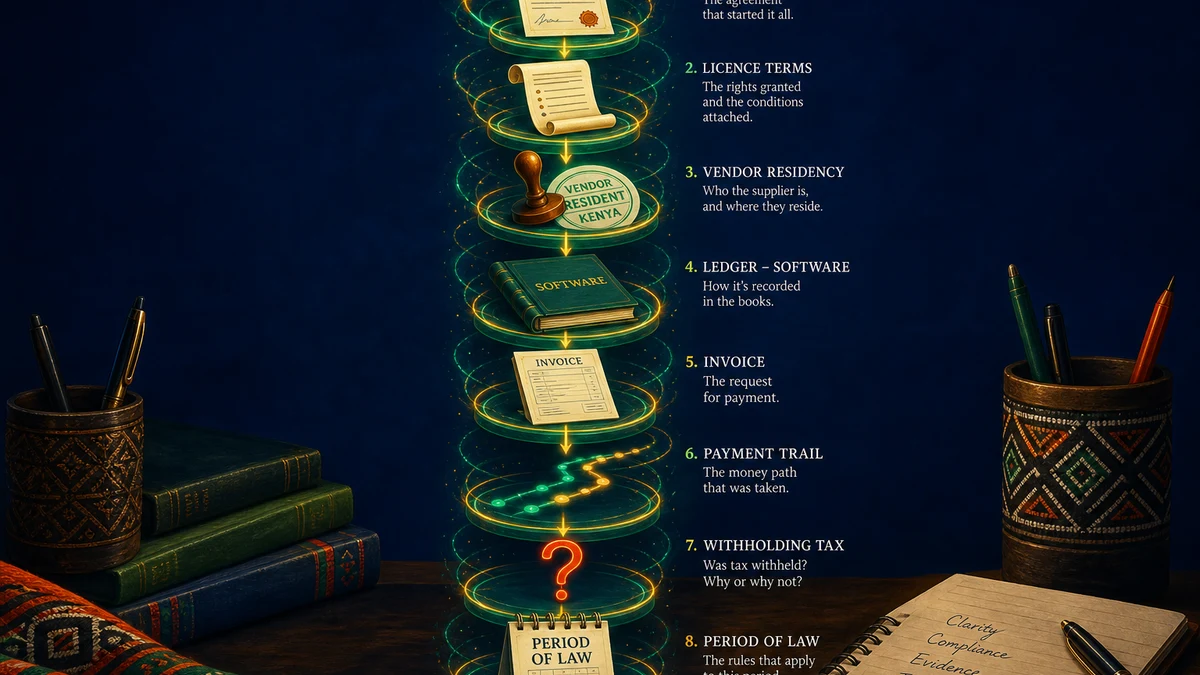
Text version of the evidence chain
- Contract: Proves who contracted with whom. Does not prove the statutory class of the payment.
- Licence terms: Prove the rights granted and withheld. Do not prove the rate.
- Vendor residency file: Proves where the payee is claimed to be resident. Does not, without documents, prove treaty entitlement.
- Ledger label: Proves how the company named the spend (“software”, “licence”, “subscription”). Does not bind KRA or the Tribunal.
- Invoice and receipt: Prove amount, date and description. Do not prove copyright rights.
- Payment trail: Proves money left. Does not prove what legal right was purchased.
- WHT / DST / VAT treatment: Proves how returns treated the payment. One head does not settle the others.
- Period of law: Proves which definition applies. A 2026 amendment does not classify a 2021 payment.
Operational self-assessment
Take the Software Payment Review
Pick one software, SaaS, licence, maintenance or support payment. Check each question you can answer from the current file, not from memory. Answers stay on this page and are not collected or stored.
0/10 questions evidenced
0–4, the payment cannot yet be reconstructed from the file.
High-priority review
- 9–10, Documented
- 5–8, Needs classification review
- 0–4, High-priority review
This is an operational documentation diagnostic, not a tax opinion, not a taxability test, and not a rate calculator. It does not file returns and does not bind KRA. Answers stay in the browser.
Review triggers
Who should review the file
These are review triggers, not declarations of tax liability. Kutuma’s 2020–2022 facts are a reason to read the contracts and the period of law, not a reason to assume the same outcome.
Monthly SaaS and cloud fees
Operators paying monthly SaaS, cloud, hosting, maps, messaging, analytics or workspace fees to Kenyan or non-resident vendors.
Ledger says software, assessment says royalty
Finance teams whose ledgers say “software” while assessments say “royalty”.
Mixed vendor lists
Groups with mixed resident and non-resident vendors on one software line.
A single withholding-tax rate
Businesses still applying a single withholding-tax rate to a mixed vendor list.
Period C payers
Payment, card-network and platform payers whose question is Period C, not Period A.
Historical restatements
Anyone restating 2020–2022 positions after the 2024 and 2026 amendments.
Screening tables, board questions, the evidence graph and the Software Payment Review are Kinako / KAN Consultants business analysis, not judicial findings and not a substitute for the statutory tests.
Boardroom questions
Eight questions before the next SaaS renewal
Question 1
Which payments in the last six years are labelled software, licence, subscription, SaaS, maintenance, support or similar?
Question 2
For each material vendor, what rights does the current contract actually grant?
Question 3
Can we split the file by payment date into Period A, Period B and Period C?
Question 4
Which vendors are documented as Kenya-resident, non-resident, or treaty-resident, with evidence?
Question 5
Do invoice, ledger, payment trail and tax treatment tell one story?
Question 6
If KRA used a single rate on a mixed vendor list, where is the residency working paper?
Question 7
Which questions are WHT, which are DST, and which are VAT, and who owns each?
Question 8
What would we hand over tomorrow that reconstructs the position without a meeting?
FAQs
Questions the file still has to answer
Did Kutuma decide that software is never a royalty in Kenya?
No. It decided that withholding tax was not applicable to Kutuma’s software-licence payments for 2020, 2021 and 2022 on the terms the Tribunal reviewed, under the royalty definition then in force.
Why do 27 December 2024 and 1 July 2026 matter if Kutuma won?
Because tax follows the law in force for the period of the payment. The 2024 Act inserted a software limb. The 2026 Act substituted the definition again and recorded a card-network limb. Those texts apply to later periods. They do not reverse the Tribunal’s orders on 2020–2022.
The Tribunal mentioned Finance Act, 2026. Did that Act insert software into the definition?
Software was first inserted by the Tax Laws (Amendment) Act, 2024, with effect from 27 December 2024. Finance Act, 2026 later substituted the definition again. Kutuma quoted the 2026 Act. This article keeps that quotation and the 2024 commencement both in view.
We pay Microsoft 365 / Google Workspace / a Kenyan host today. Does Kutuma clear us?
No. Kutuma reviewed Kutuma’s 2020–2022 terms for 15 named vendors. Your rights, dates, residency and the definition in force on the payment date still have to be read from your file.
KRA applied 20%. Is that the law?
Twenty per cent is the headline non-resident royalty rate on KRA’s published FAQ table. Treaties and residency can change the analysis. In Kutuma the Tribunal found a blanket 20% on a mixed vendor list was part of a computation the Appellant had shown to be incorrect. That is not a licence to invent a rate here.
Is this Tax Appeals Tribunal decision the last word?
It is a Tribunal judgment. As of 18 August 2026 this article has not identified a reported High Court or Court of Appeal determination disposing of this appeal. It should not be treated as the last word across the appellate system unless a later reported decision says so.
This is a Tax Appeals Tribunal decision delivered on 30 June 2026. As of 18 August 2026, we have not identified a reported High Court or Court of Appeal determination disposing of this appeal.
Every software payment has a tax identity
Tax is an interpretation of the transaction, money, supply, geography, liability, withdrawal, consideration, licence and evidence.
01 · MU-BEI
Money identity
Whose money?
Client funds vs business revenue, can you prove the distinction?
Read the companion →02 · SENDY
Supply identity
Whose sale?
Platform GMV vs platform commission, who actually supplied?
Read the companion →03 · AIRFLO
Geographic identity
Where is the value consumed?
Physical performance vs economic destination, which map does VAT ask about?
Read the companion →04 · BRISTOL ESTATE
Liability identity
Whose liability?
Company dissolution vs surviving tax obligation.
Read the companion →05 · WAMURI
Withdrawal identity
Why did the money leave?
Company cash vs personal wallet, can you prove the transaction’s tax identity?
Read the companion →06 · MINET
Consideration identity
What was the retained amount paying for?
Discount label vs facility, advantage or licensed-activity fee, can the records prove it?
Read the companion →07 · KUTUMA· reading now
Licence identity
What was the software payment buying?
End-user SaaS access vs copyright, and which year’s royalty definition applies?
You are here
08 · CHAIRMANIA × SAVLA
Evidence identity
Can the transaction be reconstructed?
A tax invoice is evidence, not immunity. Can the file prove the supply actually happened?
Read the companion →09 · RANEN × NGULLI × TRANSFLEET
Process identity
Can you prove the handoff?
Created, submitted, received, validated, reconciled, refiled, can you prove each gate?
Read the companion →Hub
CAN YOUR RECORDS PROVE YOUR BUSINESS STORY?
Whose money? Whose sale? Where is the value consumed? Whose liability? Why did the money leave? What was the retained amount paying for? What was the software payment buying? Can the transaction be reconstructed? Can you prove the handoff? The common test is evidence, not slogans.
BEFORE THE NEXT SOFTWARE PAYMENT
You may call it a subscription. The tax system will ask which rights you bought, and in which year.
NAME THE RIGHTS. NAME THE DATE. READ THE DEFINITION THAT WAS IN FORCE.
Kutuma shows that a software label is not a royalty. The 2024 and 2026 Acts show that the definition can move. Before the next SaaS renewal, make sure the contract, the payment date, the vendor residency file and the tax treatment describe the same identity.
Contextual KAN tax review
KAN Consultants can help review software, SaaS, licence, maintenance and support payments, the period of law, residency evidence and the file that connects a commercial label to the rights actually granted, without treating a checklist as a tax opinion.
Explore ClariFi
Explore how stronger financial visibility can help connect contracts, invoices, ledgers, payment trails and tax treatment, without treating a dashboard as a tax determination.
A SUBSCRIPTION IS NOT A STATUTE. THE RECORDS HAVE TO PROVE WHAT THE PAYMENT BOUGHT.
This article is provided for general business and tax education. It does not constitute legal, accounting or tax advice. Tax treatment depends on the applicable period, statutory wording, contracts, facts, residency, treaties, transaction flows and supporting evidence. Obtain professional advice for your circumstances.
Any ClariFi-style dashboard is a conceptual illustration, not a claim that the screen ships today. ClariFi does not automatically calculate tax liability, determine royalty classification, or file returns.
Sources
- Kenya Law, Kutuma Kenya Limited v Commissioner of Domestic Taxes [2026] KETAT 156 (KLR) (30 June 2026)
- Kenya Law, Seven Seas Technologies Limited v Commissioner of Domestic Taxes [2021] KEHC 358 (KLR) (10 December 2021)
- Kenya Law, Commissioner of Domestic Taxes v Dynasoft Business Solutions Limited [2024] KEHC 13980 (KLR) (11 November 2024)
- Kenya Law, Tax Laws (Amendment) Act, 2024 (No. 12 of 2024)
- Kenya Law, Finance Act, 2026 (No. 19 of 2026)
- Kenya Law, Income Tax Act (Cap. 470), consolidated
- Copyright Act
- KRA, Withholding Income Tax FAQ
- KRA, Withholding Taxes on Royalties (6 November 2019; historical definition)
Facts and findings are restated from [2026] KETAT 156 (KLR). Party submissions are labelled separately from judicial holdings. Short statutory expressions are used; longer passages are paraphrased. The Tribunal’s quotation of Finance Act, 2026 is labelled as such. The software limb of Tax Laws (Amendment) Act, 2024 is taken from the Act. The enacted Finance Act, 2026 (No. 19 of 2026) card-network limb matches the Tribunal’s quotation.
Each amount is attached to its procedural stage. Figures are not added together. No amount is presented as a Tribunal-substituted final withholding-tax liability. Principal, penalty and interest are not separated beyond what the judgment itself separates.