ClariFi
Financial intelligence and decision support for Kenyan MSMEs.
- Tax Intelligence
- Kenya
- Objection Evidence
Opening
The attachment that never entered the case
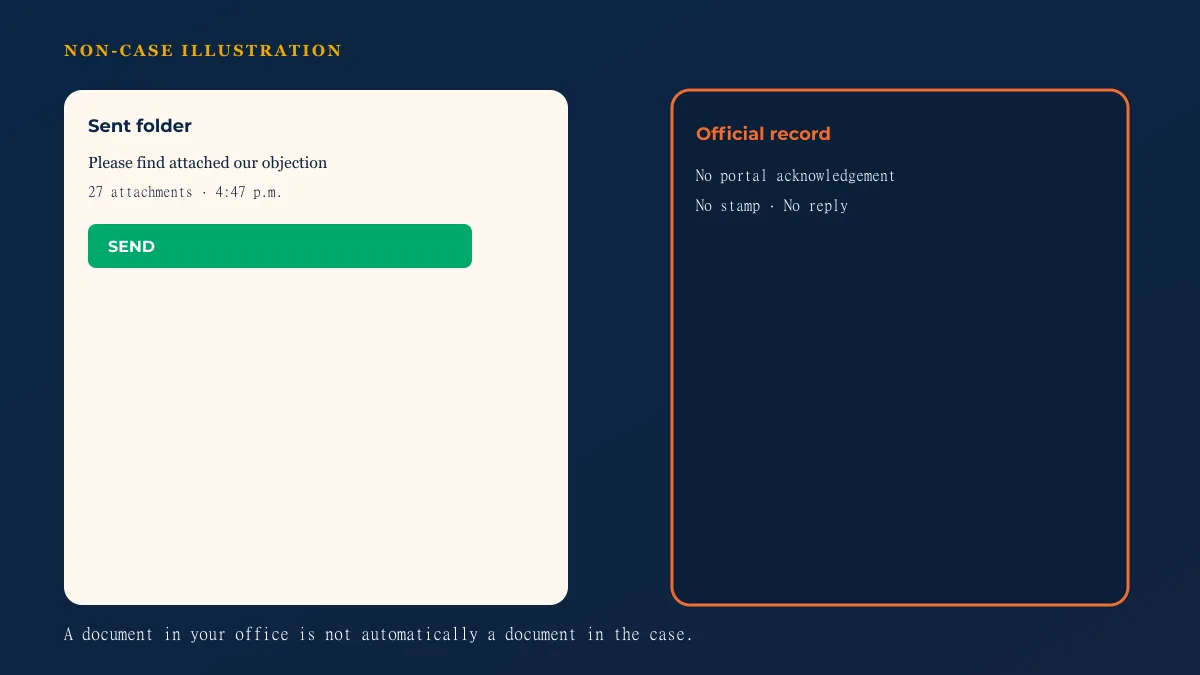
At 4:47 p.m., a finance manager presses Send.
Please find attached our objection and supporting documents.
There are twenty-seven attachments: bank statements, invoices, ledgers, contracts, reconciliations and a signed objection letter.
The manager sees the message in the Sent folder and closes the task.
Months later, the tax authority says the documents were not received.
Years later, the Tribunal asks for proof of delivery.
The business produces the same files, but not the portal acknowledgement, official reply, stamped inventory, delivery record or evidence that the exact attachments entered the objection record.
The tax dispute chain has several handoffs:
Created → approved → submitted → received → validated → reconciled → refiled → decided
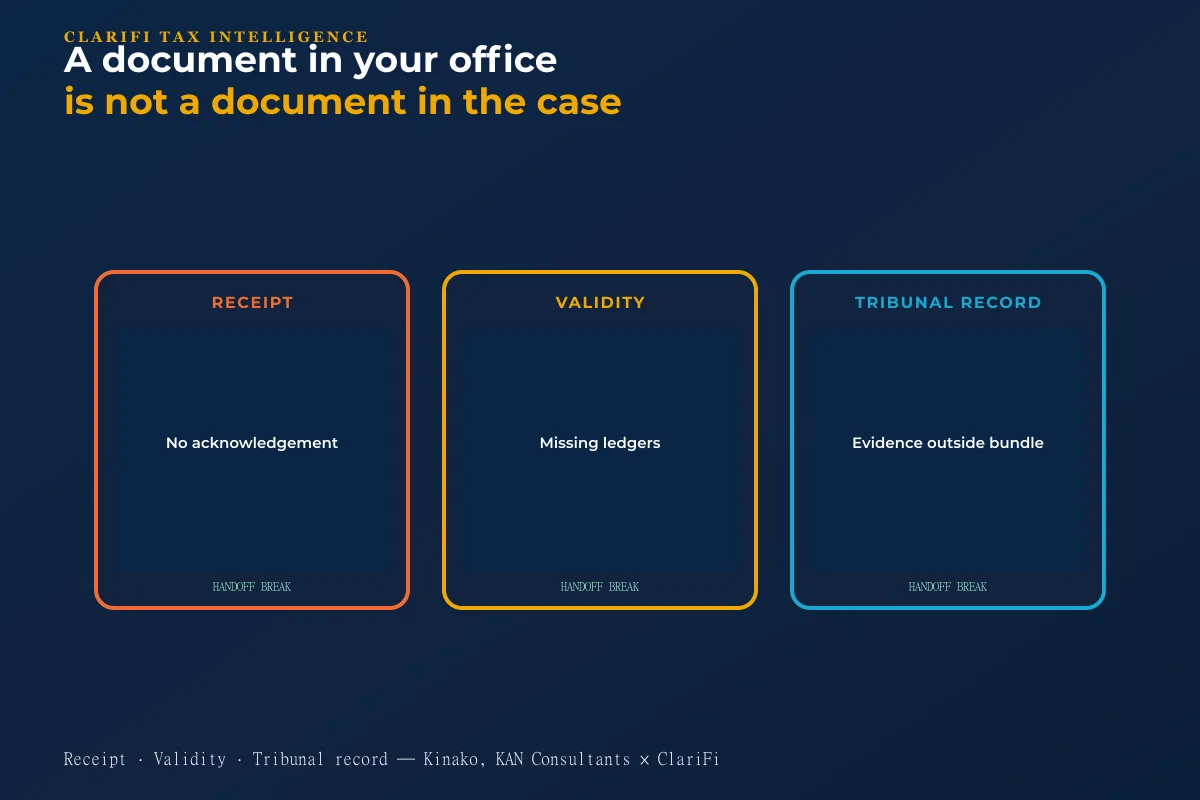
A break at any one of them can stop the merits from being heard or leave the taxpayer unable to prove that the assessment is wrong.
Three procedural gates
One digital tax file attempts to pass through three labelled gates. Labels are in words, not colour alone.
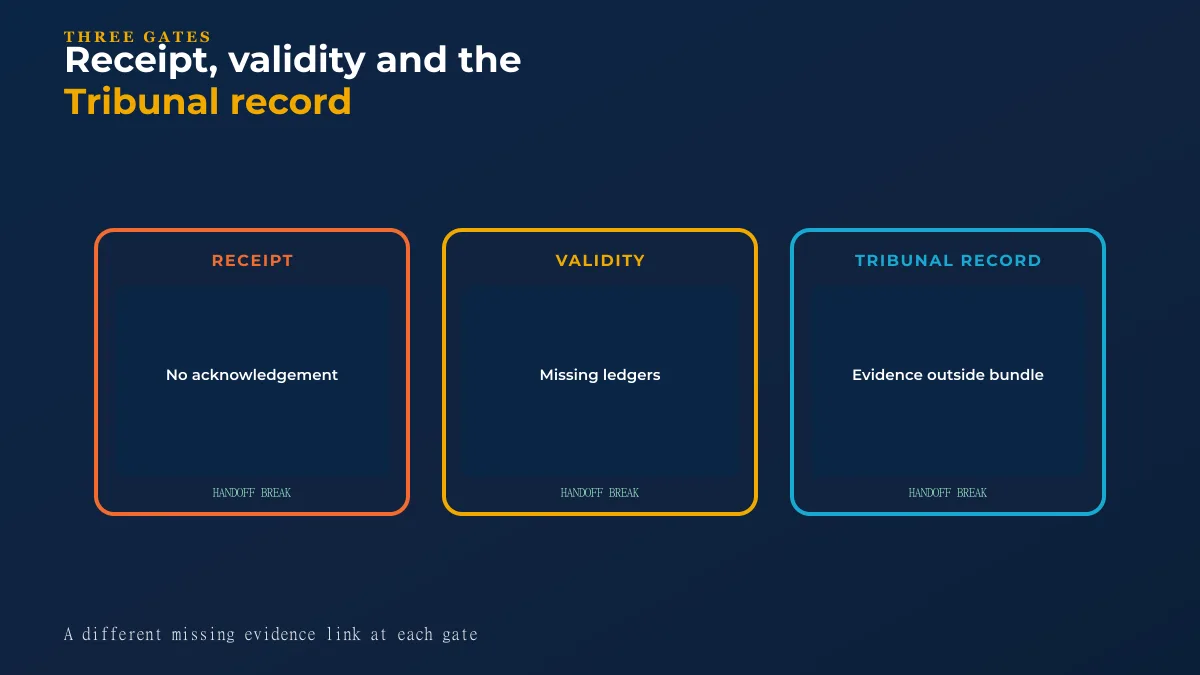
Gate · RECEIPT
Transfleet
A dated objection stops before the official inbox because no acknowledgement connects sender and recipient.
Gate · VALIDITY
Ranen
A folder reaches the gate but required ledgers, invoices, statements, Z-reports and reconciliation links are missing.
Gate · TRIBUNAL RECORD
Ngulli
The objection decision enters the appeal bundle while the underlying evidence remains outside.
The 30-second brief
Three disputes, and the Court of Appeal hierarchy
Transfleet
Receipt was not proved
Transfleet (EPZ) Ltd v Commissioner of Investigations & Enforcement [2026] KETAT 269 (KLR) concerned an agency notice for KES 389,812,700. Transfleet produced an objection letter dated 6 June 2023 but did not prove that KRA received it. The sixty-day objection clock was therefore not shown to have started, and the agency notice was upheld.
Ranen
Validity documents were not supplied
Ranen Ochuna Medical Centre v Commissioner of Legal Services & Board Services [2026] KETAT 275 (KLR) concerned corporation-tax assessments for 2021–2023 based on NHIF banking variances. Ranen did not provide the documents KRA requested to validate its objection. The Tribunal upheld the validity decision and did not determine the assessment's correctness or quantum.
Ngulli
The appeal record was incomplete
Ngulli v Commissioner of Domestic Taxes [2026] KETAT 281 (KLR) concerned income-tax and VAT assessments. KRA had made a merits objection decision, so the appeal was validly before the Tribunal. But Ngulli filed only the objection decision, demand notice and leave ruling, not the financial and tax records needed to prove the assessment wrong.
Geo Chem
The hierarchy control
Geo Chem Middle East v Commissioner for Domestic Taxes [2026] KECA 1531 (KLR) supplies the hierarchy: a section 51(4) validity decision is different from a merits objection decision, and time under section 51(11) does not operate as though a contested invalid objection had always been accepted.
Three disputes, three broken handoffs
Decision and proof matrix
| Case | Gate | What the taxpayer needed to prove | What the Tribunal found | Outcome |
|---|---|---|---|---|
| Transfleet | Receipt | KRA received the objection dated 6 June 2023 | No receipt stamp, acknowledgement, iTax slip, delivery email, courier record, postal proof or affidavit of service | Agency notice upheld; appeal dismissed |
| Ranen | Validity | The objection met section 51(3), including requested supporting documents | Requested ledgers, invoices, contracts, certified bank/M-Pesa statements, Z-reports and reconciliations were not supplied | Validity decision upheld; assessment merits untouched |
| Ngulli | Tribunal record | The evidence relied on at objection was filed before the Tribunal | The appeal bundle contained the objection decision, demand notice and leave ruling, but not the underlying financial and tax records | Objection decision upheld; appeal dismissed |
Transfleet
- Gate
- Receipt
- What the taxpayer needed to prove
- KRA received the objection dated 6 June 2023
- What the Tribunal found
- No receipt stamp, acknowledgement, iTax slip, delivery email, courier record, postal proof or affidavit of service
- Outcome
- Agency notice upheld; appeal dismissed
Ranen
- Gate
- Validity
- What the taxpayer needed to prove
- The objection met section 51(3), including requested supporting documents
- What the Tribunal found
- Requested ledgers, invoices, contracts, certified bank/M-Pesa statements, Z-reports and reconciliations were not supplied
- Outcome
- Validity decision upheld; assessment merits untouched
Ngulli
- Gate
- Tribunal record
- What the taxpayer needed to prove
- The evidence relied on at objection was filed before the Tribunal
- What the Tribunal found
- The appeal bundle contained the objection decision, demand notice and leave ruling, but not the underlying financial and tax records
- Outcome
- Objection decision upheld; appeal dismissed
The cases are not interchangeable.
- Transfleet was about whether an objection reached KRA.
- Ranen was about whether the objection became valid.
- Ngulli was about whether the evidence entered the appeal record.
Together, they show that the same document may need three different proofs:
- proof that it exists;
- proof that it was received; and
- proof that it was formally placed before the decision maker.
First, respect the legal hierarchy
Court of Appeal versus Tribunal
Ranen, Ngulli and Transfleet are Tax Appeal Tribunal decisions.
Geo Chem is a Court of Appeal judgment delivered on 31 July 2026.
The Tribunal cannot overrule the Court of Appeal. The three Tribunal decisions should therefore be read through the distinction Geo Chem draws.
Court of Appeal
Geo Chem
Hierarchy control: a section 51(4) validity decision is different from a merits objection decision.
Tax Appeal Tribunal
A validity decision
Under section 51(4) of the Tax Procedures Act, the Commissioner may determine that an objection has not been validly lodged because the statutory requirements have not been met.
That decision asks whether the objection is competent enough to enter the merits process.
Tax Appeal Tribunal
A merits objection decision
An objection decision considers the taxpayer's grounds and material, then allows the objection in whole or part or disallows it.
That decision asks whether the assessment should stand or change.
Why the distinction matters
Geo Chem held that a section 51(4) validity decision is not a merits decision. Where validity is litigated, the sixty-day period is not treated as having run against the Commissioner throughout the validity dispute; the Court described when that period begins after final determination of validity.
Ranen applied that distinction and confined itself to objection validity.
Ngulli found that KRA had not issued an invalidity notice. It had considered the supplied material and made a merits objection decision, so the appeal was properly before the Tribunal.
The label at the top of a KRA letter is not the complete answer. Its legal substance matters.
Statutory architecture
What section 51 asks the taxpayer to build
The Tax Procedures Act requires an objection within the applicable statutory period and sets cumulative conditions for a valid objection.
At the centre are:
- precise grounds of objection;
- the amendments required to correct the decision;
- reasons for those amendments;
- payment of tax not in dispute or an applicable extension request; and
- all relevant documents relating to the objection.
The wording changed during the periods covered by these cases.
Transfleet's claimed objection arose in June 2023. Ranen's arose in April 2025. Ngulli's late objection was accepted in June 2024. Later amendments introduced a more specific seven-day information-response mechanism and, from July 2025, an express rule for calculating the decision period after a late objection is allowed.
This article therefore does not treat every historical version as identical. The control lesson survives the changes: identify the applicable text, calculate from the correct event and preserve proof of every handoff.
Gate · Receipt
Transfleet: a dated objection was not proof of receipt
Transfleet owned go-downs in the Athi River Export Processing Zone and declared activities including property investment, quarry products, concrete excavation and transport.
KRA investigated its affairs for 2016–2021. It analysed iTax declarations, sought tenancy and payment details from five tenants and reviewed deposits into four United States dollar bank accounts.
On 22 May 2023, KRA communicated investigation findings of KES 389,812,700, exclusive of penalties and interest.
Transfleet produced a letter of objection dated 6 June 2023.
KRA said it never received the letter.
That factual dispute decided the case.
What Transfleet had
The Tribunal's record included:
- the objection letter dated 6 June 2023; and
- KRA's findings letter bearing a handwritten “OBJECTED 06/06/2023” notation.
What Transfleet did not prove
The Tribunal found no:
- KRA receipt stamp;
- official acknowledgement;
- iTax acknowledgement slip;
- delivery or forwarding email;
- courier or postal record; or
- affidavit of service.
The handwritten notation was Transfleet's own annotation. It did not prove delivery to KRA.
An email from KRA dated 5 June 2023 also said no response had been received and invited Transfleet to resend it. The Tribunal found no evidence of transmission after that invitation.
The sixty-day argument failed at the starting line
Transfleet argued that KRA had not issued an objection decision within sixty days, so the objection was deemed allowed.
The Tribunal held that the clock depended on KRA receiving a valid objection. Receipt had not been proved, so Transfleet had not shown that time started to run.
The assessments therefore crystallised into taxes due and payable for purposes of the dispute before the Tribunal.
The agency notice
KRA issued an agency notice dated 3 April 2025 requiring payment of KES 389,812,700 from money held for or on Transfleet's account.
The Tribunal held that an agency notice under section 42 is an appealable decision. It also rejected KRA's argument that the appeal was late because KRA proved the notice's date, but not when Transfleet received it, the statutory appeal time ran from receipt.
That procedural win did not decide the substance.
Because Transfleet failed to prove service of its objection, the Tribunal upheld the agency notice and dismissed the appeal, with each party bearing its own costs.
The Tribunal expressly said the conclusion turned on proof of service, not conclusive vindication of KRA's computation.
What Transfleet does not establish
Transfleet does not establish that:
- KRA's banking analysis was mathematically or substantively correct;
- Transfleet never prepared an objection;
- a taxpayer can never challenge an agency notice;
- the date printed on an agency notice automatically starts the appeal clock; or
- every self-generated transmission record is worthless.
It establishes a narrower point:
When receipt is disputed, the taxpayer must prove that the objection reached the Commissioner through an identifiable channel.
Transfleet proof-of-receipt chronology
- 1
Investigation findings
KRA communicated investigation findings of KES 389,812,700, exclusive of penalties and interest.
- 2
KRA invitation to resend
An email from KRA said no response had been received and invited Transfleet to resend it. The Tribunal found no evidence of transmission after that invitation.
- 3
Dated objection letter
Transfleet produced a letter of objection dated 6 June 2023. A handwritten “OBJECTED 06/06/2023” notation on KRA's findings letter was Transfleet's own annotation and did not prove delivery.
- 4
Agency notice
KRA issued an agency notice requiring payment of KES 389,812,700 from money held for or on Transfleet's account.
- 5
Tribunal judgment
The Tribunal upheld the agency notice and dismissed the appeal because receipt of the objection was not proved. The conclusion turned on proof of service, not conclusive vindication of the computation.
Gate · Validity
Ranen: operational access failure became objection failure
Ranen Ochuna Medical Centre operates in the medical and health-services sector.
KRA raised corporation-tax assessments for 2021–2023 after comparing declared turnover with NHIF banking information.
The judgment reports conflicting principal-tax figures: KES 6,978,192.64 in its background and KES 4,978,193 in the later analysis. The appeal was not decided on that quantum.
Ranen lodged a late objection on 17 April 2025.
KRA asked for:
- detailed sales ledgers;
- sales invoices and contractual agreements;
- certified M-Pesa and bank statements;
- Z-reports; and
- reconciliations, including withholding certificates and declarations.
Ranen replied that many staff members had left, including those who managed the relevant email account, and that it could not access the passwords.
The operational problem was real.
It did not supply the requested documents.
What the Tribunal decided
The Tribunal looked beyond the title “objection decision” and treated KRA's 5 June 2025 letter as a section 51(4) validity determination.
It held that KRA had identified what was missing, allowed Ranen an opportunity to provide it, issued a final reminder and communicated the consequence of non-compliance.
Ranen's explanation did not satisfy the requirement to submit the relevant documents.
The Tribunal therefore upheld KRA's validity decision and dismissed the appeal, with each party bearing its own costs.
It made no pronouncement on:
- whether NHIF receipts were correctly reconciled;
- whether the forty per cent expense allowance was appropriate;
- whether the declared turnover was correct; or
- which reported principal-tax figure was accurate.
The merits never crossed the validity gate.
Ranen objection-validity chronology
- 1
Late objection
Ranen lodged a late objection. The dispute was later decided as an objection-validity dispute, not on the assessment's correctness or quantum.
- 2
KRA asked for supporting documents
KRA requested detailed sales ledgers, invoices and contracts, certified M-Pesa and bank statements, Z-reports and reconciliations. The judgment dates are internally inconsistent on this letter; this article does not silently correct them.
- 3
Operational access failure
Ranen replied that many staff members had left, including those who managed the relevant email account, and that it could not access the passwords. The documents were not supplied.
- 4
Validity determination
The Tribunal treated KRA's 5 June 2025 letter as a section 51(4) validity determination, not a merits objection decision.
- 5
Tribunal judgment
The Tribunal upheld the validity decision and dismissed the appeal. It made no pronouncement on the corporation-tax assessment or quantum.
Gate · Tribunal record
Ngulli: evidence shown to KRA did not enter the Tribunal record
Fidellis Mueke Ngulli operated Ngulli & Co. Advocates as a sole proprietorship.
KRA audited the practice and issued assessments involving income tax and VAT across different periods. The judgment contains several different component figures and tax descriptions.
The most reliable aggregate reference is a demand notice dated 18 March 2025 for KES 43,946,640, inclusive of interest and penalties. That number should not be treated as a reconciliation of the inconsistent components in the judgment.
Ngulli's late objection of 12 June 2024 was accepted on 21 June 2024. KRA issued a decision on 9 August 2024.
In a separate ruling on 1 August 2025, the Tribunal granted leave to appeal out of time and lifted agency notices. That was an interim procedural success, not a decision that the assessments were wrong.
The validity issue
KRA argued in the main appeal that Ngulli had not submitted all relevant documents and therefore had no valid objection.
The Tribunal disagreed with that characterisation.
KRA had not issued a section 51(4) invalidity notice. It acknowledged receiving audited accounts, bank statements, general ledgers and trial balances for 2019–2020, requested further information, considered the material available and confirmed the assessments.
That was a merits objection decision capable of appeal.
Ngulli crossed the validity gate.
The appeal-record failure
Crossing the gate did not discharge the burden before the Tribunal.
The Tribunal examined Ngulli's appeal bundle and found only:
- the objection decision dated 9 August 2024;
- the demand notice dated 18 March 2025; and
- the ruling dated 1 August 2025 granting leave to appeal out of time.
It did not find the audited accounts, bank statements, trial balances, general ledgers, invoices, withholding certificates or other underlying records Ngulli said KRA had failed to consider.
The Tribunal held that the duty to adduce evidence did not end at objection. The taxpayer had to place the relevant documents before the Tribunal to prove that the decision was wrong or excessive.
Without them, the Tribunal could not authenticate the claim or rework the assessment.
The appeal was dismissed. The objection decision was upheld. Each party bore its own costs.
What Ngulli does not establish
Ngulli does not establish that:
- no records were ever given to KRA;
- audited accounts and ledgers have no evidential value;
- every objection missing one attachment is invalid;
- the component assessment figures in the judgment reconcile; or
- an extension of time or lifted agency notice determines the main appeal.
It establishes a procedural evidence point:
A document considered during audit or objection does not automatically become evidence in the Tribunal appeal.
Ngulli appeal-record chronology
- 1
Late objection
Ngulli's late objection was accepted on 21 June 2024.
- 2
Merits objection decision
KRA issued a decision. The Tribunal later found this was a merits objection decision, not a section 51(4) invalidity notice.
- 3
Demand notice
Demand notice for KES 43,946,640, inclusive of interest and penalties. This is the most reliable aggregate reference, not a reconciliation of the inconsistent component figures.
- 4
Leave and lifted agency notices
The Tribunal granted leave to appeal out of time and lifted agency notices. That was an interim procedural success, not a decision that the assessments were wrong.
- 5
Tribunal judgment
The appeal was validly before the Tribunal, but the underlying financial and tax records were not in the appeal bundle. The appeal was dismissed and the objection decision upheld.
The decision fork
Validity, merits or enforcement?
Before responding to a KRA letter, classify the decision.
| Decision type | Core question | Typical evidence focus | What it does not necessarily decide |
|---|---|---|---|
| Validity decision | Did the objection meet the entry requirements? | Grounds, amendments sought, reasons, undisputed tax treatment, relevant documents and proof of response | Correctness of the assessment |
| Merits objection decision | Should the assessment stand or change? | Transaction records, ledgers, bank reconciliation, computations and legal analysis | Whether a later appeal bundle is complete |
| Enforcement measure | May KRA collect through the chosen mechanism? | Crystallised liability, objection/appeal status, service, timing and statutory recovery conditions | Substantive correctness of every computation |
Validity decision
- Core question
- Did the objection meet the entry requirements?
- Typical evidence focus
- Grounds, amendments sought, reasons, undisputed tax treatment, relevant documents and proof of response
- What it does not necessarily decide
- Correctness of the assessment
Merits objection decision
- Core question
- Should the assessment stand or change?
- Typical evidence focus
- Transaction records, ledgers, bank reconciliation, computations and legal analysis
- What it does not necessarily decide
- Whether a later appeal bundle is complete
Enforcement measure
- Core question
- May KRA collect through the chosen mechanism?
- Typical evidence focus
- Crystallised liability, objection/appeal status, service, timing and statutory recovery conditions
- What it does not necessarily decide
- Substantive correctness of every computation
A single KRA document may be poorly labelled.
Read its substance, statutory basis, findings and orders.
Then choose the correct response route and deadline.
Business-control framework
The eight-link Evidence Handoff Spine
The following is a Kinako/KAN business-control framework. It is not a statutory checklist and does not determine legal validity.
1. Decision identity
Preserve the complete tax decision, assessment number, tax head, period, issue date and evidence of when it was notified.
Do not calculate a deadline from the date printed on a document if the law runs from notification or receipt.
2. Accountable ownership
Assign a named executive owner, technical preparer, reviewer and filing officer.
Record the statutory deadline and internal deadline separately.
3. Precise objection architecture
For each disputed item, state:
- the decision challenged;
- the precise ground;
- the amendment required;
- why the amendment is required;
- the amount accepted, if any; and
- the evidence supporting the correction.
4. Source-to-variance reconciliation
Map every disputed variance from KRA's computation to the taxpayer's bank, ledger, invoice, contract, return and explanation.
Do not send twenty-seven attachments without showing which question each answers.
5. Submission manifest
Create an indexed list containing:
- filename;
- period;
- transaction or issue;
- page or worksheet reference;
- file size or checksum where useful; and
- the objection ground it supports.
6. Proof of receipt
Preserve the portal acknowledgement, official response, stamped inventory, delivery confirmation, courier proof or other evidence appropriate to the permitted channel.
A screenshot of a Sent folder may help establish dispatch. It may not, by itself, prove legal receipt.
7. Request-and-response ledger
Log every invalidity notice, clarification request, call, reminder and deadline.
Answer through the permitted channel and preserve evidence of the response and attachments.
8. Appeal-record replication
When appealing, rebuild the record required by the Tribunal process.
Do not assume that material once sent to KRA automatically travels into the appeal bundle.
The Evidence Handoff Matrix
Created, submitted, received, acknowledged, reconciled, refiled
Use one control table for every material dispute:
| Stage | Control question | Minimum proof |
|---|---|---|
| Created | Is the document complete and approved? | Version-controlled final file and sign-off |
| Submitted | Was it transmitted through the correct channel? | Portal, email, physical or other authorised filing record |
| Received | Can receipt be proved? | Official acknowledgement, stamp, reply or delivery evidence |
| Validated | Were deficiencies identified and cured? | Validity notice, response register and proof of response |
| Reconciled | Does the evidence answer the exact variance? | Issue-by-issue reconciliation and computation |
| Refiled | Is it in the Tribunal record? | Appeal index, filing receipt and served bundle |
| Decided | What decision was actually made? | Validity, merits or enforcement classification |
Created
- Control question
- Is the document complete and approved?
- Minimum proof
- Version-controlled final file and sign-off
Submitted
- Control question
- Was it transmitted through the correct channel?
- Minimum proof
- Portal, email, physical or other authorised filing record
Received
- Control question
- Can receipt be proved?
- Minimum proof
- Official acknowledgement, stamp, reply or delivery evidence
Validated
- Control question
- Were deficiencies identified and cured?
- Minimum proof
- Validity notice, response register and proof of response
Reconciled
- Control question
- Does the evidence answer the exact variance?
- Minimum proof
- Issue-by-issue reconciliation and computation
Refiled
- Control question
- Is it in the Tribunal record?
- Minimum proof
- Appeal index, filing receipt and served bundle
Decided
- Control question
- What decision was actually made?
- Minimum proof
- Validity, merits or enforcement classification
The objective is not to collect the largest bundle.
It is to prove where the right document was at the right procedural moment.
Credential continuity
The hidden tax cost of staff departure
Ranen turns an ordinary operational weakness into a board-level tax risk.
- What happens when the employee or adviser who owns the tax mailbox leaves?
- Who controls the password?
- Can another authorised officer retrieve the correspondence?
- Is the portal account tied to one person's phone?
- Are attachments stored outside the departed employee's device?
- Can the business reproduce what was sent, when, by whom and in response to which request?
- Does offboarding transfer open statutory deadlines?
An inaccessible mailbox is not merely an IT inconvenience.
During a tax dispute, it can become a missing evidential link.
Request register
Build a KRA request register
For each request, record:
| Field | Control |
|---|---|
| Request | Exact KRA wording and statutory reference |
| Received | Date, time, channel and recipient |
| Due | Statutory deadline and internal deadline |
| Owner | Named preparer and accountable executive |
| Evidence | Indexed documents and reconciliation |
| Review | Tax and legal review status |
| Submitted | Channel, date, time and filing officer |
| Receipt | Acknowledgement or delivery proof |
| Gap | Missing item, reason and mitigation |
| Escalation | Professional review and decision required |
Request
Exact KRA wording and statutory reference
Received
Date, time, channel and recipient
Due
Statutory deadline and internal deadline
Owner
Named preparer and accountable executive
Evidence
Indexed documents and reconciliation
Review
Tax and legal review status
Submitted
Channel, date, time and filing officer
Receipt
Acknowledgement or delivery proof
Gap
Missing item, reason and mitigation
Escalation
Professional review and decision required
Do not let an unanswered request remain inside one employee's inbox.
Enforcement
When an agency notice arrives
An agency notice can affect cash immediately, but panic is not a response plan.
Step 1
Preserve the notice and receipt event
Record the notice, addressee, copied parties, amount, statutory basis and when each affected person received it.
Step 2
Identify the underlying liability
Map the agency notice to the assessment, objection, objection decision, appeal, payment plan or court/Tribunal order.
Step 3
Separate enforcement from merits
Ask whether the immediate dispute concerns:
- the assessment;
- objection validity;
- a merits objection decision;
- appeal timing;
- a stay or recovery condition; or
- the agency notice itself.
Step 4
Escalate immediately
Agency-notice disputes are deadline-sensitive and fact-specific. Obtain professional review rather than relying on this article or a diagnostic.
Transfleet confirms that an agency notice can be appealable. It does not remove the need to prove the correct appeal route, receipt date, underlying dispute status and compliance with applicable requirements.
Document-readiness heuristic
Take the Evidence Handoff Test
Select Yes, Partial or Not available for one material tax dispute:
This test is a document-readiness heuristic, not a legal deadline calculator or tax-risk score.
Answers stay in this browser session only. They are not stored, transmitted or included in analytics.
An outcome appears only after all twelve questions have an answer.
No outcome yet, answer every question first.
Result language
- Procedurally anchored: the core handoffs are documented and reproducible.
- Repair the evidence chain: one or more links need reconstruction or stronger proof.
- Urgent professional review: a critical receipt, validity, deadline, appeal or Tribunal-record link is missing.
This test measures document readiness only. It does not determine whether an objection or appeal is valid, calculate a deadline, stay recovery, prove service, decide tax liability or replace professional advice.
Board and audit committee
Questions for the board and audit committee
Question 1
Which open tax matters are within thirty days of a statutory event?
Question 2
Can we prove when each assessment, request and decision was received?
Question 3
Who owns the tax portal, dispute mailbox and authorised phone number?
Question 4
Do we have an indexed record of every attachment sent to KRA?
Question 5
Can we prove KRA received the exact version we rely on?
Question 6
Are KRA variances reconciled to bank, ledger, invoice, contract and return?
Question 7
Which matters involve an invalidity notice rather than a merits decision?
Question 8
Has every audit or objection document been replicated into the appeal record where required?
Question 9
What happens to active tax deadlines when an employee or adviser leaves?
Question 10
Which agency notices, freezes or recovery actions could interrupt operations?
Question 11
Are procedural wins being mistaken for merits wins?
Question 12
What tax, penalty, interest, cashflow and business-continuity exposure sits behind each broken handoff?
Caution
What the three cases establish
Together, they establish
- A document's existence does not prove its receipt.
- The taxpayer bears the initial burden of proving the tax decision wrong or excessive.
- An objection must meet the statutory validity requirements applicable to its date.
- The substance of a KRA decision matters more than its label.
- A validity decision is different from a merits objection decision.
- Evidence supplied during audit or objection does not automatically enter the Tribunal record.
- An agency notice can be an appealable decision.
- Proof of notification and receipt can determine whether a deadline challenge succeeds.
They do not establish
- that every banking analysis is correct;
- that every bank credit is taxable income;
- that a dated objection letter proves service;
- that KRA can disregard evidence it demonstrably received;
- that staff departure automatically excuses non-compliance;
- that an invalid objection can never be repaired through a lawful process;
- that a successful extension or stay determines the merits;
- that Transfleet's KES 389,812,700 computation was conclusively vindicated;
- that the conflicting Ranen or Ngulli figures can be silently reconciled; or
- that the Evidence Handoff Spine is a statutory test.
Tax Intelligence identity playbook
Nine identity questions
| Story | Identity question |
|---|---|
| MU-BEI | Whose money is it? |
| Sendy | Whose sale is it? |
| Airflo | Where is the value consumed? |
| Bristol Estate | Whose liability survives? |
| Wamuri | Why did the money leave? |
| Minet | What was the retained amount paying for? |
| Kutuma | What did the software payment buy, and when? |
| Chairmania × Savla | Can the transaction be reconstructed? |
| Ranen × Ngulli × Transfleet | Can you prove the handoff? · reading now |
MU-BEI
Whose money is it?Sendy
Whose sale is it?Airflo
Where is the value consumed?Bristol Estate
Whose liability survives?Wamuri
Why did the money leave?Minet
What was the retained amount paying for?Kutuma
What did the software payment buy, and when?Chairmania × Savla
Can the transaction be reconstructed?Ranen × Ngulli × Transfleet
Can you prove the handoff? · reading now
Across all nine stories, the closing question is unchanged:
Can your records prove your business story?
The tax identity of a transaction
Across all nine stories, the closing question is unchanged: Can your records prove your business story?
01 · MU-BEI
Money identity
Whose money?
Client funds vs business revenue, can you prove the distinction?
Read the companion →02 · SENDY
Supply identity
Whose sale?
Platform GMV vs platform commission, who actually supplied?
Read the companion →03 · AIRFLO
Geographic identity
Where is the value consumed?
Physical performance vs economic destination, which map does VAT ask about?
Read the companion →04 · BRISTOL ESTATE
Liability identity
Whose liability?
Company dissolution vs surviving tax obligation.
Read the companion →05 · WAMURI
Withdrawal identity
Why did the money leave?
Company cash vs personal wallet, can you prove the transaction’s tax identity?
Read the companion →06 · MINET
Consideration identity
What was the retained amount paying for?
Discount label vs facility, advantage or licensed-activity fee, can the records prove it?
Read the companion →07 · KUTUMA
Licence identity
What was the software payment buying?
End-user SaaS access vs copyright, and which year’s royalty definition applies?
Read the companion →08 · CHAIRMANIA × SAVLA
Evidence identity
Can the transaction be reconstructed?
A tax invoice is evidence, not immunity. Can the file prove the supply actually happened?
Read the companion →09 · RANEN × NGULLI × TRANSFLEET· reading now
Process identity
Can you prove the handoff?
Created, submitted, received, validated, reconciled, refiled, can you prove each gate?
You are here
Hub
CAN YOUR RECORDS PROVE YOUR BUSINESS STORY?
Whose money? Whose sale? Where is the value consumed? Whose liability? Why did the money leave? What was the retained amount paying for? What was the software payment buying? Can the transaction be reconstructed? Can you prove the handoff? The common test is evidence, not slogans.
FAQs
Frequently asked questions
Is an email in my Sent folder proof that KRA received an objection?
It may help prove dispatch, but Transfleet shows why receipt may require more. The appropriate proof depends on the authorised channel and facts: a portal acknowledgement, official reply, receipt stamp, delivery confirmation or other evidence may be needed. Preserve both the transmission and the recipient's acknowledgement.
When does KRA's sixty-day objection period start?
The applicable statutory version and procedural facts matter. Section 51(11) refers to receipt of a valid notice of objection, while Geo Chem explains the position where validity is contested. Do not calculate the period from the date on a taxpayer's letter alone; obtain professional advice on the exact decision and statutory version.
What is the difference between an invalidity decision and an objection decision?
A validity decision addresses whether the objection meets the statutory entry requirements. A merits objection decision considers the substantive grounds and allows or disallows the objection. Geo Chem confirms that they are legally distinct, even where a document's heading is unclear.
Why did Ranen lose?
The Tribunal found that KRA had requested specific supporting documents, Ranen did not provide them and its staff/email-access explanation did not satisfy section 51(3). It therefore upheld the validity determination without deciding whether the underlying corporation-tax assessment or quantum was correct.
Why did Ngulli lose if KRA had received some documents?
Ngulli crossed the objection-validity gate, but did not file the underlying financial and tax records in the Tribunal appeal bundle. The Tribunal held that the evidential burden continued at appeal and dismissed the case because the record before it could not prove the assessment wrong.
Did Transfleet prove that its objection was deemed allowed?
No. Transfleet showed an objection letter dated 6 June 2023 but did not prove KRA received it. The Tribunal held that the sixty-day clock was not shown to have started and upheld the agency notice. It did not conclusively approve KRA's underlying computation.
Does an appeal automatically stop an agency notice?
These cases do not create that automatic rule. Recovery, stay and agency-notice questions depend on the applicable law, the stage of the dispute, filing and service, and any Tribunal or court order. Escalate immediately for professional review.
What should a business retain for every tax submission?
Retain the decision and receipt date, deadline record, signed objection, computation, indexed attachments, reconciliation, portal or delivery proof, KRA acknowledgements, clarification requests and responses, internal approvals, appeal filings, service evidence and the full Tribunal bundle.
BEFORE THE NEXT TAX DECISION ARRIVES
Do not let “we sent it” become the final control.
IDENTIFY THE DECISION. OWN THE DEADLINE. STATE THE CORRECTION. RECONCILE THE VARIANCE. INDEX THE FILES. PROVE RECEIPT. ANSWER THE REQUEST. REBUILD THE APPEAL RECORD.
Review my tax dispute file
KAN Consultants can review tax-decision classification, objection readiness, evidence reconciliation, proof of submission, information requests, appeal-file completeness and agency-notice exposure.
Review My Tax Dispute FileKAN Consultants performs tax review. Contextual review can cover classification, objection readiness, reconciliation, proof of submission, information requests, appeal-file completeness and agency-notice exposure, without treating a checklist as a tax opinion.
Test the evidence handoff
Test the evidence handoff
Take the Evidence Handoff TestTurn tax records into decision evidence
ClariFi helps businesses connect deadlines, documents, reconciliations and evidence handoffs so missing links can be seen before they become dispute failures. It does not validate legal service or provide legal or tax opinions.
Explore ClariFiClariFi helps organise deadlines, records, reconciliations and proof of handoff. It does not validate legal service or provide a tax opinion.
Decision → Owner → Grounds → Reconciliation → Manifest → Receipt → Response → Tribunal record
This article is for general business and tax education only. It is not legal, accounting or tax advice. Objection validity, deemed allowance, appeal timing, agency notices and tax liability depend on the statutory version, decision type, notification, filing channel, evidence and procedural record. Obtain professional advice immediately for an active tax dispute.
Sources
- Ranen Ochuna Medical Centre v Commissioner of Legal Services & Board Services, Tax Appeal E1251 of 2025, [2026] KETAT 275 (KLR)
- Ngulli v Commissioner of Domestic Taxes, Tax Appeal E927 of 2025, [2026] KETAT 281 (KLR)
- Transfleet (EPZ) Ltd v Commissioner of Investigations & Enforcement, Tax Appeal E536 of 2025, [2026] KETAT 269 (KLR)
- Geo Chem Middle East v Commissioner for Domestic Taxes, Civil Appeal E581 of 2024, [2026] KECA 1531 (KLR)
- Ngulli v Commissioner of Domestic Taxes, Miscellaneous Application E029 of 2025, [2025] KETAT 405 (KLR)
- Transfleet (EPZ) Limited v Commissioner of Domestic Taxes, Miscellaneous Application E031 of 2025, [2025] KETAT 362 (KLR)
- Tax Procedures Act version applicable from 31 December 2022
- Tax Procedures Act version applicable from 1 September 2023
- Tax Procedures Act version applicable from 27 December 2024
- Current Tax Procedures Act, Cap. 469B
- Tax Appeals Tribunal Act, Cap. 469A