ClariFi
Financial intelligence and decision support for Kenyan MSMEs.
- Tax Intelligence
- Kenya
- Input VAT
Opening
The invoice is the cover page, not the whole transaction
A Kenyan business receives a supplier invoice for:
- taxable value: KES 1,000,000;
- VAT: KES 160,000; and
- total payable: KES 1,160,000.
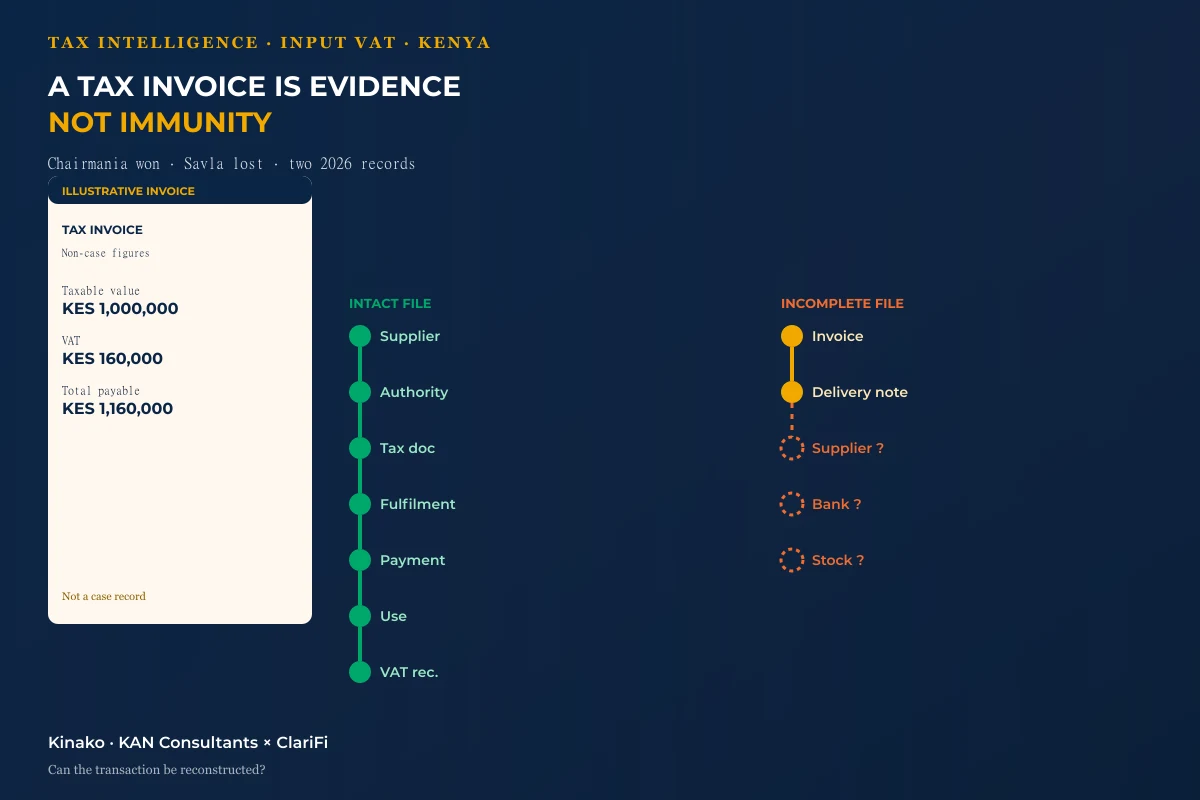
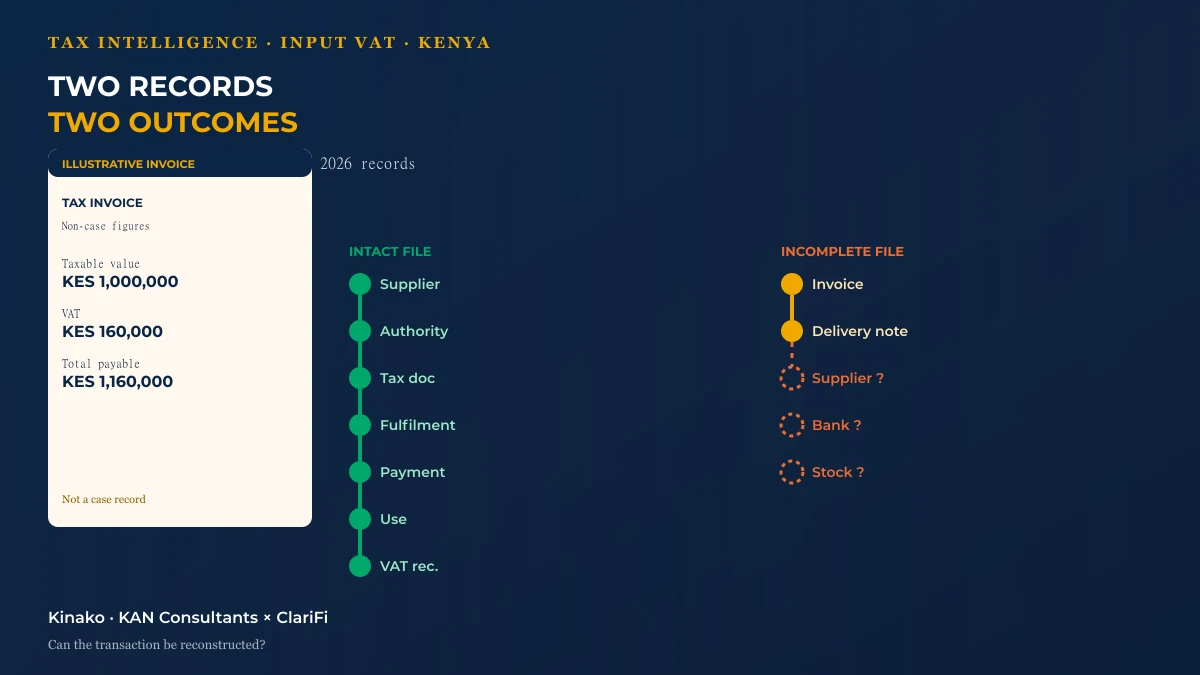
Illustrative invoice, non-case figures
Tax invoice
Supplier name present · PIN present · VAT mathematically correct
- Taxable value
- KES 1,000,000
- VAT
- KES 160,000
- Total payable
- KES 1,160,000
Non-case figures · not drawn from Chairmania or Savla
The supplier name is present. The PIN is present. The VAT amount is mathematically correct.
Finance records the purchase. The business claims KES 160,000 as input VAT.
Years later, KRA asks a harder question:
A tax invoice can prove that a document was issued. It does not, by itself, always prove who supplied what, who received it, how payment moved, where the goods went, whether a service was performed or how the purchase entered the business’s taxable activity.
That is why two Kenyan taxpayers could present invoices and still reach different outcomes in 2026.
Chairmania won.
Savla lost.
The cases are not opposites. They are a lesson in how the evidential burden moves.
“A tax invoice is evidence, not immunity” is Kinako/KAN editorial language, not a judicial quotation.
Two 2026 decisions
The 30-second brief
Chairmania · Tax Appeals Tribunal
Chairmania Events Ltd v Commissioner for Investigation and Enforcement [2026] KETAT 283 (KLR)
KES 15,755,537 additional VAT assessment for 2024
KRA challenged input VAT linked to equipment and services allegedly hired from Terrex Traders Ltd, which KRA described as a “missing trader.” The Tribunal found that Chairmania’s invoices and ETR receipts, bank/payment records, supplier payment ledgers and payment vouchers discharged its initial evidential burden. KRA had not dismantled that record with corroborated evidence.
Savla · Court of Appeal
Savla v Commissioner of Domestic Taxes [2026] KECA 1292 (KLR)
KES 5,704,658 additional VAT for September 2014 to December 2017
Savla presented invoices, delivery notes and purchase-ledger extracts but did not provide requested supplier-location and contact information, detailed general ledgers, cheque and bank tracing, or evidence of receipt, stock uptake and goods movement. The Court of Appeal held that the initial burden had not been discharged. KRA’s responsive obligation to prove the missing-trader allegation had therefore not crystallised.
Evidence and outcome
Two cases, two records, two outcomes
| Question | Chairmania | Savla |
|---|---|---|
| Court | Tax Appeals Tribunal | Court of Appeal |
| Decision date | 14 August 2026 | 10 July 2026 |
| Tax period | 2024 | September 2014–December 2017 |
| Additional VAT | KES 15,755,537 | KES 5,704,658 |
| Core documents | Invoices/ETR receipts, bank and payment records, supplier payment ledgers, payment vouchers | Invoices, delivery notes, purchase-ledger extracts |
| KRA’s concern | Terrex described as a missing trader; authenticity, payment and underlying supply challenged | Suppliers could not be verified; broader supplier, bank and stock evidence requested |
| Evidential result | Tribunal held the initial burden shifted to KRA | Court of Appeal held the initial burden had not shifted |
| Outcome | Appeal allowed; objection decision set aside; each party bore own costs | Appeal dismissed; assessment confirmed; costs to the Commissioner |
| Precedential posture | Fresh Tribunal decision; appealable | Appellate authority binding below the Court of Appeal, subject to any later Supreme Court treatment |
Court
- Chairmania
- Tax Appeals Tribunal
- Savla
- Court of Appeal
Decision date
- Chairmania
- 14 August 2026
- Savla
- 10 July 2026
Tax period
- Chairmania
- 2024
- Savla
- September 2014–December 2017
Additional VAT
- Chairmania
- KES 15,755,537
- Savla
- KES 5,704,658
Core documents
- Chairmania
- Invoices/ETR receipts, bank and payment records, supplier payment ledgers, payment vouchers
- Savla
- Invoices, delivery notes, purchase-ledger extracts
KRA’s concern
- Chairmania
- Terrex described as a missing trader; authenticity, payment and underlying supply challenged
- Savla
- Suppliers could not be verified; broader supplier, bank and stock evidence requested
Evidential result
- Chairmania
- Tribunal held the initial burden shifted to KRA
- Savla
- Court of Appeal held the initial burden had not shifted
Outcome
- Chairmania
- Appeal allowed; objection decision set aside; each party bore own costs
- Savla
- Appeal dismissed; assessment confirmed; costs to the Commissioner
Precedential posture
- Chairmania
- Fresh Tribunal decision; appealable
- Savla
- Appellate authority binding below the Court of Appeal, subject to any later Supreme Court treatment
The cases cannot be compared by counting documents.
Savla had delivery notes. Chairmania’s judgment does not say it produced delivery notes. Yet Chairmania succeeded and Savla failed.
The real comparison is whether the documents answered the specific doubts raised and formed a coherent record of the underlying supply.
Precedential order
First, respect the court hierarchy
Binding appellate authority
Court of Appeal
Savla · 10 July 2026
Chairmania does not overrule, dilute or create an exception to Savla.
Fresh tribunal decision
Tax Appeals Tribunal
Chairmania · 14 August 2026
Must be read subject to the Court of Appeal decision.
- Savla is a Court of Appeal judgment.
- Chairmania is a Tax Appeals Tribunal judgment delivered five weeks later.
- The Tribunal cannot overrule the Court of Appeal. Chairmania therefore does not overrule, dilute or create an exception to Savla or reduce the standard Savla establishes.
- Chairmania did not cite or reconcile Savla. Some of its broad statements about a taxpayer having no burden beyond statutory documents sit in tension with Savla's holding that reasonable further transaction-tracing information could be required. Chairmania must therefore be read subject to Savla.
The safer reading is that both decisions apply the same burden principle to different records:
- in Savla, the taxpayer’s initial record did not answer reasonable requests about supplier identity, payment and physical movement of goods;
- in Chairmania, the Tribunal found that the taxpayer produced competent statutory and transaction evidence, after which KRA relied on uncorroborated third-party “missing trader” data rather than rebutting the file with precision.
The hierarchy matters. So do the facts.
Statutory starting point
What the VAT Act starts with
Section 17 of the Value Added Tax Act allows a registered person to deduct input tax, subject to the Act, where the supply or import was acquired to make taxable supplies.
It also identifies the documentation required for an input-tax claim, including the relevant tax invoice.
But section 17 does two jobs:
- it identifies qualifying documentation; and
- it ties the deduction to an actual taxable supply acquired for taxable business activity.
The invoice addresses the first layer. The transaction trail helps prove the second.
The comparison is about evidence and burden:
- section 56(1) of the Tax Procedures Act places the burden on the taxpayer to show that a tax decision is incorrect; and
- section 30 of the Tax Appeals Tribunal Act requires an appellant to prove that the tax decision is wrong or that the assessment should have been different.
The taxpayer starts with the burden. The important question is what is sufficient to move it.
Chairmania evidence trail
Chairmania: an events business and a disputed supplier trail
Chairmania Events Ltd organises and supports events.
KRA investigated its 2024 tax affairs and issued an additional VAT assessment of KES 15,755,537 on 3 July 2025.
The disputed input VAT related to equipment and services said to have been hired from Terrex Traders Ltd, including tents, projectors, sound systems, chairs, a dais and video systems.
That commercial context matters. Event delivery can depend on short-lived, mobile and subcontracted resources. A tent is erected, used and removed. Sound equipment enters a venue and leaves after the event. A crew performs a service that may not create conventional warehouse stock.
The evidence architecture must fit the transaction.
The deadline argument did not win the case
Chairmania objected in August 2025. After an initial invalidity notice and an approved extension, it lodged a valid objection on 19 August 2025.
KRA issued its objection decision on 16 October 2025.
The Tribunal described the decision as having been issued on the forty-fourth day and rejected Chairmania’s argument that the objection had been allowed by operation of time. The published dates remain within sixty calendar days, but the Tribunal’s stated day count is not arithmetically consistent with those dates.
Chairmania did not win on a procedural technicality.
It won on the substantive input-VAT question.
- 1
Additional VAT assessment
KRA issued an additional VAT assessment of KES 15,755,537 for 2024, linked to equipment and services said to have been hired from Terrex Traders Ltd.
- 2
Objection process
Chairmania objected in August 2025. After an initial invalidity notice and an approved extension, it lodged a valid objection on 19 August 2025.
- 3
Objection decision
KRA issued its objection decision. The Tribunal later rejected Chairmania’s argument that the objection had been allowed by operation of time. Chairmania did not win on that procedural technicality.
- 4
Tax Appeals Tribunal judgment
Appeal allowed. The Tribunal treated the listed invoice, ETR, bank/payment, supplier-ledger and voucher record as sufficient to shift the evidential burden. The objection decision was set aside. Each party bore its own costs.
What Chairmania put into the evidence file
The judgment records the following:
- tax invoices and ETR receipts;
- bank statements and payment receipts;
- supplier payment ledgers; and
- payment vouchers.
Chairmania also said it had supplied VAT returns and financial statements.
KRA’s response was that Terrex was a “missing trader”; some ETR receipts could not be authenticated through iTax; some receipts allegedly lacked matching invoices; bank statements did not show payments to Terrex; supplier statements and delivery notes were absent; and the underlying supply had not been proved.
Those were serious allegations. But an allegation is not the same thing as a finding.
Terrex Traders Ltd’s “missing trader” status is treated here as KRA’s allegation and investigation flag, not a judicial fraud finding. Chairmania’s judgment does not say it produced delivery notes. KRA alleged those were absent.
The Chairmania burden shift
The Tribunal approached the burden as something capable of moving.
KRA’s assessment began with a presumption of correctness. Chairmania had to produce competent evidence showing why the input-VAT decision was wrong.
The Tribunal held that Chairmania did so.
Once the invoices, ETR receipts, bank/payment material, supplier payment ledgers and vouchers were placed before it, the evidential burden moved to KRA to dismantle that record with precision.
The Tribunal found that KRA had not:
- presented sufficiently corroborated investigation or authentication material;
- corroborated the third-party missing-trader information;
- connected the allegation to the specific claims with sufficient precision; or
- rebutted the documentary trail the Tribunal accepted.
It therefore held that KRA erred by disallowing the input VAT.
The appeal was allowed. The objection decision dated 16 October 2025 was set aside. Each party bore its own costs.
Savla missing-evidence trail
Savla: invoices and delivery notes did not close the gaps
Savla concerned an additional VAT assessment of KES 5,704,658 for September 2014 to December 2017.
The taxpayer objected in May 2018. KRA requested additional information in June 2018 and confirmed the assessment in July 2018.
The Tax Appeals Tribunal initially allowed the taxpayer’s appeal and vacated the assessment.
The High Court reversed that outcome on 4 February 2022.
Savla then appealed to the Court of Appeal.
On 10 July 2026, the Court of Appeal dismissed the appeal and confirmed that the taxpayer had not discharged the burden of proving the transactions.
- 1
Tax period
Additional VAT of KES 5,704,658 for September 2014 to December 2017.
- 2
Objection
The taxpayer objected in May 2018.
- 3
Further information requested
KRA requested additional supplier-location and contact information, detailed general ledgers, cheque and bank tracing, and evidence of receipt, stock uptake and goods movement.
- 4
Assessment confirmed
KRA confirmed the assessment in July 2018. This article refers only to the decision having been issued in July 2018.
- 5
Tax Appeals Tribunal
The Tax Appeals Tribunal initially allowed the taxpayer’s appeal and vacated the assessment.
- 6
High Court
The High Court reversed that outcome on 4 February 2022.
- 7
Court of Appeal
Appeal dismissed. The Court held that the initial burden had not been discharged. Assessment confirmed. Costs to the Commissioner.
What Savla produced, and what remained unanswered
Savla supplied:
- invoices;
- delivery notes; and
- extracts from the purchase ledger.
Those documents were relevant. The Court did not describe them as worthless.
But KRA had asked for more:
- physical locations of the suppliers;
- names and designations of supplier contact persons;
- viable telephone and postal contacts;
- detailed general ledgers for 2014–2017;
- cheque counterfoils and bank statements tracing payment;
- evidence that the goods were received;
- evidence of stock uptake; and
- evidence showing movement of goods through and out of the business.
Savla did not provide those records and did not explain why they could not be produced.
The Court of Appeal held that KRA’s requests were reasonable in the context of the missing-trader concern.
The taxpayer had not yet crossed the first evidential threshold.
KRA therefore did not have to produce its missing-trader investigation report to rebut a case that the taxpayer had not first proved.
The appeal was dismissed with costs to the Commissioner.
Visual summary
The distinction in one picture
Savla · Court of Appeal
Invoice → Delivery note → Purchase-ledger extract → unresolved supplier, bank and stock questions
Initial burden: not discharged
KRA’s responsive burden: not yet activated
Chairmania · Tax Appeals Tribunal
Invoice/ETR → Bank/payment material → Supplier ledger → Voucher → Tribunal accepts coherent transaction record
Initial burden: discharged on the Tribunal’s findings
KRA’s responsive burden: activated but not discharged
This is not a mechanical formula. It is a visual summary of how the Tribunal and Court of Appeal described the records before them.
Burden of proof
The burden-of-proof pendulum
Think of the burden as a pendulum rather than a permanent weight.
Position 1
assessment issued
The tax decision stands unless the taxpayer proves it wrong.
Position 2
taxpayer produces competent evidence
The taxpayer must do more than deny the assessment. The file should answer the transaction-specific questions raised.
Savla stopped at Position 2.
Position 3
evidential burden moves
If the taxpayer establishes a prima facie case, KRA must engage with the evidence and justify why it should still be rejected.
The Chairmania Tribunal found that Chairmania reached Position 3.
Position 4
decision maker weighs both records
The Tribunal or court examines the evidence actually filed, not merely what one party says was once sent during an audit.
Business-control framework
The seven-link Transaction Evidence Spine
The following is a Kinako/KAN business-control framework. It is not a statutory checklist and does not guarantee input-VAT deductibility.
1
Supplier identity
Record the supplier’s legal name, PIN, registration status, physical location, working contacts and verified bank account. Know who negotiated, who approved and who can answer transaction questions later.
2
Commercial authority
Retain the quotation, tender or sourcing record, contract, purchase order, scope, budget approval and conflict-of-interest declaration where applicable. The file should show why the purchase existed before the invoice arrived.
3
Tax document
Retain the tax invoice and the electronic fiscal record applicable to that tax period. Check the supplier identity, date, description, taxable value, VAT and invoice reference. Do not relabel historical ETR records as eTIMS records.
4
Delivery or acceptance
For goods, retain dispatch, transport, delivery, goods-received and inspection records. For services, retain work orders, attendance, deliverables, completion reports and sign-off. For rentals and events, retain equipment schedules, venue access, dispatch/return logs, crew records, installation evidence and customer-job linkage.
5
Payment trace
Connect the invoice to the supplier ledger, payment voucher, bank statement, cheque counterfoil or electronic settlement. The payee should match the supplier unless a documented and legally supportable arrangement explains otherwise.
6
Business use and output link
Show how the purchase entered taxable activity: stock received and later sold; materials issued to a project; rented equipment deployed to an event; a service accepted by the responsible team; or a digital tool assigned to users or a business process.
7
Accounting and VAT reconciliation
Connect the transaction to: accounts payable; the purchase or general ledger; the bank; the VAT return; credit or debit notes; supplier statements; and the output, project, customer or cost centre it supported.
Every link should carry common identifiers: supplier, date, amount, invoice number, purchase order or job reference, and payment reference.
Inquiry versus proof
Missing-trader data: red flag, inquiry and proof
A missing-trader flag can justify scrutiny.
Red flag, reason to inquire
It may indicate that a supplier:
- cannot be located;
- did not declare invoices;
- used suspect fiscal documents;
- lacks the capacity to make the supply;
- has inconsistent contact or bank details; or
- sits in a chain associated with fictitious transactions.
Proof still has to be made
But the label does not answer every question by itself.
Chairmania shows that, once the Tribunal accepts a taxpayer’s competent evidence, KRA should connect the third-party information to the disputed claims and rebut the record.
Savla shows the other side: where the taxpayer has not supplied reasonable supplier, payment and stock evidence, KRA’s responsive burden may never arise.
Fit the evidence
Evidence must fit the transaction
| Transaction | Evidence that commonly matters |
|---|---|
| Goods | Purchase order, invoice, transport record, delivery note, GRN, inspection, stock card, warehouse entry, issue or sale |
| Professional service | Contract/SOW, personnel or attendance record, deliverable, acceptance, invoice, payment and project linkage |
| Equipment hire or event support | Hire schedule, asset/equipment list, dispatch and return records, venue access, installation, crew record, event job and customer evidence |
| Rent or facility use | Lease/licence, premises identity, occupancy/use evidence, invoices, payment, allocation and business purpose |
| Digital or platform service | Contract and terms, named account, access/user record, usage or service output, invoice, payment and business-system linkage |
Goods
Purchase order, invoice, transport record, delivery note, GRN, inspection, stock card, warehouse entry, issue or sale
Professional service
Contract/SOW, personnel or attendance record, deliverable, acceptance, invoice, payment and project linkage
Equipment hire or event support
Hire schedule, asset/equipment list, dispatch and return records, venue access, installation, crew record, event job and customer evidence
Rent or facility use
Lease/licence, premises identity, occupancy/use evidence, invoices, payment, allocation and business purpose
Digital or platform service
Contract and terms, named account, access/user record, usage or service output, invoice, payment and business-system linkage
The table is operational guidance. Required legal evidence depends on the transaction, tax period and issue raised.
Control signals
Five supplier red flags worth escalating before payment
Flag 1
The legal name, PIN, bank account and invoice identity do not match.
Flag 2
A new supplier receives a large or unusual order without a traceable sourcing decision.
Flag 3
The invoice arrives without a purchase order, contract or accountable business owner.
Flag 4
Goods or services cannot be connected to a receiving point, stock record, project, event or user.
Flag 5
The supplier becomes unreachable when supporting documents are requested.
A red flag is not a fraud finding. It is a control signal.
File construction
Build the file before the VAT return
Before onboarding
- verify legal identity, PIN, address, contacts and bank details;
- document capability and conflicts;
- define the records the supplier must provide; and
- identify who can approve changes to payment details.
Before ordering
- create a purchase request and approval;
- issue a purchase order or execute a scope;
- assign a project, event, stock or cost-centre reference; and
- agree delivery and acceptance evidence.
Before payment
- match the order, invoice and receipt/acceptance record;
- confirm bank details through an approved process;
- review fiscal-document requirements for the period; and
- hold exceptions for accountable approval.
Before claiming input VAT
- reconcile invoice, payment, supplier ledger and VAT return;
- confirm the purchase supported taxable supplies;
- close gaps while the people and documents are still available; and
- index the evidence by transaction rather than storing it in disconnected folders.
Monthly workflow
The monthly input-VAT close
Use one transaction-level review table:
| Field | Minimum control |
|---|---|
| Supplier | Legal identity, PIN, location and working contact |
| Authority | Contract, PO or approved scope |
| Tax document | Correct invoice and period-appropriate fiscal record |
| Fulfilment | Delivery, GRN, acceptance, completion or use evidence |
| Payment | Trace to the named supplier |
| Business link | Stock, project, event, customer or system |
| Reconciliation | Ledger, bank and VAT return agree |
| Exception | Documented owner, action and resolution date |
Supplier
Legal identity, PIN, location and working contact
Authority
Contract, PO or approved scope
Tax document
Correct invoice and period-appropriate fiscal record
Fulfilment
Delivery, GRN, acceptance, completion or use evidence
Payment
Trace to the named supplier
Business link
Stock, project, event, customer or system
Reconciliation
Ledger, bank and VAT return agree
Exception
Documented owner, action and resolution date
The objective is not to collect the largest possible bundle.
It is to create a connected file that another person can reconstruct.
Information-request workflow
When KRA asks for more
1. Freeze the relevant record
Preserve the contract, invoice, fiscal receipt, payment, delivery/acceptance and ledger as they existed for the period.
2. Build a request register
List every item requested, the transaction it relates to, the owner, due date and response status.
3. Respond with an index
Do not send an unlabelled document dump. Map each question to the document that answers it.
4. Reconcile before arguing
Check supplier, invoice, date, amount, payment, ledger and return. Explain credits, reversals, bundles and timing differences.
5. Record transmission and receipt
Preserve emails, portal acknowledgements, stamped schedules or other evidence showing what was supplied and when.
6. Put the evidence into the appeal record
Documents previously shown to KRA do not automatically become evidence before the Tribunal or court. File the materials required by the applicable appeal process.
7. Separate the questions
Distinguish: whether a tax invoice is formally valid; whether a taxable supply occurred; whether the buyer paid; whether the supplier was genuine or traceable; whether the purchase supported taxable output; and whether KRA’s allegation is evidenced.
Operational self-assessment
Take the Transaction Evidence Test
Select Yes, Partial or Not available for one material input-VAT transaction: Answers stay on this page and are not collected or stored.
Answer all ten questions to see a document-readiness result. No outcome is shown until the file is complete.
- Documented: the core transaction spine is present and connected.
- Needs reconstruction: one or more material links are incomplete or disconnected.
- High-priority review: supplier identity, actual supply, payment or business-use evidence has a major gap.
This test measures documentary readiness only. It does not authenticate the supply, determine whether input VAT is deductible, identify fraud or calculate tax.
The displayed result is a document-readiness heuristic, not a tax threshold. It measures file readiness only. It does not authenticate a supply, determine deductibility, find fraud or calculate tax liability.
Board and audit committee
Questions for the board and audit committee
Question 1
What is the value of input VAT claimed from new, high-value or high-risk suppliers?
Question 2
Can our five largest monthly claims be reconstructed from order to VAT return?
Question 3
Which team owns supplier identity, receipt evidence and VAT approval?
Question 4
Can accounts payable stop payment when the supplier, invoice and bank details do not match?
Question 5
Do goods, services, rentals and digital purchases use evidence appropriate to their transaction type?
Question 6
How are missing-trader or supplier-noncompliance alerts investigated and closed?
Question 7
Are KRA information requests tracked to accountable owners and proof of delivery?
Question 8
Can documents used during audit be reproduced in objection and appeal records?
Question 9
Which historical claims lack payment, delivery, stock, event or project linkage?
Question 10
What exposure, penalty and interest sit behind the downside scenario?
Holdings
What Chairmania and Savla establish
Together, they establish
- A tax invoice is important evidence but may not conclusively prove an actual taxable supply.
- The taxpayer bears the initial burden of showing that the tax decision is wrong.
- The evidence required depends on the questions reasonably raised by the transaction.
- A connected payment, supplier, fulfilment and accounting trail can move the evidential burden.
- If that burden moves, KRA should engage with and rebut the evidence rather than rely on an unsupported label.
- The Tribunal or court decides from the record before it.
They do not establish
- that every missing-trader purchase is fictitious;
- that an invoice alone always succeeds or always fails;
- that delivery notes are mandatory for every service or rental;
- that a buyer is automatically protected because it paid a supplier;
- that Chairmania overrules Savla;
- that ETR and eTIMS terminology can be used interchangeably across historical periods; or
- that the seven-link framework is a statutory test.
FAQs
Frequently asked questions
Is a tax invoice enough to claim input VAT in Kenya?
It is required documentation for an ordinary input-VAT claim, but Savla confirms that an invoice may not conclusively prove that the taxable supply actually occurred. The taxpayer may need supplier, payment, delivery, stock, acceptance and business-use evidence depending on the issue raised and the statutory version applicable to the period.
What did Chairmania decide?
The Tribunal allowed Chairmania’s appeal against a KES 15,755,537 VAT assessment for 2024. It found that Chairmania’s invoices/ETR receipts, bank/payment material, supplier payment ledgers and vouchers discharged the initial burden, while KRA did not sufficiently corroborate or apply its missing-trader allegation to rebut that evidence.
What did Savla decide?
The Court of Appeal upheld a KES 5,704,658 VAT assessment for September 2014–December 2017. Savla had invoices, delivery notes and purchase-ledger extracts but did not provide requested supplier, detailed ledger, bank-tracing and stock-movement evidence or explain the gaps.
Do Chairmania and Savla contradict each other?
They should not be presented as equal, competing precedents. Savla is a Court of Appeal decision and Chairmania is a Tribunal decision, so Chairmania must be read subject to Savla. Their outcomes can be distinguished by their periods, transactions and evidence records: the Court of Appeal found Savla’s initial burden unmet, while the Chairmania Tribunal treated the record before it as sufficient to shift the evidential burden. However, some of Chairmania’s broader language about evidence beyond statutory documents is in tension with Savla, and Chairmania did not cite or reconcile the appellate decision.
Does a missing-trader flag automatically invalidate the buyer’s input VAT?
Neither case creates that automatic rule. A missing-trader allegation can justify deeper inquiry. The result depends on the law, the buyer’s evidence, the specific KRA material and whether the decision maker finds that each party discharged the burden resting on it.
Must a buyer verify that a supplier filed its VAT return?
Chairmania stated that section 17 did not place on the taxpayer the task of confirming supplier returns or third-party data. That statement should not be treated as a blanket safe harbour. Section 17 has changed over time, supplier-declaration rules may affect a claim, and a buyer should still perform reasonable supplier due diligence and preserve the transaction trail.
What evidence should a business retain?
Retain supplier identity, the sourcing and approval record, contract or purchase order, invoice and period-appropriate fiscal record, delivery or acceptance, payment trace, stock/project/event/business-use evidence, supplier and general ledgers, VAT reconciliation, correspondence and proof of what was submitted to KRA.
Series map
The Tax Intelligence identity playbook
| Story | Identity question |
|---|---|
| MU-BEI | Whose money is it? |
| Sendy | Whose sale is it? |
| Airflo | Where is the value consumed? |
| Bristol Estate | Whose liability survives? |
| Wamuri | Why did the money leave? |
| Minet | What was the retained amount paying for? |
| Kutuma | What did the software payment buy, and when? |
| Chairmania × Savla | Can the transaction be reconstructed? · reading now |
MU-BEI
Whose money is it?Sendy
Whose sale is it?Airflo
Where is the value consumed?Bristol Estate
Whose liability survives?Wamuri
Why did the money leave?Minet
What was the retained amount paying for?Kutuma
What did the software payment buy, and when?Chairmania × Savla
Can the transaction be reconstructed? · reading now
Across all eight stories, the closing question is unchanged:
Can your records prove your business story?
The tax identity of a transaction
Tax is an interpretation of the transaction, money, supply, geography, liability, withdrawal, consideration, licence and evidence.
01 · MU-BEI
Money identity
Whose money?
Client funds vs business revenue, can you prove the distinction?
Read the companion →02 · SENDY
Supply identity
Whose sale?
Platform GMV vs platform commission, who actually supplied?
Read the companion →03 · AIRFLO
Geographic identity
Where is the value consumed?
Physical performance vs economic destination, which map does VAT ask about?
Read the companion →04 · BRISTOL ESTATE
Liability identity
Whose liability?
Company dissolution vs surviving tax obligation.
Read the companion →05 · WAMURI
Withdrawal identity
Why did the money leave?
Company cash vs personal wallet, can you prove the transaction’s tax identity?
Read the companion →06 · MINET
Consideration identity
What was the retained amount paying for?
Discount label vs facility, advantage or licensed-activity fee, can the records prove it?
Read the companion →07 · KUTUMA
Licence identity
What was the software payment buying?
End-user SaaS access vs copyright, and which year’s royalty definition applies?
Read the companion →08 · CHAIRMANIA × SAVLA· reading now
Evidence identity
Can the transaction be reconstructed?
A tax invoice is evidence, not immunity. Can the file prove the supply actually happened?
You are here
09 · RANEN × NGULLI × TRANSFLEET
Process identity
Can you prove the handoff?
Created, submitted, received, validated, reconciled, refiled, can you prove each gate?
Read the companion →Hub
CAN YOUR RECORDS PROVE YOUR BUSINESS STORY?
Whose money? Whose sale? Where is the value consumed? Whose liability? Why did the money leave? What was the retained amount paying for? What was the software payment buying? Can the transaction be reconstructed? Can you prove the handoff? The common test is evidence, not slogans.
BEFORE THE NEXT VAT RETURN
Do not let the invoice make the tax decision alone.
IDENTIFY THE SUPPLIER. AUTHORISE THE PURCHASE. VERIFY THE TAX DOCUMENT. PROVE DELIVERY OR ACCEPTANCE. TRACE THE PAYMENT. LINK BUSINESS USE. RECONCILE THE RETURN.
ClariFi helps businesses connect supplier, payment, operational and accounting records so exceptions can be seen before an audit. It does not authenticate supplies or provide legal or tax opinions. KAN Consultants can review material input-VAT claims, supplier risk, missing-trader exposure, transaction evidence, KRA information requests and the completeness of an objection-ready file.
Review my input-VAT evidence
KAN Consultants can review material input-VAT claims, supplier risk, missing-trader exposure, transaction evidence, KRA information requests and the completeness of an objection-ready file.
Test the transaction file
Take the Transaction Evidence Test on this page.
Turn transaction records into decision evidence
ClariFi helps businesses connect supplier, payment, operational and accounting records so exceptions can be seen before an audit. It does not authenticate supplies or provide legal or tax opinions.
The invoice begins the story. Your records must prove the transaction.
This article is for general business and tax education only. It is not legal, accounting or tax advice. Input-VAT entitlement depends on the applicable statutory period, actual supply, supplier, documentation, taxable business use, payment and evidence. Obtain professional advice for your circumstances.
ClariFi helps organise transaction visibility and evidence. KAN Consultants performs tax review. Neither ClariFi nor the diagnostic authenticates a transaction or provides a tax opinion.
“A tax invoice is evidence, not immunity” is Kinako/KAN editorial language, not a judicial quotation. The seven-link Transaction Evidence Spine is business-control analysis, not a statutory test.
Sources
- Chairmania Events Ltd v Commissioner for Investigation and Enforcement, Tax Appeal E1370 of 2025, [2026] KETAT 283 (KLR)
- Savla v Commissioner of Domestic Taxes, Civil Appeal E100 of 2022, [2026] KECA 1292 (KLR)
- Value Added Tax Act, Cap. 476
- Value Added Tax Act version applicable from 26 April 2024
- Value Added Tax Act version applicable from 1 January 2017
- Finance Act 2020, section 11
- Tax Procedures Act, Cap. 469B
- Tax Appeals Tribunal Act, Cap. 469A
Source-integrity note
Chairmania paragraph 64 calls 16 October 2025 the “44th day” after the valid objection of 19 August 2025. The dates are 58 elapsed calendar days apart, so the stated count appears wrong even though the objection decision was still within sixty calendar days. The Tribunal also invoked Tax Procedures Act section 77, whose weekend-exclusion text is directed to the lodgement of objections and appeals. This article relies on the timely-within-sixty-days result, not the forty-four-day arithmetic.
Chairmania paragraph 74 describes five conditions, while paragraph 75 refers to “all these 4 requirements.” Paragraph 74 includes supplier declaration, while paragraph 79 says section 17 did not require Chairmania to confirm that suppliers had filed returns. The 2024 statutory wording and the judgment’s own treatment should therefore not be reduced to a universal rule that supplier reporting never matters.
Paragraph 75 states that KRA acknowledged compliance with the statutory requirements, although the earlier summary of KRA’s case disputes payment, document authenticity and the underlying supply. KRA said the bank statements showed no payment to Terrex and that delivery notes and supplier statements were absent. The Tribunal later lists payment evidence but does not identify a Terrex-specific bank entry or otherwise expressly reconcile that conflict.
The judgment also says KRA did not investigate or authenticate, even though its summary of KRA’s case records an investigation, a missing-trader finding and attempted ETR verification. This article states the narrower apparent holding: the Tribunal found KRA’s investigation and third-party data insufficiently corroborated to rebut the evidence it accepted.
Chairmania’s record also uses the phrase “proof of payment to customers.” This article does not treat that phrase as proof of supplier payment and relies only on the separately listed bank/payment, supplier-ledger and voucher evidence.
Savla’s summary of the Tribunal’s reasoning in paragraph 18 sits awkwardly with the procedural history described earlier in the Court of Appeal judgment. This article relies on the Court of Appeal’s own ultimate holdings rather than reconstructing an unstated Tribunal test.
Savla paragraph 3 records the objection decision as 19 July 2018, while paragraph 4, the originating Tribunal history and the Tribunal's final order record 10 July 2018. This article therefore refers only to the decision having been issued in July 2018. The appellate judgment's September 2014–December 2017 tax period is used even though the Tribunal's prayer section describes 2015–2017.
The statutory text also differed across the cases. Finance Act 2020 section 11 inserted supplier-declaration language into VAT Act section 17(2), after the end of Savla's tax period and before Chairmania's 2024 period. The article does not treat the precise statutory test as identical in both cases.
No reported appeal, stay or correction affecting Chairmania was located on Kenya Law as at 18 August 2026. The judgment was only four days old. Absence from the published record does not prove that no appeal or stay application has been filed. Recheck immediately before publication.