ClariFi
Financial intelligence and decision support for Kenyan MSMEs.
- VAT
- Exports
- Tax Intelligence
- Kenya
Opening story
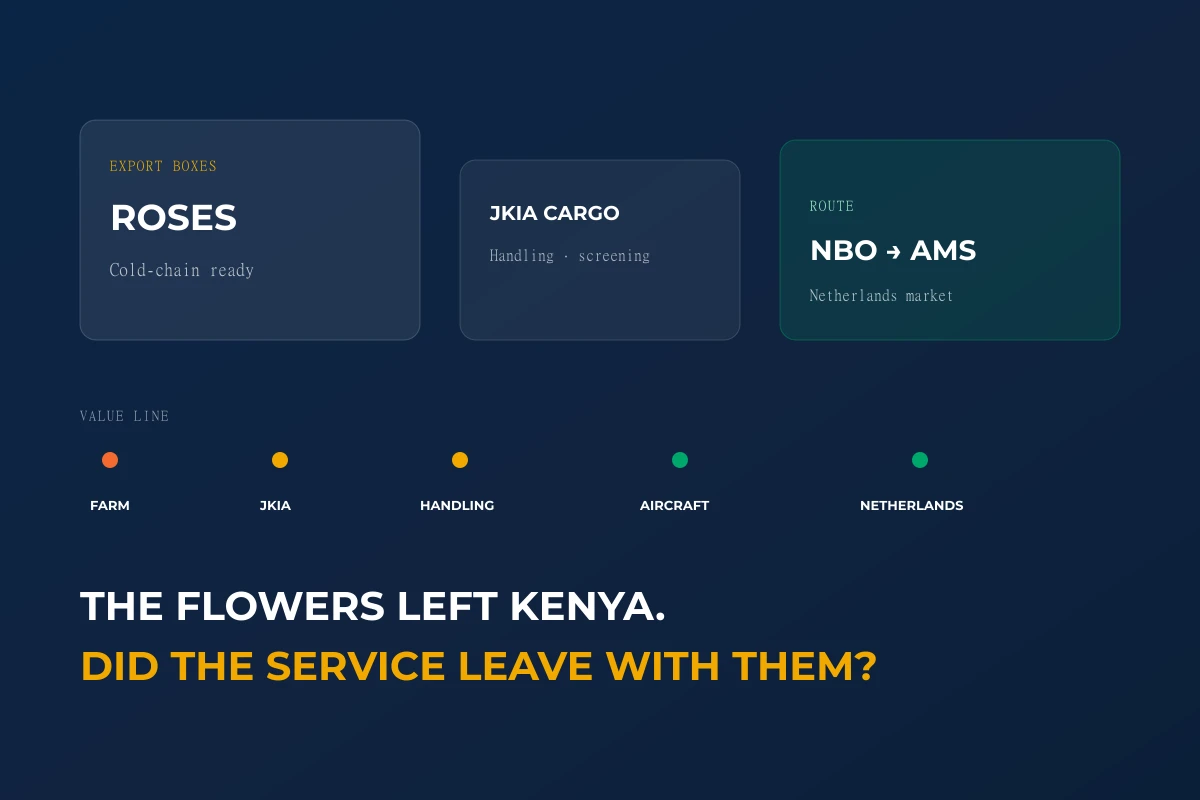
A box of Kenyan roses arrives at JKIA
The flowers have already been sold. An overseas commercial owner wants them prepared for export. Before boarding the aircraft they must be cooled, handled, screened, documented, cleared and prepared for international transportation.
Every physical action happens in Kenya.
Kenyan workers perform it.
Kenyan equipment supports it.
JKIA hosts it.
The export destination is abroad.
The economic beneficiary is abroad.
The work happened in Kenya. But where was the value consumed?
If a service is performed here, can it still be an exported service? Airflo shows why the answer cannot be reduced to where employees were standing.
Export journey
Follow the flowers — then follow the value
One consignment. Two simultaneous flows: where the goods move, and where the service value ultimately lands.
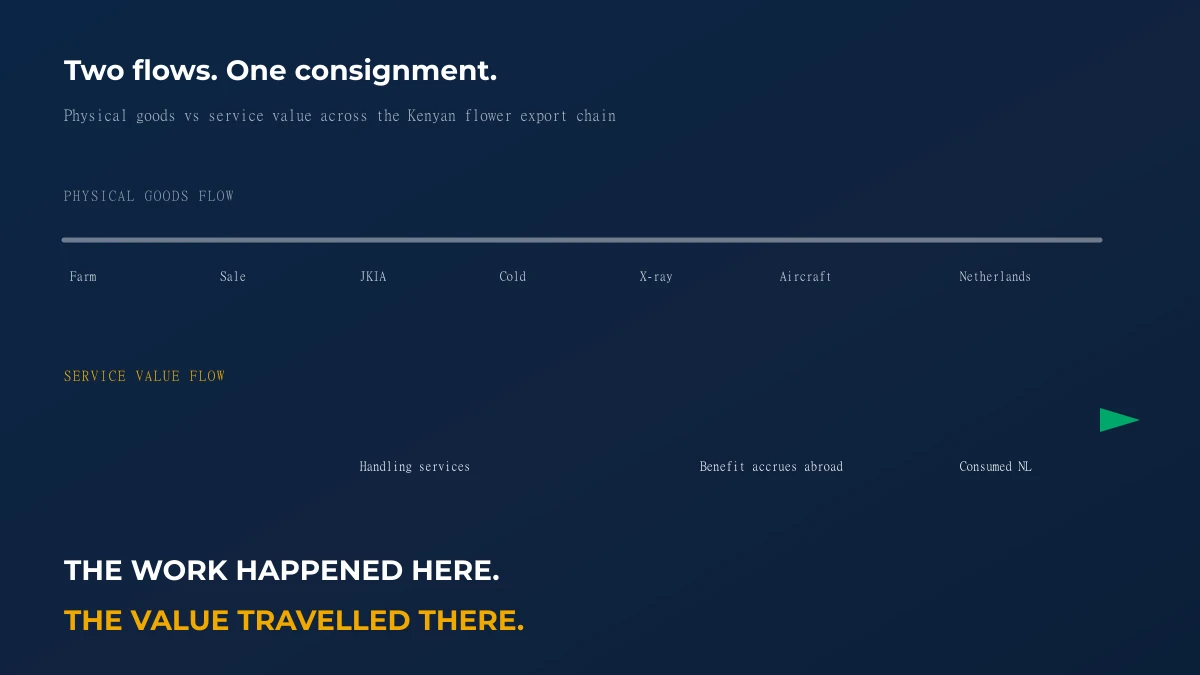
Physical goods flow
Farm
Growing & harvest
Sale / ownership
Overseas buyer owns flowers
Flowers
Export consignment
JKIA
Cargo environment
Cold storage
Temperature control
Vacuum cooling
Conditioning
X-ray
Security screening
Customs / export
Documentation
Aircraft
International freight
Netherlands
Arrival market
Overseas customer
Economic beneficiary
Service value flow
Handling at JKIA is performed in Kenya; the High Court found the economic benefit accrued in the Netherlands.
- 1
Farm
Growing & harvest
- 2
Sale / ownership
Overseas buyer owns flowers
- 3
Flowers
Export consignment
- 4
JKIA
Cargo environment
- 5
Cold storage
Temperature control
- 6
Vacuum cooling
Conditioning
- 7
X-ray
Security screening
- 8
Customs / export
Documentation
- 9
Aircraft
International freight
- 10
Netherlands
Arrival market
- 11
Overseas customer
Economic beneficiary
Text version of the export journey
- Farm: Growing & harvest
- Sale / ownership: Overseas buyer owns flowers
- Flowers: Export consignment
- JKIA: Cargo environment
- Cold storage: Temperature control
- Vacuum cooling: Conditioning
- X-ray: Security screening
- Customs / export: Documentation
- Aircraft: International freight
- Netherlands: Arrival market
- Overseas customer: Economic beneficiary
Signature visual
One service. Three different maps.
VAT analysis may require you to know which map the law is asking about. Do not oversimplify the legal test into a single street address.
Map 1
Physical geography
Where was the work performed?
Kenya / JKIA — Kenyan workers, Kenyan equipment, Kenyan airport.
Map 2
Contractual geography
Who contracted for or instructed the service?
Airflo Limited contracted with its Netherlands parent, Airflo BV, which arranged logistics for overseas customers who had already purchased the flowers.
Map 3
Economic geography
Where was the service ultimately used or consumed?
The High Court held the benefit accrued in the Netherlands — flowers delivered in pristine condition for Airflo BV and its European customers, not for Kenyan growers.
Two honest readings of the same facts
Fair treatment of both sides matters. The Commissioner and Airflo looked at the same airport work and asked different geography questions.
What KRA saw
Kenyan consumption framing
- Kenyan company
- Kenyan employees
- Kenyan airport (JKIA)
- Work performed in Kenya
On this view, because Airflo is Kenyan and the handling happened at JKIA, the supply falls within Kenya under Section 8 of the VAT Act and should attract the standard rate — local performance, local consumption.
KRA position: Kenyan consumption / standard-rated supply
What Airflo saw
Exported-service framing
- Foreign contracting / parent structure (Airflo BV)
- Overseas ownership of flowers before handling
- Export destination / European customers
- Economic benefit consumed abroad
On this view, the customer structure and destination principle matter more than the airport address: services to Airflo BV for flowers already owned abroad, consumed in the Netherlands — zero-rated exported services under Section 2 and the Second Schedule.
Airflo position: exported service / zero-rating
From refund rejection to three courts
Excess input VAT refund claims arising from zero-rated treatment of logistical services to Airflo BV, as recorded in the High Court judgment. Objection decision dated 21 May 2021.
- 01
Tax Appeals Tribunal
Allowed the appeal; services treated as exported / zero-rated; Commissioner ordered to process VAT refund claims within 6 months
- 02
High Court
Appeal dismissed; Tribunal decision of 8 April 2022 upheld; costs against the Appellant
- 03
Court of Appeal
Appeal dismissed; High Court judgment upheld; Commissioner directed to process VAT refund claims within 90 days; costs awarded to Airflo (as reported)
Key holdings
High Court
Exported services / zero-rating
Handling services to Airflo BV — documentation, cold room, vacuum cooling and X-ray screening — fell within exported services and were zero-rated; the benefit accrued in the Netherlands, not for Kenyan growers ([2023] KEHC 17848 (KLR)).
High Court
Place of use or consumption
Following Total Touch Cargo Holland, what matters is where the service is finally used or consumed — not solely where it is performed.
High Court
Not exempt horticultural services
The VAT Act does not define horticultural services; airport logistics were not expanded into the First Schedule exemption. Ambiguity construed in favour of the taxpayer.
Court of Appeal (reported) · reported
Jurisdiction ≠ rate
Reported CoA reasoning: Section 8(1) brings the supply within Kenya's taxing jurisdiction; Section 2 and the Second Schedule provide zero-rating where the service is for use or consumption abroad.
Court of Appeal (reported) · reported
Refund processing and costs
Reported order: process VAT refund claims within 90 days of judgment; costs awarded to Airflo (as dual-sourced from secondary reports).
Distinct from the earlier Panalpina Airflo VAT refund litigation culminating in Panalpina Airflo Limited v Commissioner of Domestic Taxes [2019] KEHC 12289 (KLR). Do not merge periods or amounts.
Two questions. Do not confuse them.
The Court of Appeal line — as reported — treats Section 8 and zero-rating as harmonious, not mutually exclusive. A service can fall within Kenya's VAT system and still attract a zero rate if the law so provides.
Question 1
Can Kenya tax the service?
Jurisdiction / place-of-supply question. Section 8 of the VAT Act — place of supply / Kenya's taxing jurisdiction over supplies made in Kenya
Question 2
If yes, at what rate?
Standard rate? Zero rate? Exempt? Second Schedule, Part A — zero-rating of the exportation of goods or taxable services
Zero-rated is not the same as exempt
The distinction matters commercially because it can determine whether input VAT becomes recoverable — the commercial heart of a KES 46 million refund dispute.
Zero-rated
- VAT rate
- 0%
- Character
- Still a taxable supply treated as taxable in all other respects (VAT Act Section 7). Customers are not charged VAT, but the supplier remains inside the VAT system.
- Input VAT
- Excess input tax arising from zero-rated supplies may be refundable under Section 17(5) — subject to the Commissioner's processes and supporting evidence.
Exempt
- Output VAT
- Not charged
- Character
- Outside the zero-rating pathway. Horticultural services appear as exempt supplies in the First Schedule — a different statutory box from exported services.
- Input VAT
- Input VAT attributable to exempt supplies is generally not recoverable in the same way as for zero-rated taxable supplies. Re-characterising logistics as exempt horticulture can block a refund claim.
In Airflo, the Commissioner argued horticultural exemption; the High Court refused to expand that undefined category to airport logistics. Classification was not a word game — it decided whether a refund pathway stayed open.
Is everything that happens to a flower a horticultural service?
The High Court declined to stretch an undefined statutory phrase to cover airport logistics merely because the cargo was flowers.
Farm level
- Growing
- Harvesting
- Cultivation
- Agricultural operations
Growers perform horticultural production. That is where cultivation lives.
Airport logistics
- Documentation / customs export handling
- Cold room / cold storage
- Vacuum cooling
- Security (X-ray screening)
- Palletisation
These are logistical support services ancillary to international freight — not cultivation redefined by cargo type.
Tax geography is not always physical geography
Wrong question
Where did we do the work?
Necessary — but incomplete if treated as the whole VAT test for exported services.
Better questions
- Who consumed the value?
- Who owned the commercial interest?
- Who received the benefit?
- Where did that benefit terminate?
- What does the contract say?
- What evidence supports the result?
Operational diagnostic
Take the Airflo Test
If your Kenyan business supplies services to an overseas customer, can you answer these questions with YES — supported by documents, not hope?
🔴 0/14 YES answers
0–7 YES — rebuild the commercial, contractual and documentary story
EXPORT TREATMENT REQUIRES URGENT REVIEW
- 12–14 YES → Stronger evidence environment
- 8–11 YES → Cross-border VAT gaps
- 0–7 YES → Export treatment requires urgent review
This is an operational diagnostic, not a legal determination of VAT status.
The Cross-Border Tax Evidence Graph
Tap or hover a node to see what it proves — and what a broken link leaves unexplained.
Text version of the evidence chain
- Customer: Who is the contractual customer — and are they established outside Kenya?
- Contract: What does the written agreement say about parties, instructions and risk?
- Ownership: Who owns the underlying goods when the service is performed?
- Instructions: Who directs packing, screening, consignment and destination?
- Place performed: Where do employees and equipment actually do the work?
- Beneficiary: Who receives the commercial benefit of the service?
- Economic destination: Where is that benefit ultimately used or consumed?
- Commercial risk: Who bears loss, delay and quality risk on the commercial interest?
- Invoice: Does the invoice match the contractual customer and VAT treatment?
- Payment: Does the money trail match the parties and commercial story?
- Export documents: Do shipping, customs and handling records support export characterisation?
- VAT classification: Zero-rated, standard-rated or exempt — and why?
- Return: Does the VAT return reconcile to invoices, payments and evidence?
- Refund / liability: Is a refund claim or assessment supportable from the full chain?
- Audit evidence: Can the entire story be reconstructed years later?
Every transaction has more than one identity
Tax is not just a number attached to an invoice. It is an interpretation of the transaction — money, supply, geography, liability and evidence.
01 · MU-BEI
Money identity
Whose money?
Client funds vs business revenue — can you prove the distinction?
Read the companion →02 · SENDY
Supply identity
Whose sale?
Platform GMV vs platform commission — who actually supplied?
Read the companion →03 · AIRFLO· reading now
Geographic identity
Where is the value consumed?
Physical performance vs economic destination — which map does VAT ask about?
You are here
04 · BRISTOL ESTATE
Liability identity
Whose liability?
Company dissolution vs surviving tax obligation.
Read the companion →05 · WAMURI
Withdrawal identity
Why did the money leave?
Company cash vs personal wallet — can you prove the transaction’s tax identity?
Read the companion →06 · MINET
Consideration identity
What was the retained amount paying for?
Discount label vs facility, advantage or licensed-activity fee — can the records prove it?
Read the companion →07 · KUTUMA
Licence identity
What was the software payment buying?
End-user SaaS access vs copyright — and which year’s royalty definition applies?
Read the companion →08 · CHAIRMANIA × SAVLA
Evidence identity
Can the transaction be reconstructed?
A tax invoice is evidence—not immunity. Can the file prove the supply actually happened?
Read the companion →09 · RANEN × NGULLI × TRANSFLEET
Process identity
Can you prove the handoff?
Created, submitted, received, validated, reconciled, refiled — can you prove each gate?
Read the companion →Hub
CAN YOUR RECORDS PROVE YOUR BUSINESS STORY?
Whose money? Whose sale? Where is the value consumed? Whose liability? Why did the money leave? What was the retained amount paying for? What was the software payment buying? Can the transaction be reconstructed? Can you prove the handoff? The common test is evidence — not slogans.
The cross-border transaction stack
Cross-border tax treatment should be designed into the transaction — not reconstructed after KRA asks.
- 1
Commercial layer
Who buys? Who sells? Who benefits?
- 2
Contract layer
Who contracts with whom?
- 3
Operational layer
Where is the work performed?
- 4
Economic layer
Where does the value terminate?
- 5
Documentary layer
Invoice, instructions, shipping records, proof of ownership.
- 6
Tax layer
Jurisdiction, VAT classification, rate, refund.
- 7
Evidence layer
Can the entire story be reconstructed?
A boardroom scenario
Foreign billing alone should not be treated as automatic proof of an exported service.
CEO
“The customer is overseas.”
CFO
“So we zero-rated the invoice.”
Tax Advisor
“That tells me where the invoice went.”
Five questions for exporters
01
Who buys the service?
02
Who actually benefits?
03
Where is that benefit consumed?
04
What VAT treatment follows?
05
What evidence proves it?
Cross-border tax is also a data problem
A business may need to connect customer data, contracts, transactions, invoices, bank payments, shipping records, revenue, VAT treatment, refunds and evidence. If each lives in a different system, the tax story becomes difficult to reconstruct.
This is the kind of transaction intelligence cross-border businesses increasingly need — financial visibility, classification clarity and evidence continuity — not a claim that any single screen automates VAT outcomes.
CONCEPTUAL ILLUSTRATION — NOT NECESSARILY AN EXISTING CLARIFI SCREEN
Cross-border transaction
- Customer
- Netherlands
- Service performed
- Kenya
- Economic destination
- Netherlands
- Contract
- ✓
- Export evidence
- ✓
- VAT classification
- Zero-rated / Review
- Invoice reconciliation
- ✓
- Payment evidence
- ✓
- Tax evidence status
- Strong
Any ClariFi-style dashboard in this article is a conceptual illustration, not a claim that the screen ships today.
BEFORE YOU ZERO-RATE THE NEXT INVOICE
DON'T JUST KNOW WHERE YOUR INVOICE WENT. KNOW WHERE YOUR VALUE WENT.
Cross-border VAT is rarely solved by a foreign address alone. Before treating a service as exported, make sure the commercial story, contractual story, economic story and documentary story all point in the same direction.
Review your cross-border tax architecture
KAN Consultants can help assess how your contracts, service flows, customer relationships, documentation and VAT treatment fit together before those assumptions become a refund dispute or tax assessment.
See the story behind the transaction
Explore how stronger financial visibility and transaction intelligence can help businesses understand not only what moved, but why it moved and how it was classified.
THE FLOWERS MAY LEAVE KENYA IN HOURS. YOUR EVIDENCE MAY NEED TO DEFEND THE TRANSACTION YEARS LATER.
This article is provided for general business and tax education only. It does not constitute legal, accounting or tax advice. Cross-border VAT treatment depends on the specific transaction, contractual relationships, applicable law and supporting evidence. Businesses should obtain professional advice for their circumstances.
Sources
- High Court judgment [2023] KEHC 17848 (KLR) — Kenya Law
- Business Daily — Court of Appeal report (10 July 2026 decision)
- Total Touch Cargo Holland destination-principle line (cited in High Court)
High Court text was retrieved from Kenya Law. Tribunal detail is taken from that High Court judgment. Court of Appeal citation and orders are dual-sourced from secondary reports pending Kenya Law retrieval — re-verify before formal advice.