ClariFi
Financial intelligence and decision support for Kenyan MSMEs.
- Tax Intelligence
- Kenya SME
- Transaction Evidence
Money received ≠ money earned
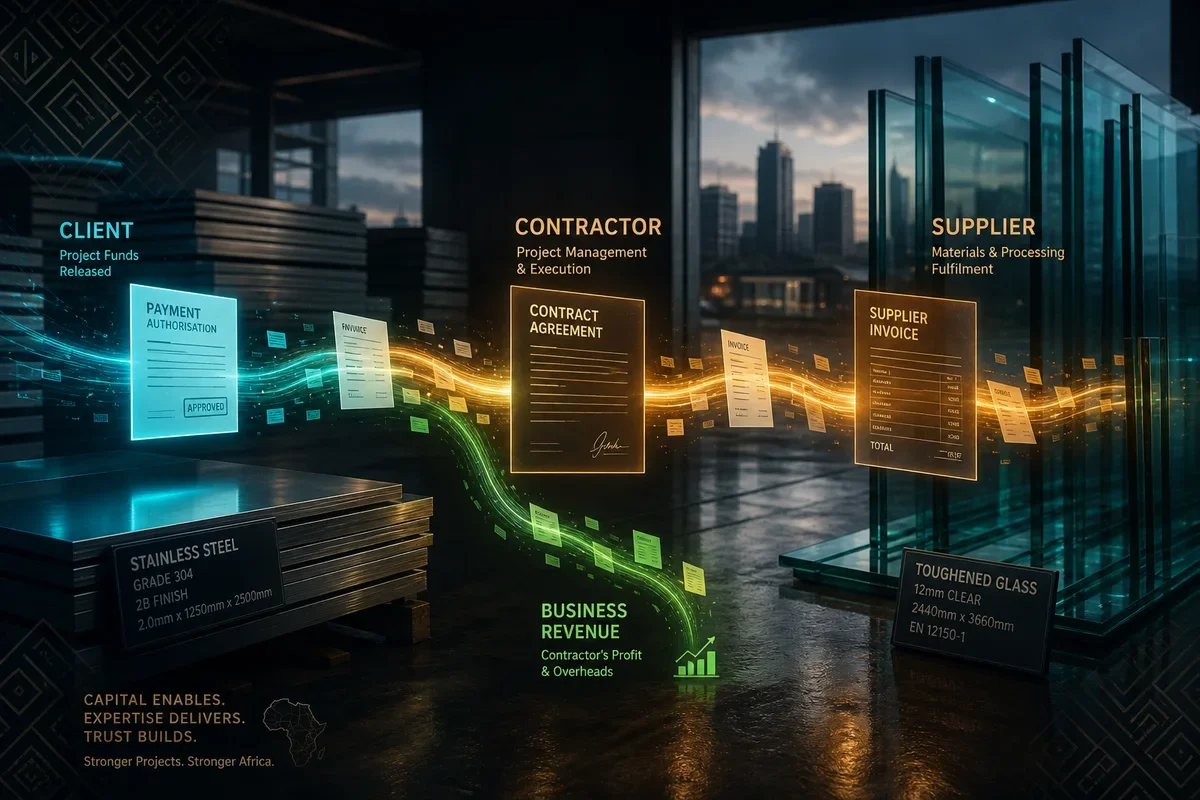
A client sends a construction company:
KES 5,000,000
The money splits into:
Contractor fee
KES 500,000
Materials for the client
KES 4,500,000
How much did the business earn?
The obvious commercial answer is KES 500,000.
Money received vs money earned
Money Received
KES 5,000,000
Bank deposit. Transaction flow into the business account. Visible. Traceable. Easy for a tax system to see.
Money Earned
KES 500,000
Fee. Margin. Profit. Only this portion belongs to the business — if the evidence layer can prove it.
The evidence layer
- Contract
- Agency terms
- Client instruction
- Supplier invoice
- Payment trail
- Ledger
- eTIMS
- Tax reconciliation
The evidence layer determines whether the distinction survives an audit.
The MU-BEI story — in five cards
According to the case account… MU-BEI Stainless and Toughened Glass Limited faced a tax dispute that turned on how money through the business was characterised — and whether records could defend that characterisation.
Case figures below follow the narrative case account and have not been independently verified against a published judgment. Treat them as educational context, not audited fact.
Card 1
eTIMS invoices
Approx. KES 10 million
Electronic tax invoices on record.
Card 2
Declared sales
Approx. KES 1.4 million
Sales declared for the relevant period.
Card 3
Apparent difference
More than KES 8 million
The gap that invited scrutiny.
Card 4
Additional banking differences
Approx. KES 2.3 million
Banking trails that did not reconcile cleanly.
Card 5
Reported assessment
More than KES 1.7 million
Including tax, penalties and interest — as reported in the case account.
What the taxman sees
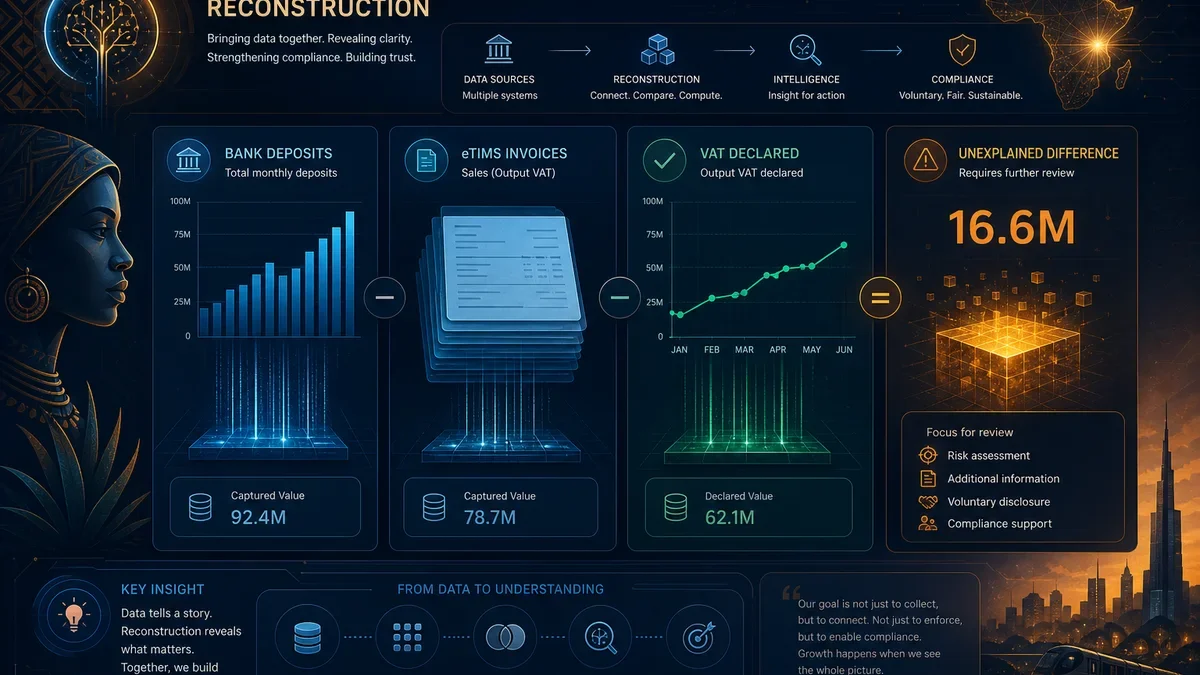
The tax story emerges from records, not intentions. When bank deposits, eTIMS invoices and VAT declarations diverge, the review screen lights up.
Review console
Illustrative · Educational
| Source | Amount | Status |
|---|---|---|
| Bank deposits | Review band | ⚠ Review |
| eTIMS invoices | Difference band | ⚠ Difference |
| VAT declared | Difference band | ⚠ Difference |
| WHT certificates | Supporting | ✓ Supporting |
| Supplier payments | Needs trail | ? Reconcile |
- ⚠ Review
Bank deposits
Review band
- ⚠ Difference
eTIMS invoices
Difference band
- ⚠ Difference
VAT declared
Difference band
- ✓ Supporting
WHT certificates
Supporting
- ? Reconcile
Supplier payments
Needs trail
Illustrative reconstruction for educational purposes. Not legal advice.
Editorial imagery


Agent or principal?
The commercial arrangement shapes the tax story — but only if contracts, conduct and records agree.
Model A
Principal
- Client
- Business
- Supplier
Business buys and resells. Potential tax treatment follows the business acting as principal — the full commercial flow may look like its own supply.
Model B
Agent
- Client
- Business acting for client
- Supplier
The business earns a fee while separately handling client money for materials or third-party costs.
Legal principle · Plain English
The Agency Exception — In Plain English
Under Section 13(5) of the Value Added Tax Act, incidental costs incurred while making a supply are generally included in taxable value — unless the Commissioner is satisfied that the supplier merely made a disbursement to a third party as an agent of the client.
Genuine third-party disbursements made as an agent for a client may receive different VAT treatment where statutory requirements are satisfied. Do not overstate the law — evidence must persuade the Commissioner.
Read VAT Act (Kenya Law)Ask five questions:
- 1Was there a genuine agency relationship?
- 2Was the expenditure made on the client's behalf?
- 3Is the client identifiable?
- 4Is the third-party supplier identifiable?
- 5Can the transaction be reconstructed from documents?
5 YES answers = stronger evidence — not automatic tax exemption.
You Cannot Reconcile January–May Against January–March
Comparing different periods can produce a false discrepancy. KRA's analysis should be internally consistent, but taxpayers must still demonstrate their own correct position.
Bank deposits
- JAN
- FEB
- MAR
- APR
- MAY
VAT return
- JAN
- FEB
- MAR
Attack the assessment. Then rebuild the correct answer.
Weak defence
“KRA's calculation is wrong.”
Ending there leaves the tribunal with a complaint — not a reconstructed tax position.
Strong defence
“KRA's calculation is wrong. Here is our transaction-level reconciliation showing:”
- • Actual revenue (fee / margin)
- • Client funds passing through
- • Supplier payments
- • Transfers
- • Other explained deposits
Once you challenge the tax decision, evidence becomes your currency
Left pan
KRA Assessment
Right pan
Taxpayer Evidence
Section 56(1) of the Tax Procedures Act places the burden of proof on the taxpayer in proceedings under a tax law.
Section 30 of the Tax Appeals Tribunal Act requires an appellant to prove that a tax decision is wrong — or that the amount assessed should have been different.
In plain language: after you appeal, you must show — with documents — why the assessment should not stand, or what the correct figures should be.
Operational self-assessment
Take the MU-BEI Test
Pick one large customer payment from your bank account. Can your business reconstruct the whole transaction in five minutes?
🔴 0/12 items available
Potential audit exposure
- 10–12 items → Strong evidence environment
- 6–9 → Control gaps
- 0–5 → Potential audit exposure
This is an operational self-assessment, not a legal determination of tax liability.
The Tax Evidence Graph
Tap or hover a node to see what it proves — and what it does not.
Text version of the evidence chain
- Client: The party who paid — and whose commercial intent must be reconstructible.
- Contract / Agency Terms: Defines whether the business acts as principal, agent, contractor or intermediary.
- Client Instruction: Shows what the client authorised — procurement, payment of a supplier, or a disbursement on their behalf.
- Funds Received: Shows what entered the business account but does not by itself determine the economic character of the funds.
- Revenue: The portion that belongs to the business as income — fee, margin or sale.
- Client Funds: Money passing through for the client's benefit — if the evidence supports that characterisation.
- eTIMS: What the tax system was told about the supply. Misaligned invoicing creates visible risk.
- Supplier: The third party who received materials or services purchased for the client.
- VAT: How the transaction was treated on the return — including any agency disbursement claim.
- Invoice: Supplier documentation that closes the materials trail.
- Payment Trail: Bank evidence connecting receipt, fee, and outflow to the supplier.
- Ledger: How the books classified the deposit, fee, liability and expense.
- Reconciliation: Connects the commercial story to the accounting and tax story.
- Audit Evidence: What survives when KRA reconstructs the business from records alone.
Seven systems should tell one story
- Bank
- Accounting Ledger
- eTIMS
- VAT Return
- WHT
- Supplier Records
- Customer Records
Tax risk grows when the same transaction has seven different identities across seven different systems.
The risk begins when seven systems tell seven different stories.
Three levels of tax maturity
Most businesses stop at Level 1. Controversies are won — or lost — at Levels 2 and 3.
Level 1
Record Keeping
“We have receipts somewhere.”
Level 2
Reconciliation
“We can explain the numbers.”
Level 3
Transaction Intelligence
“Our systems automatically explain the transaction, its owner, purpose, tax treatment and evidence.”
Strategic direction — transaction intelligence.
The bigger question is not tax compliance. It is transaction intelligence.
Modern businesses increasingly need visibility into what entered the account, whose money it was, why it was received, what portion is revenue, where the rest went, which invoice supports it, how it was classified, and whether the tax treatment reconciles.
That is a systems question as much as a tax question. Businesses need tools that explain not only how much money moved, but why it moved, whose money it was, how it was classified, and whether the evidence supports that classification — through cash-flow visibility, spend and ledger control, and evidence retention. For a related financial-control narrative, see NetBuild: when growth becomes a cash trap.
The tax identity of a transaction
Tax is an interpretation of the transaction — money, supply, geography, liability, withdrawal and evidence.
01 · MU-BEI· reading now
Money identity
Whose money?
Client funds vs business revenue — can you prove the distinction?
You are here
02 · SENDY
Supply identity
Whose sale?
Platform GMV vs platform commission — who actually supplied?
Read the companion →03 · AIRFLO
Geographic identity
Where is the value consumed?
Physical performance vs economic destination — which map does VAT ask about?
Read the companion →04 · BRISTOL ESTATE
Liability identity
Whose liability?
Company dissolution vs surviving tax obligation.
Read the companion →05 · WAMURI
Withdrawal identity
Why did the money leave?
Company cash vs personal wallet — can you prove the transaction’s tax identity?
Read the companion →06 · MINET
Consideration identity
What was the retained amount paying for?
Discount label vs facility, advantage or licensed-activity fee — can the records prove it?
Read the companion →07 · KUTUMA
Licence identity
What was the software payment buying?
End-user SaaS access vs copyright — and which year’s royalty definition applies?
Read the companion →08 · CHAIRMANIA × SAVLA
Evidence identity
Can the transaction be reconstructed?
A tax invoice is evidence—not immunity. Can the file prove the supply actually happened?
Read the companion →09 · RANEN × NGULLI × TRANSFLEET
Process identity
Can you prove the handoff?
Created, submitted, received, validated, reconciled, refiled — can you prove each gate?
Read the companion →Hub
CAN YOUR RECORDS PROVE YOUR BUSINESS STORY?
Whose money? Whose sale? Where is the value consumed? Whose liability? Why did the money leave? What was the retained amount paying for? What was the software payment buying? Can the transaction be reconstructed? Can you prove the handoff? The common test is evidence — not slogans.
MONEY MOVING THROUGH YOUR BUSINESS IS NOT THE SAME THING AS MONEY BELONGING TO YOUR BUSINESS.
BUT IF YOU CANNOT PROVE THE DIFFERENCE, THE DISTINCTION MAY NOT SURVIVE AN AUDIT.
EVERY SHILLING SHOULD HAVE A STORY.
Who paid it? Why did they pay it? Whose money is it? Where did it go? How was it recorded? How was it taxed? Can you prove it? If those answers are unclear, book a tax advisory consultation before your next filing—or your next KRA query.
This article is for general business and tax education and does not constitute legal or tax advice. Businesses should obtain advice based on their specific facts and circumstances.