
ClariFi
Financial intelligence and decision support for Kenyan MSMEs.
- Tax Intelligence
- Kenya
- Revenue Classification
Opening
What was the “hospital discount” really paying for?
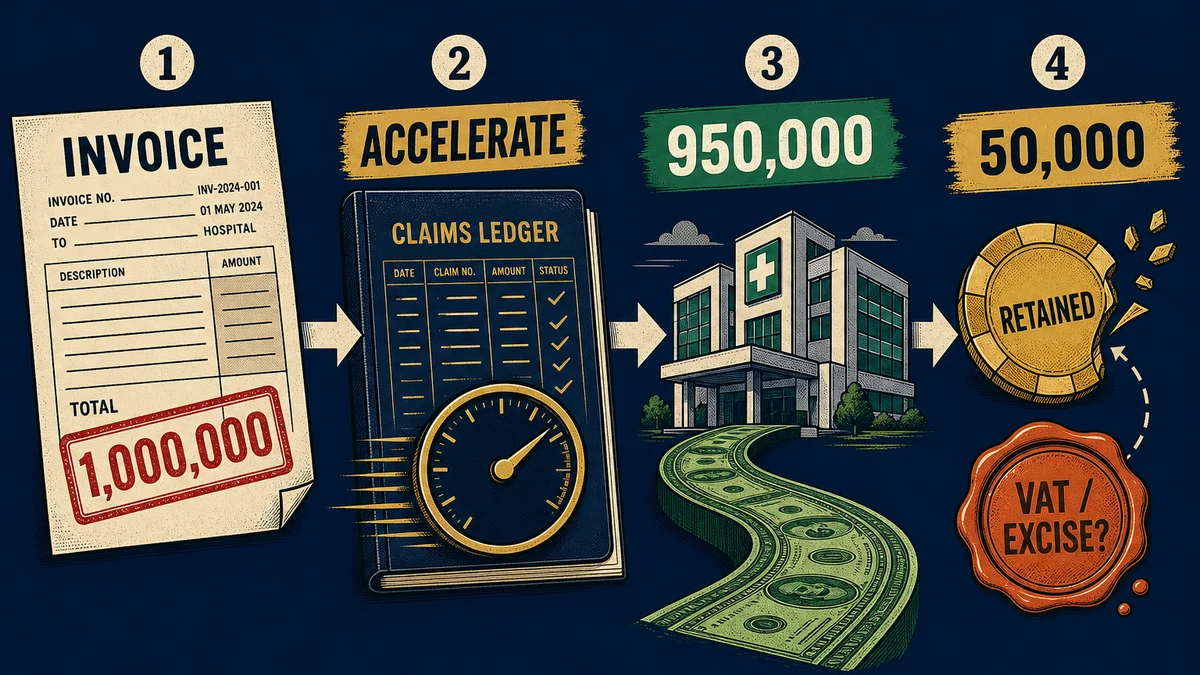
Imagine a hospital invoice of KES 1,000,000. The claim is validated. Payment is accelerated. The hospital receives KES 950,000. KES 50,000 is retained.
Illustrative invoice
One face value. Two possible identities at settlement.
Hospital invoice
KES 1,000,000
Illustrative face value — not a Minet invoice
- Ward care····
- Theatre····
- Pharmacy····
Settlement perforation
The label
DISCOUNT
Underneath
FEE
Emerald stream
KES 950,000
Accelerated net payment to the hospital
Gold retention
KES 50,000
The slice that stayed behind — discount, or consideration?
Same invoice. Two possible tax identities.
Illustrative diagram: a hospital invoice of KES 1,000,000 is perforated at settlement. KES 950,000 streams to the hospital as accelerated payment.KES 50,000 is retained. A commercial label reads discount; the tax question is whether that retained amount was a fee.
These figures are illustrative only. They are not Minet’s actual invoice values, discount percentages, or assessed amounts.
A label records what a business calls a transaction. Tax analysis asks what the parties actually did, what benefit was supplied, and what the retained amount paid for. “Substance over label” is used here as Kinako / KAN Consultants’ practical business-analysis lens. It is not presented as a direct quotation from the Court, and it does not replace the VAT, excise-duty and burden-of-proof tests the Court applied.
The 30-second brief
Five cards. One classification problem.
01 · Arrangement
A discount that kept a slice of the invoice
Hospitals submitted medical claims. Minet received, validated and processed them, then settled faster than an ordinary waiting period would allow. The hospital received a net amount. Minet retained an agreed percentage, which it recorded as hospital discounts.
02 · Minet’s position
A commercial incentive, not a fee
Minet said the retained amount was a trade discount for early payment — sometimes also linked to recommending providers — and not consideration for a service supplied to hospitals. It said the amount was not “other fees” connected with its licensed insurance work, even though it had already treated the amount as income for corporation tax.
03 · KRA’s position
A retained fee for a real advantage
KRA said Minet earned the amount through medical-scheme administration, claims processing and faster hospital payments. On that view, the retention was consideration for a taxable supply and “other fees” connected with Minet’s licensed activities.
04 · High Court outcome
VAT stood. Excise duty returned.
The High Court dismissed Minet’s VAT appeal and allowed the Commissioner’s excise-duty appeal. Excise duty of KES 32,927,502 for 2018–2021 was reinstated with statutory interest and penalties. The hospital-discount VAT assessment was reconfirmed. Costs of both appeals were awarded against Minet.
05 · Business lesson
Ask what the retained amount paid for
A label records what a business calls a transaction. Tax analysis asks what the parties actually did, what benefit was supplied, and whether the retained amount was consideration. That is a practical business-analysis lens — not a slogan that replaces the statutory tests the Court applied.
Transaction flow
How the money moved
The commercial pattern described in the judgments is a claims-settlement path, not a simple checkout discount. A hospital invoice entered the process. A net amount left it. A retained amount stayed in between.

How the claim becomes two amounts
Claim in
Hospital submits claim
Validate
Minet validates and processes
Accelerate
Minet accelerates settlement
Net pay
Hospital receives net payment
Retain
Minet retains the agreed amount
Emerald · early payment
Gold · retained amount
Orange · VAT / excise question
Step 1
Hospital submits claim
Step 2
Minet validates and processes
Step 3
Minet accelerates settlement
Step 4
Hospital receives net payment
Step 5
Minet retains the agreed amount
Commercial label
“hospital discount”
Tax question
What facility, advantage, or service was supplied in return?
The settlement flow is an educational illustration of the commercial pattern described in the judgments. It does not reproduce every contractual relationship in the case.
Controlling figures
Keep every amount attached to its stage
The audit raised more than hospital discounts. Later figures narrowed. The High Court then decided one limb with precision on excise duty, and reconfirmed VAT without stating a standalone final VAT number in its orders.
| Stage | Excise duty | VAT | Treatment |
|---|---|---|---|
| Initial assessment, 7 October 2022 | KES 67,380,627 | KES 73,200,583 | Principal assessments across the audited issues, plus interest and penalties. These totals were not confined to hospital discounts. |
| Objection decision, 28 December 2022 | KES 53,514,443 | approximately KES 50.46 million | Confirmed amounts across the objection issues, plus interest and penalties — not hospital-discount figures alone. The High Court judgment records the objection-stage VAT amount as KES 50,461,388. The extracted Tribunal text displays KES 50,461,383. Because the official texts remain inconsistent on that last digit, this article uses approximately KES 50.46 million. |
| Hospital-discount limb before the Tribunal | KES 32,927,502 | KES 36,197,245 | Amounts specifically associated with hospital discounts for 2018–2021, plus interest and penalties as assessed. These are not the initial or objection-stage totals. |
| High Court outcome, 31 July 2026 | KES 32,927,502 reinstated | Hospital-discount VAT assessment reconfirmed | The High Court did not state a standalone final VAT amount in its dispositive orders. It reconfirmed the hospital-discount VAT assessment. This article does not treat KES 50,461,388 or KES 36,197,245 as a High Court VAT order. |
Initial assessment, 7 October 2022
- Excise duty
- KES 67,380,627
- VAT
- KES 73,200,583
- Treatment
- Principal assessments across the audited issues, plus interest and penalties. These totals were not confined to hospital discounts.
Objection decision, 28 December 2022
- Excise duty
- KES 53,514,443
- VAT
- approximately KES 50.46 million
- Treatment
- Confirmed amounts across the objection issues, plus interest and penalties — not hospital-discount figures alone. The High Court judgment records the objection-stage VAT amount as KES 50,461,388. The extracted Tribunal text displays KES 50,461,383. Because the official texts remain inconsistent on that last digit, this article uses approximately KES 50.46 million.
Hospital-discount limb before the Tribunal
- Excise duty
- KES 32,927,502
- VAT
- KES 36,197,245
- Treatment
- Amounts specifically associated with hospital discounts for 2018–2021, plus interest and penalties as assessed. These are not the initial or objection-stage totals.
High Court outcome, 31 July 2026
- Excise duty
- KES 32,927,502 reinstated
- VAT
- Hospital-discount VAT assessment reconfirmed
- Treatment
- The High Court did not state a standalone final VAT amount in its dispositive orders. It reconfirmed the hospital-discount VAT assessment. This article does not treat KES 50,461,388 or KES 36,197,245 as a High Court VAT order.
Each amount is attached to its procedural stage. The figures are not added together, and no amount is presented as Minet’s total final liability. Principal tax is distinguished from interest, penalties and costs. The High Court reconfirmed the hospital-discount VAT assessment without stating a standalone final VAT figure in its dispositive orders.
Procedural history
From audit to High Court
Minet Kenya Insurance Brokers Limited is licensed under the Insurance Act as an insurance broker and medical insurance provider, and is registered for VAT. The hospital-discount dispute that reached the High Court was one limb of a wider audit covering January 2017 to December 2021.
- 1
Audit period
KRA audited January 2017 to December 2021. The hospital-discount VAT and excise questions that later reached the High Court focused on 2018 to 2021.
- 2
Initial assessment
Principal assessments of KES 67,380,627 excise duty and KES 73,200,583 VAT, plus interest and penalties, across the audited issues — not hospital discounts alone.
- 3
Objection
Minet objected to the entire assessment.
- 4
Objection decision
The objection was partly allowed. Confirmed principal tax included KES 53,514,443 excise duty and approximately KES 50.46 million VAT, plus interest and penalties, across the remaining issues.
- 5
Tribunal decision
The Tax Appeals Tribunal decided Appeal E033 of 2023. It upheld VAT on hospital discounts, set aside the KES 32,927,502 excise-duty assessment on that limb, and dealt separately with other issues by consent or variation.
- 6
High Court appeals
The Commissioner’s appeal, E160 of 2024, was filed on 1 July 2024. Minet’s appeal, E167 of 2024, was filed on 4 July 2024. The appeals were consolidated.
- 7
High Court judgment
Peter M. Mulwa J dismissed Minet’s VAT appeal, allowed the Commissioner’s excise-duty appeal, reinstated excise duty of KES 32,927,502 for 2018–2021 with statutory interest and penalties, reconfirmed the hospital-discount VAT assessment, and awarded costs of both appeals against Minet.
Facts and findings are restated from the Tribunal judgment in [2024] KETAT 734 (KLR) and the High Court decision in [2026] KEHC 12434 (KLR). Party submissions are labelled separately from judicial holdings. Short statutory expressions such as “facility or advantage” and “other fees” are used; longer judgment passages are paraphrased. The unrelated Minet decision reported as [2024] KETAT 763 (KLR) is not a source for this article.
Separate the record
Four voices. Four jobs. Do not mix them.
A party’s submission is not a finding. The Tribunal’s characterisation is not the High Court’s holding. The practical lesson for finance teams is to keep those voices distinct when a classification dispute is later reconstructed from the file.
What Minet argued
Party submissions
- The retained amount was a commercial discount for settling hospital invoices faster — a trade term, not a fee charged to hospitals.
- Minet did not supply a marketing, efficiency, or other service to medical providers that would trigger VAT.
- Hospital discounts were not “other fees” under the Excise Duty Act because they did not arise from licensed insurance-brokerage or medical-insurance activities.
- Making timely payment was efficient performance of a commercial relationship, not the rendering of an excisable or taxable service.
- The company had already recognised the amounts as income and paid corporation tax; that did not, in its view, convert a discount into a VAT or excise charge.
What KRA argued
Party submissions
- The retained percentage was earned through medical-insurance administration, claims receipt, validation and accelerated settlement.
- Hospitals received a real commercial advantage: faster cash and improved liquidity.
- The amount withheld from the invoice was consideration for that advantage, not a mere price reduction on an unrelated supply.
- The income fell within “other fees” connected with Minet’s licensed activities as an insurance intermediary and medical insurance provider.
- A general belief that an arrangement is a financial or commercial discount does not establish a specific VAT exemption.
What the Tribunal decided
9 May 2024 holdings
- The Tribunal characterised the arrangement as similar to invoice discounting: paying part of an invoice early and retaining a charge for facilitating cash flow.
- On excise duty, it held that Minet was not licensed to provide invoice-discounting or similar trade-financing services, so the retained amount did not relate to licensed activities. The KES 32,927,502 excise assessment on hospital discounts was set aside.
- On VAT, it held that making cash-flow available was a facility or advantage within the VAT Act definition of a supply of services. Minet had not shown a statutory exemption. VAT on the hospital-discount limb therefore stood, subject to excluding VAT that had been charged on the excise the Tribunal found incorrectly assessed.
What the High Court held
31 July 2026 holdings
- The invoice-discounting theory had not been pleaded or supported by the parties’ evidence and should not have been introduced by the Tribunal on its own.
- The decisive excise question was not whether Minet held a separate invoice-discounting licence. It was whether the retained fee related to Minet’s licensed activities.
- Minet’s claims receipt, validation, administration and accelerated settlement functions arose from its regulated medical-insurance work. The Court therefore treated the retained amount as falling within “other fees” connected with licensed activities.
- Faster claim settlement gave hospitals accelerated cash flow and liquidity. The retained percentage was consideration for that identifiable advantage.
- Minet was VAT-registered and did not discharge the burden, under section 56(1) of the Tax Procedures Act, of demonstrating an applicable statutory exemption. A general belief that an arrangement is a financial or commercial discount does not establish a specific VAT exemption.
- Minet’s VAT appeal was dismissed. The Commissioner’s excise-duty appeal was allowed. Excise duty of KES 32,927,502 for 2018–2021 was reinstated with statutory interest and penalties. The hospital-discount VAT assessment was reconfirmed. Costs of both appeals were awarded against Minet.
Facts and findings are restated from the Tribunal judgment in [2024] KETAT 734 (KLR) and the High Court decision in [2026] KEHC 12434 (KLR). Party submissions are labelled separately from judicial holdings. Short statutory expressions such as “facility or advantage” and “other fees” are used; longer judgment passages are paraphrased. The unrelated Minet decision reported as [2024] KETAT 763 (KLR) is not a source for this article.
VAT
Why VAT applied
Section 2 of the VAT Act, 2013 defines a supply of services as anything done that is not a supply of goods or money. That definition includes the performance of services, the grant of rights, the making available of any facility or advantage, and the toleration of a situation. The “facility or advantage” limb was in force throughout 2018 to 2021. It is not a 2026 invention.
The Court found that faster claim settlement gave hospitals accelerated cash flow and liquidity. That was an identifiable advantage. Minet retained a percentage of the invoice as consideration for that advantage. Minet was VAT-registered. The remaining question was whether a specific statutory exemption applied.
Financial services listed in the First Schedule to the VAT Act can be exempt. The Court held that Minet did not discharge the burden, under section 56(1) of the Tax Procedures Act, of demonstrating that a specific exemption covered these administrative earnings. A general belief that an arrangement is a financial or commercial discount does not establish that exemption. The Tribunal had also noted the VAT Act’s own burden provision on exemption claims. Either way, the taxpayer had to point to the law — not to the label.
That is why VAT has a separate identity from corporation tax. A business can recognise income, pay tax on profit, and still have an unanswered VAT question: was the same amount consideration for a taxable supply? In Minet, the High Court treated the retained percentage as that consideration. It did not need to find that every Kenyan discount is a service. It needed to find that this retained amount paid for an advantage the hospitals actually received.
This article does not publish a current excise rate or calculate liability. Excise definitions, exclusions and rates must be read from the Excise Duty Act as it stood in the period under review. The VAT Act section 2 definition of a supply of services — including making a facility or advantage available — was in force throughout 2018 to 2021.
Excise duty
Why excise duty returned
The Tribunal characterised the transaction as similar to invoice discounting. On that theory, Minet was paying hospitals early, retaining a charge for cash-flow support, and doing something it was not licensed to do. Because the retained amount did not, on that view, relate to licensed insurance activities, the Tribunal set aside excise duty of KES 32,927,502 for 2018 to 2021.
The High Court held that this theory had not been pleaded or supported by the parties’ evidence. A tribunal should not introduce a commercial characterisation of its own and then decide the case on that characterisation. The decisive question was not whether Minet held a separate invoice-discounting licence.
The question was whether the retained fee related to Minet’s licensed activities. Minet received medical claims, validated them, administered the process and accelerated settlement using the operational infrastructure of its regulated medical-insurance work. The Court treated the retained amount as falling within “other fees” — fees, charges or commissions charged by a financial institution relating to licensed activities, excluding items such as interest and insurance premiums as the schedule then provided.
Excise duty of KES 32,927,502 was therefore reinstated, with statutory interest and penalties. That is a licensed-activity nexus finding, not a finding that every business fee in Kenya is excisable, and not a published rate for a later year. The historical wording of the schedule — including what counted as “other fees” and what was excluded — must be read as it stood in 2018 to 2021. A later amendment cannot be applied backwards by habit.
For regulated businesses, the practical lesson is narrower than a scare story and sharper than a slogan. If a fee, charge, commission or retention arises from the work the licence already authorises — claims handling, administration, settlement — the excise question is not “do we also hold a specialist side-licence?” It is “does this amount relate to the licensed activity we already perform?”
This article does not publish a current excise rate or calculate liability. Excise definitions, exclusions and rates must be read from the Excise Duty Act as it stood in the period under review. The VAT Act section 2 definition of a supply of services — including making a facility or advantage available — was in force throughout 2018 to 2021.
Three different tax questions
Income tax did not answer VAT. VAT did not answer excise duty.
Paying corporate income tax on a retained amount did not, by itself, answer the separate VAT and excise-duty questions. The Court did not decide a broad “double taxation” doctrine. It decided two statutory tests on the same commercial facts.
Corporate income tax
Was the retained amount business income or profit?
Minet treated hospital discounts as income and paid corporation tax on them. That answered a profit question. It did not, by itself, decide whether VAT or excise duty also applied.
VAT
Was it consideration for a taxable supply?
VAT asks whether a registered person made a supply — including making a facility or advantage available — and whether the retained amount was consideration for that supply, unless a specific exemption is proved.
Excise duty
Was it an excisable fee connected with licensed activities?
Excise duty on “other fees” asks a narrower question: whether a qualifying institution charged fees, charges or commissions relating to its licensed activities. A separate product licence is not the whole test.
Where this article moves beyond judicial findings into control frameworks, screening questions or boardroom lessons, that content is Kinako / KAN Consultants business analysis — not a quotation from the Court and not a substitute for the statutory tests the Court applied.
Screening framework
Discount versus service-linked retention
Use this matrix to ask better questions of a gross-to-net settlement. It is not a statutory test and it does not decide tax. It helps a finance team see whether the records describe a price reduction or a retained amount earned for an activity.
| Question | Conventional price reduction | Potential service-linked retention |
|---|---|---|
| What changes? | Price of the underlying supply | Amount retained for an identifiable activity or advantage |
| What does the recipient do? | Ordinarily pays the reduced price | May process, accelerate, administer, finance, market, or facilitate |
| Why is value surrendered? | Pricing or trade term | Compensation for a benefit or service |
| What evidence matters? | Quotation, invoice, credit note, payment term | Contract, service description, settlement logic, ledger, invoice and payment trail |
| VAT question | Is this simply a reduced taxable value? | Is the retained amount consideration for a supply? |
| Excise question | Usually requires no licensed-fee nexus | Does the amount relate to a qualifying entity’s licensed activity? |
What changes?
- Conventional price reduction
- Price of the underlying supply
- Potential service-linked retention
- Amount retained for an identifiable activity or advantage
What does the recipient do?
- Conventional price reduction
- Ordinarily pays the reduced price
- Potential service-linked retention
- May process, accelerate, administer, finance, market, or facilitate
Why is value surrendered?
- Conventional price reduction
- Pricing or trade term
- Potential service-linked retention
- Compensation for a benefit or service
What evidence matters?
- Conventional price reduction
- Quotation, invoice, credit note, payment term
- Potential service-linked retention
- Contract, service description, settlement logic, ledger, invoice and payment trail
VAT question
- Conventional price reduction
- Is this simply a reduced taxable value?
- Potential service-linked retention
- Is the retained amount consideration for a supply?
Excise question
- Conventional price reduction
- Usually requires no licensed-fee nexus
- Potential service-linked retention
- Does the amount relate to a qualifying entity’s licensed activity?
This is a screening framework, not a statutory test or automatic conclusion. It is Kinako / KAN Consultants business analysis — not a judicial finding.
Operational self-assessment
Take the Minet Test
Pick one discount, rebate, retention or net settlement. Check each question you can answer from the current file — not from memory. Answers stay on this page and are not collected or stored.
0/10 questions evidenced
0–5 — the retained amount may not have a defensible identity
High classification risk — professional review recommended
- 9–10 — stronger classification and evidence
- 6–8 — material documentation or tax-analysis gaps
- 0–5 — high classification risk; professional review recommended
This is an operational diagnostic, not a tax opinion.
Review triggers
Who should review similar models
These are review triggers, not declarations of tax liability. If your model keeps a slice of someone else’s invoice, the Minet facts are a reason to read the contracts again — not a reason to assume the same outcome.
Insurance and claims administrators
Where claims are received, validated and settled, and a percentage is retained from provider invoices, the question is what that retention pays for — administration, acceleration, or a genuine price term.
Supply-chain finance and early-payment programmes
If a buyer, platform or intermediary pays early and keeps a slice of the invoice, review whether the kept amount is a purchase-price adjustment or consideration for a liquidity facility.
Platforms using gross-to-net settlements
Gross inflows that later become net payouts can hide a service-linked retention. Map who supplied what before treating the difference as a discount.
Fintech and embedded-finance products
Embedded payment, float, or accelerated-settlement features should be reviewed against VAT supply tests and, where a licensed institution is involved, against the excise “other fees” nexus.
Distributors using rebates and retrospective incentives
A rebate that looks like a price reduction may still need evidence of what, if anything, was supplied in return — listing, volume, data, or nothing at all.
Marketplaces retaining commissions or margins
A commission, take-rate or margin is usually easier to name than a “discount.” If the commercial documents still call it a discount, the records should explain why.
Procurement and invoice-processing intermediaries
Anyone who stands between an invoice and settlement — validating, batching, financing or paying — should be able to show whether a retained amount is a service fee or a reduced purchase price.
Where this article moves beyond judicial findings into control frameworks, screening questions or boardroom lessons, that content is Kinako / KAN Consultants business analysis — not a quotation from the Court and not a substitute for the statutory tests the Court applied.
Finance playbook
Seven actions for finance teams
Classification work is file work. The useful response to Minet is not a new slogan. It is a complete inventory of every amount that is labelled a discount and a decision about what that amount actually is.
- 1
Inventory discounts, rebates, commissions, retentions, incentives and net settlements.
- 2
Map the complete gross-to-net transaction flow — who invoices, who pays, who keeps the difference.
- 3
Identify what each party does and receives, in the contract and in actual conduct.
- 4
Test income tax, VAT and excise duty separately. One answer does not settle the other two.
- 5
Reconcile contracts, invoices, eTIMS, ledgers, bank records and settlement reports.
- 6
Document the legal and factual basis for any exemption or classification, using the law as it stood in the relevant period.
- 7
Obtain qualified Kenyan tax and legal advice before retrospective correction or restructuring.
Boardroom questions
Five questions before the next settlement run
Question 1
Which income streams are labelled as discounts, rebates, recoveries, or margins?
Question 2
What activity or advantage does the business provide to earn each amount?
Question 3
Which retained amounts arise from regulated or licensed operations?
Question 4
Do our contracts, systems, invoices, and tax returns give the transaction one consistent identity?
Question 5
What is the quantified historical VAT, excise, penalty, and interest exposure if our classification is challenged?
Transaction intelligence
From label to evidence
Businesses increasingly need systems capable of connecting contracts, payment flows, revenue classification, invoices, ledgers, tax treatment and evidence. The useful path is not a slogan. It is a chain.
A cash-flow view can show that money moved. A decision view can show what the business intended. Neither view, by itself, classifies a retained amount for VAT or excise duty. The records still have to name the transaction.
CONCEPTUAL ILLUSTRATION — NOT NECESSARILY AN EXISTING CLARIFI SCREEN
- Transaction ID
- CLM-2019-00482
- Gross invoice
- KES 1,000,000
- Net settlement
- KES 950,000
- Retained amount
- KES 50,000
- Commercial label
- Hospital discount
- Advantage mapped
- Accelerated settlement / liquidity
- VAT question
- Consideration for a facility or advantage?
- Excise question
- Fee connected with licensed activity?
- Evidence status
- Contract · invoice · settlement report · ledger
Any ClariFi-style dashboard in this article is a conceptual illustration, not a claim that the screen ships today. ClariFi does not automatically calculate tax liability, determine exemptions, or file returns.
Every retained amount has a tax identity
Tax is an interpretation of the transaction — money, supply, geography, liability, withdrawal, consideration and evidence.
01 · MU-BEI
Money identity
Whose money?
Client funds vs business revenue — can you prove the distinction?
Read the companion →02 · SENDY
Supply identity
Whose sale?
Platform GMV vs platform commission — who actually supplied?
Read the companion →03 · AIRFLO
Geographic identity
Where is the value consumed?
Physical performance vs economic destination — which map does VAT ask about?
Read the companion →04 · BRISTOL ESTATE
Liability identity
Whose liability?
Company dissolution vs surviving tax obligation.
Read the companion →05 · WAMURI
Withdrawal identity
Why did the money leave?
Company cash vs personal wallet — can you prove the transaction’s tax identity?
Read the companion →06 · MINET· reading now
Consideration identity
What was the retained amount paying for?
Discount label vs facility, advantage or licensed-activity fee — can the records prove it?
You are here
07 · KUTUMA
Licence identity
What was the software payment buying?
End-user SaaS access vs copyright — and which year’s royalty definition applies?
Read the companion →08 · CHAIRMANIA × SAVLA
Evidence identity
Can the transaction be reconstructed?
A tax invoice is evidence—not immunity. Can the file prove the supply actually happened?
Read the companion →09 · RANEN × NGULLI × TRANSFLEET
Process identity
Can you prove the handoff?
Created, submitted, received, validated, reconciled, refiled — can you prove each gate?
Read the companion →Hub
CAN YOUR RECORDS PROVE YOUR BUSINESS STORY?
Whose money? Whose sale? Where is the value consumed? Whose liability? Why did the money leave? What was the retained amount paying for? What was the software payment buying? Can the transaction be reconstructed? Can you prove the handoff? The common test is evidence — not slogans.
BEFORE THE NEXT SETTLEMENT
You may call it a discount. The tax system will ask what you did to earn it.
NAME THE TRANSACTION. MAP THE ADVANTAGE. MAKE THE RECORDS TELL THE SAME STORY.
A commercial label records what a business calls a transaction. Tax analysis asks what the parties actually did, what benefit was supplied, and what the retained amount paid for. Before the next gross-to-net settlement, make sure the contract, the payment trail, the invoice and the tax treatment describe the same identity.
Contextual KAN tax review
KAN Consultants can help review discounts, rebates, retentions, early-payment arrangements, VAT and excise classification, and the evidence that connects a commercial label to the transaction it describes.
Explore ClariFi
Explore how stronger financial visibility can help businesses connect contracts, payment flows, invoices, ledgers and tax treatment — without treating a dashboard as a tax opinion.
A LABEL IS NOT THE TRANSACTION. THE RECORDS HAVE TO PROVE WHAT THE MONEY WAS FOR.
This article is provided for general business and tax education. It does not constitute legal, accounting or tax advice. Tax treatment depends on the applicable period, statutory wording, contracts, facts, regulatory status, transaction flows and supporting evidence. Obtain professional advice for your circumstances.
Sources
- Kenya Law — Minet Kenya Insurance Brokers Limited v Commissioner of Domestic Taxes [2026] KEHC 12434 (KLR) (31 July 2026)
- Kenya Law — Minet Kenya Insurance Brokers Limited v Commissioner of Domestic Taxes [2024] KETAT 734 (KLR) (9 May 2024)
- Value Added Tax Act, 2013
- Tax Procedures Act, 2015
- Excise Duty Act, 2015
- Insurance Act
Facts and findings are restated from the Tribunal judgment in [2024] KETAT 734 (KLR) and the High Court decision in [2026] KEHC 12434 (KLR). Party submissions are labelled separately from judicial holdings. Short statutory expressions such as “facility or advantage” and “other fees” are used; longer judgment passages are paraphrased. The unrelated Minet decision reported as [2024] KETAT 763 (KLR) is not a source for this article.
Each amount is attached to its procedural stage. The figures are not added together, and no amount is presented as Minet’s total final liability. Principal tax is distinguished from interest, penalties and costs. The High Court reconfirmed the hospital-discount VAT assessment without stating a standalone final VAT figure in its dispositive orders.