ClariFi
Financial intelligence and decision support for Kenyan MSMEs.
- eTIMS
- Stock Management
- Tax Evidence
- MSME Controls
- Agribusiness
- VAT
Answer first
This is not simply an inventory-software announcement
On 1 September 2026, ClariFi published “VAT-Exempt Does Not Mean Evidence-Exempt.” That advisory examined Yarde Park Lounge Ltd v Commissioner for Domestic Taxes, a tax appeal involving a substantial assessment and an agribusiness supply chain. The central lesson was not that dry maize had suddenly become taxable. It was that a taxpayer may believe its tax classification is correct and still lose because it cannot adequately reconstruct the transactions supporting its position. Read the companion advisory.
Three days later, on 4 September 2026, the Kenya Revenue Authority issued a public notice on the planned implementation of the Stock Management Functionality for Electronic Invoicing. KRA said businesses should maintain accurate and current stock records covering goods purchased or received, sold, transferred, returned, adjusted or otherwise disposed of. It also announced that stakeholder consultations would begin in September 2026. The notice did not specify a universal activation deadline.
The Yarde Park decision asks
Can the taxpayer reconstruct the transaction?
KRA’s stock-management direction adds
Can the taxpayer reconstruct the movement of the goods behind the transaction?
These are not separate conversations. They are two parts of the same emerging compliance architecture.
From invoice to evidence chain
An invoice proves that a document was generated
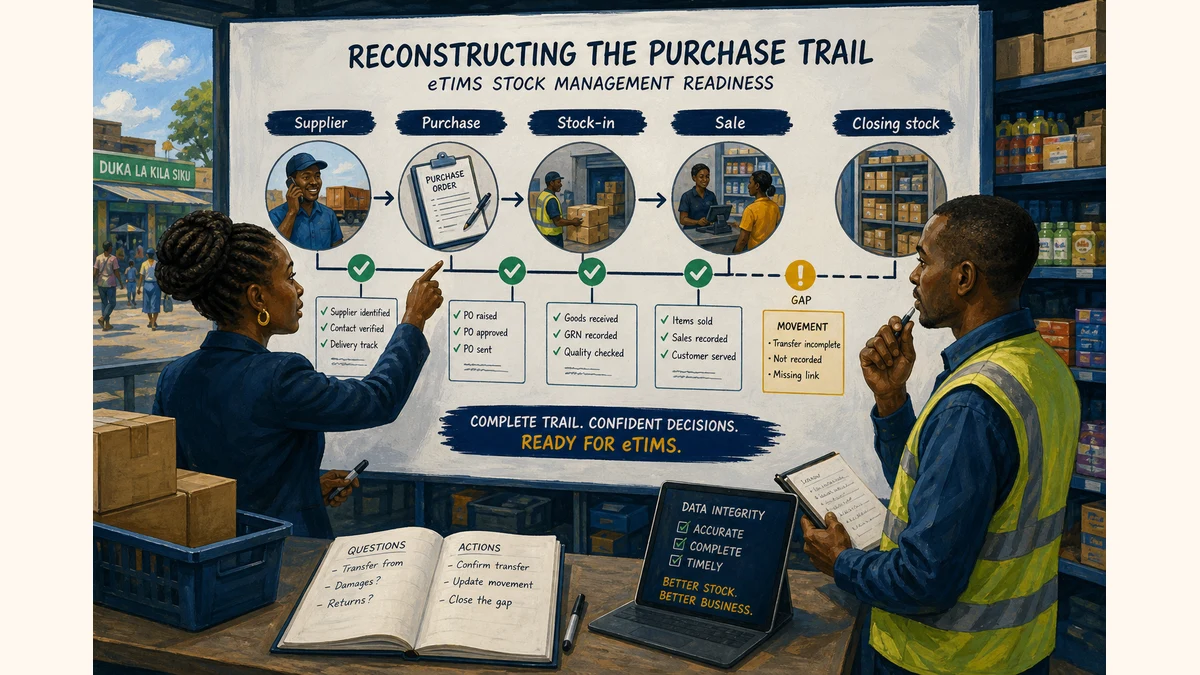
KRA is not merely asking businesses to count the products sitting on their shelves. It is moving electronic invoicing toward a connected economic record.
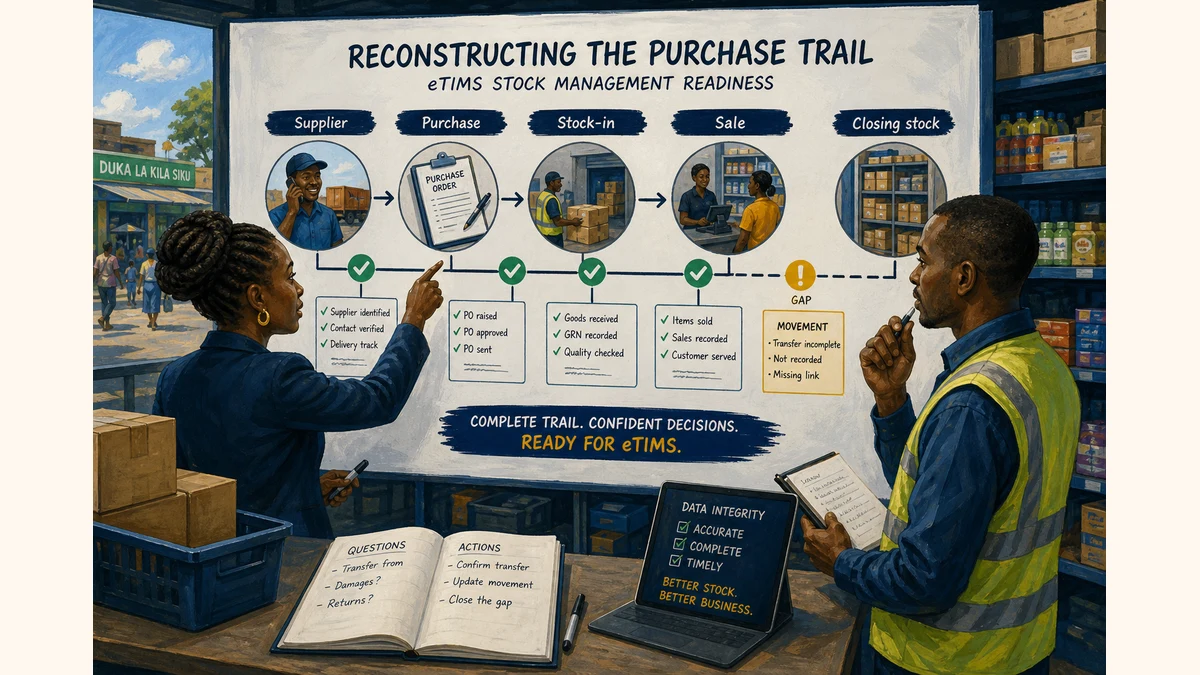
An invoice does not necessarily prove:
- that the goods existed;
- where they came from;
- when they entered the business;
- which branch or warehouse received them;
- whether they were sold, transferred, damaged or returned;
- whether the quantity invoiced agrees with the quantity purchased;
- whether the payment relates to those particular goods; or
- whether the closing stock figure is credible.
That is why the invoice is not the transaction. It is one event within the transaction.
Legal baseline
The legal obligation did not begin on 4 September 2026
The public notice should not be read as the creation of an entirely new stock-record obligation. The Tax Procedures (Electronic Tax Invoice) Regulations, 2024 already require users of applicable systems to maintain stock-in and stock-out records and to record local purchases and imports. The Regulations also allow the Commissioner to place specified categories—such as service providers and certain non-VAT-registered businesses using simplified systems—on systems that do not maintain stock records.
The September 2026 notice appears to signal an implementation and operationalisation stage: how opening stock will be treated; how existing systems will connect; how movements and adjustments will be recorded; how exceptions will be handled; which taxpayers will use which stock functionality; what transitional period will apply; and how implementation challenges will be resolved.
The notice itself does not yet answer those questions. Businesses should therefore prepare their records without inventing implementation rules that KRA has not announced.
From invoice compliance to transaction integrity
Classification, proof and stock movement are different questions
The earlier ClariFi advisory drew a distinction between classification and proof. Stock management introduces a third question.
| Evidence layer | Central question | Typical evidence |
|---|---|---|
| Tax classification | What product or service was supplied? | Product description, item code, contract, applicable tax treatment |
| Transaction existence | Did the purchase or sale actually occur? | Supplier identity, invoice, order, delivery record, payment reference |
| Stock movement | What happened to the goods? | Goods-received note, stock-in record, transfer, stock-out, return or adjustment |
| Financial reconciliation | Do the quantities and values agree? | Purchase ledger, inventory records, cost of sales, sales ledger and closing stock |
A business can answer one question correctly and still fail another. That was the deeper warning in the Yarde Park matter: commercial reality and evidential readiness are not always the same thing.
VAT-exempt does not mean stock-evidence exempt
Exemption does not make goods disappear from operating records
A VAT-exempt product still has a description, quantity, supplier, purchase date, unit of measure, purchase value, delivery point, storage location, subsequent movement, buyer or internal user, and a closing-stock consequence.
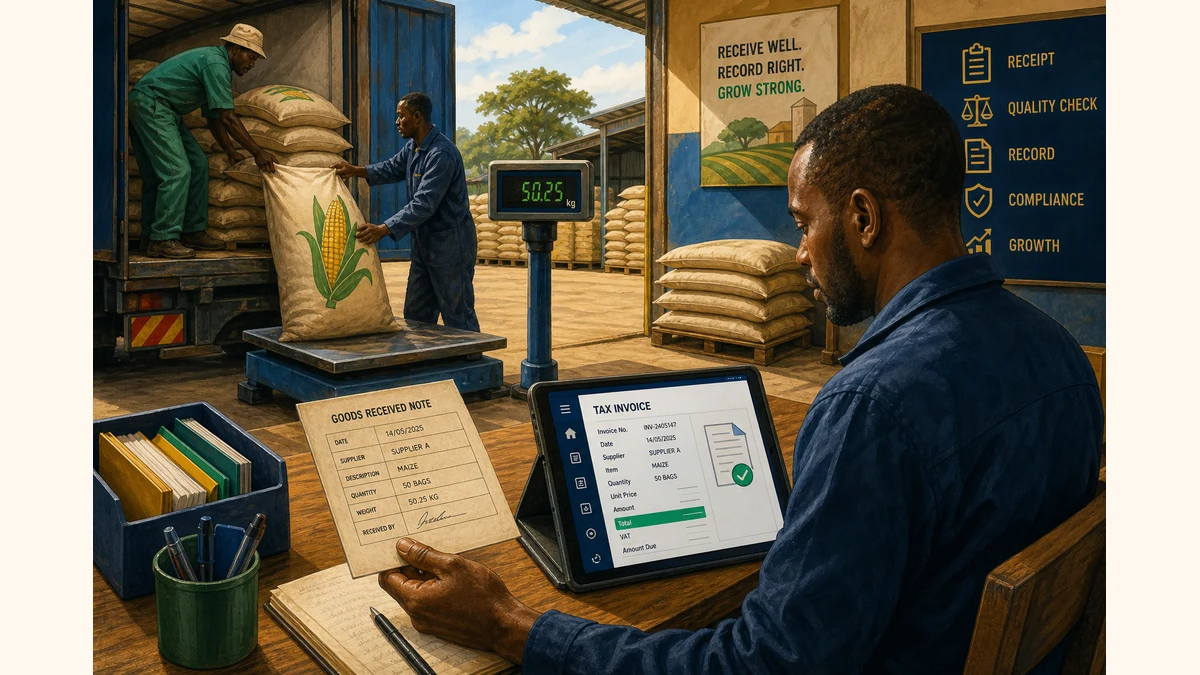
Consider a maize aggregator. The aggregator may correctly argue that qualifying maize was VAT-exempt during the relevant period. But the business must still be able to explain who supplied the maize, how much was received, how the quantity was measured, what grade was accepted, where it was delivered, how the supplier was paid, when the maize entered stock, whether it was consolidated with other produce, what quantity was delivered to the miller, what losses or adjustments occurred, and how the purchase value connects to the resulting revenue.
A bank statement may demonstrate that money left the account. It does not, by itself, identify the quantity of maize bought, the delivery accepted, the lot created or the sale ultimately generated. An eTIMS invoice may demonstrate that an electronic invoice was issued. It does not automatically cure incorrect quantities, duplicated suppliers, missing deliveries, unexplained stock adjustments or unmatched payments.
The compliance objective is therefore not merely to produce more invoices. It is to preserve transaction integrity.
The new risk
An invoice that cannot be reconciled to stock
As electronic invoicing, purchases, imports and inventory become more connected, inconsistencies may become easier to identify. These are examples of possible reconciliation questions—not confirmed automatic KRA assessment rules.
| Exception | Question it may raise |
|---|---|
| Sales exceed recorded available stock | Where did the additional goods come from? |
| Purchases do not appear in stock | Were the goods received, consumed, transferred or never delivered? |
| Stock decreases without sales | Was there wastage, theft, owner withdrawal or an undocumented transfer? |
| Persistent negative stock | Were invoices issued before stock receipts were recorded? |
| Large year-end adjustment | What evidence supports the correction? |
| Purchase invoice without goods receipt | Was the transaction completed? |
| Goods receipt without supplier evidence | Who supplied the stock and under what invoicing route? |
| Branch stock-out without branch stock-in | Was the movement a transfer, sale or loss? |
| Returns without credit notes | Were the invoice and tax records corrected? |
| Closing stock inconsistent with cost of sales | Are quantities, valuation or sales records incomplete? |
The September notice does not state the exact analytics, tolerances or enforcement procedures that KRA will use. Businesses should nevertheless assume that unexplained differences will become harder to defend as transaction data becomes more structured.
Organizational memory
The granary must have witnesses

What enters the granary, what leaves the granary and what remains in the granary must each have a witness.
Traditional African commerce understood stock governance before the language of APIs, ERPs and electronic tax invoices arrived. The granary was not merely a storage place. It represented accumulated labour, community security, exchange value, future obligations, entrusted resources, and the memory of what had entered and left the household.
- a supplier record
- an electronic invoice
- a weighbridge ticket
- a goods-received note
- a batch number
- a mobile-money reference
- a warehouse transfer
- a delivery confirmation
- a credit note
- an authorised adjustment
- an audit log
Stock management is therefore not only a tax matter. It is a matter of organizational memory.
The greatest risk
Many stock differences begin as routine operating habits
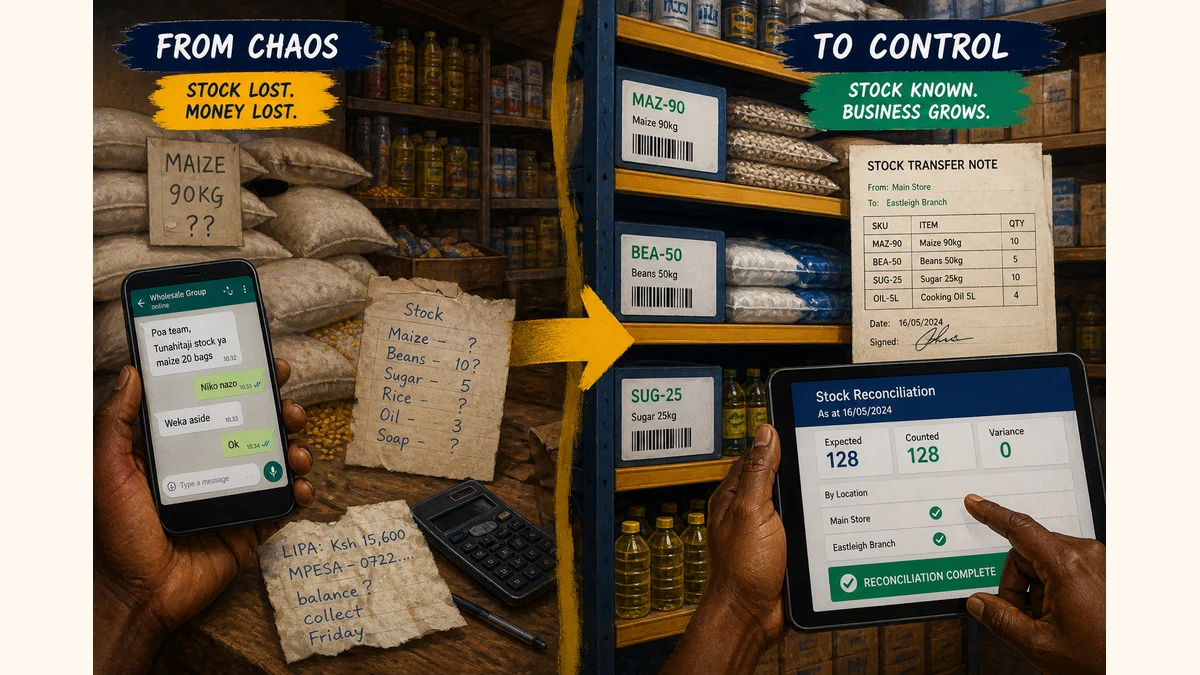
- goods arrive when the storekeeper is absent;
- the owner collects products for personal use;
- a branch requests stock through WhatsApp;
- damaged goods are discarded without approval;
- suppliers deliver quantities different from the original order;
- staff record purchases in kilograms but sell in packets;
- returns are accepted but the original invoice is not referenced;
- payments are made to an agent rather than the named supplier;
- a spreadsheet is overwritten;
- the accountant reconstructs the month several weeks later.
The solution is not to place the entire burden on the accountant. Stock integrity requires coordinated responsibility across Procurement → Receiving → Warehousing → Sales → Finance → Tax → Management.
KRA’s proposed functionality should therefore be approached as an organizational-development challenge, not merely as a software installation.
Who should act first?
Priority lies with businesses that receive, hold, transform or resell goods
- wholesalers and retailers
- agribusiness aggregators
- manufacturers
- supermarkets and mini-markets
- restaurants and hospitality businesses
- pharmacies and medical-supply businesses
- hardware and construction-material dealers
- distributors
- importers
- fuel stations
- e-commerce merchants
- businesses operating several shops or warehouses
- mixed businesses supplying both goods and services
Pure service providers may be assigned systems that do not maintain stock records under the Regulations. But businesses should not self-declare themselves outside the stock requirement merely because services form part of their operations. The applicable eTIMS solution, business model and KRA implementation guidance must be considered.
- A clinic may provide VAT-exempt medical services while also using or selling medicines and consumables.
- A school may provide exempt education while operating a bookstore, uniform shop or catering facility.
- A repair business may primarily provide labour but also install spare parts.
The operating model—not only the industry label—determines the stock questions that must be answered.
A 30-day MSME readiness programme
Prepare evidence without inventing implementation rules
Businesses do not need to wait for the final implementation date before improving their evidence. They should, however, avoid uploading unsupported opening balances or making speculative system changes before KRA issues the detailed implementation instructions.
1.Days 1–7: Define what counts as stock
Create a complete list of products held for resale, raw materials, work in progress, finished goods, packaging, consumables incorporated into sales, consignment stock, branch stock, goods held by agents, and customer goods that must not be treated as business-owned inventory. Assign a responsible owner to each category.
2.Days 8–14: Clean the item master
For each item, define one consistent name, internal SKU, KRA item classification where applicable, purchase/storage/sales units, conversion factor, VAT treatment, location, and whether batch, expiry or serial tracking is necessary. “Maize,” “dry maize,” “90kg maize bag” and “maize stock” should not become four unrelated items.
3.Days 15–21: Establish movement controls
Every stock movement should have a reason code and supporting evidence. Distinguish purchase or receipt, customer return, branch transfer, production consumption, finished-goods production, sale, supplier return, damage, expiry, theft, sample or promotion, owner withdrawal, counting correction and approved write-off. An adjustment should never be used merely to force the system to agree with the desired closing balance.
4.Days 22–30: Reconcile and test retrieval
Select one material product, one supplier, one month, one branch and one major customer sale. Reconstruct Supplier → Purchase → Invoice route → Delivery → Stock-in → Movement → Sale → Stock-out → Payment → Ledger → Closing balance. Measure missing documents, quantity and value differences, unexplained timing gaps, duplicates, unapproved adjustments and retrieval time.
The target is not perfect paperwork. The target is a coherent and credible account of what actually happened.
Stakeholder consultations
Questions businesses should take to the KRA consultations
Stakeholder participation should go beyond asking whether the system is mandatory. These are implementation questions—not arguments against accurate stock records.
- Commencement and transition
- What will be the activation date, pilot period and enforcement transition?
- Opening stock
- How should taxpayers establish opening quantities where historical inventory records are incomplete?
- Valuation versus quantity
- Will the functionality capture quantities only, or will it require inventory values and prescribed valuation methods?
- Existing systems
- How will businesses using ERPs, point-of-sale systems or sector-specific platforms connect without duplicating entries?
- Corrections
- How will late purchase invoices, incorrect units, backdated receipts and stock-count corrections be handled?
- Agribusiness realities
- How will moisture loss, grading differences, aggregation, bulk consolidation and conversion between bags and kilograms be treated?
- Manufacturing
- What level of bill-of-materials, production and yield information will be expected?
- Multi-location businesses
- How will branch transfers, mobile warehouses, agent-held stock and consignment arrangements be recorded?
- Simplified systems
- How will qualifying non-VAT taxpayers and service providers know whether they have been placed on a system without stock records?
- System downtime and connectivity
- What practical fallback will apply where stock is received or sold during an outage?
- Historical errors
- Will taxpayers have a controlled correction or clean-up window before enforcement?
- Data governance
- What information will KRA receive, how frequently will it be transmitted and what access controls will apply?
Well-designed consultation can protect both tax integrity and business continuity.
The ClariFi response
Make the evidence chain visible
ClariFi should not attempt to replace eTIMS, the taxpayer’s accounting system, warehouse application or point-of-sale platform. Its role is the diagnostic, reconciliation and decision layer.
Question 1
Can we identify the goods?
Are the item, quantity, unit of measure, classification and location clear?
Question 2
Can we identify the transaction?
Are the supplier, buyer, invoice, delivery and payment connected?
Question 3
Can we explain the movement?
Can every material stock-in, stock-out, return, transfer and adjustment be accounted for?
Question 4
Can we reconcile the story?
Do purchases, stock movements, cost of sales, revenue and closing stock form a credible whole?
Advisory framework
48-Hour Stock Evidence Test
This advisory framework helps management surface stock-evidence gaps before an audit notice or mandatory system activation. It is not a live ClariFi product score and not a prediction of a KRA assessment.
Answers stay in this browser session only. They are not stored, transmitted or included in analytics.
Answer all eight indicators to see a readiness signal.
The decision to make now
Can you reconstruct the goods, the transaction and the financial position within 48 hours?
Select one material purchase today. Identify the supplier, invoicing route, product and quantity, receiving evidence, payment, stock entry, any subsequent transfer or transformation, the downstream sale, the stock-out, the accounting entry and the closing-stock effect. Where one link is missing, record the exception now. Do not wait for an audit notice, objection deadline or mandatory system activation to discover that the business cannot explain its own commercial history.
VAT-exempt does not mean evidence-exempt. And as KRA operationalises electronic stock management: evidence must now move with the goods.
FAQs
Frequently asked questions
- Has KRA already activated mandatory stock management for every business?
- KRA’s 4 September 2026 notice announces preparation and stakeholder consultations. It does not state a universal activation date. However, the 2024 Electronic Tax Invoice Regulations already contain stock-record obligations for users of applicable systems.
- Does the requirement apply to VAT-exempt businesses?
- VAT exemption concerns the tax treatment of the supply. It does not eliminate the need to maintain evidence supporting the nature, quantity, purchase, movement and sale of goods. The applicable stock functionality will depend on the business and the system prescribed by KRA.
- Should a business upload estimated opening stock immediately?
- A business should prepare a reconciled opening-stock position, document assumptions and obtain internal approval. It should not invent quantities or make unsupported uploads before understanding the final KRA implementation instructions.
- Does an eTIMS invoice prove that the stock existed?
- It proves that an electronic invoice containing specified transaction information was generated and transmitted. Supporting records may still be required to demonstrate receipt, movement, payment, delivery and reconciliation.
- Can an existing ERP or point-of-sale system integrate with eTIMS?
- KRA provides system-to-system integration through OSCU and VSCU for businesses with existing invoicing or ERP systems. Integration is subject to the applicable technical and certification processes.
ClariFi decision support
Run the 48-Hour Stock Evidence Test
Turn stock gaps into a retrievable evidence trail
ClariFi helps MSMEs map gaps between Supplier → Purchase → Receipt → Stock → Sale → Payment → Ledger. The review identifies unsupported opening stock, unmatched purchases, negative-stock exposure, undocumented transfers, unexplained adjustments, missing delivery evidence, unit-of-measure inconsistencies and purchase-to-stock-to-sale reconciliation gaps. ClariFi is not a substitute for eTIMS, accounting software or advice from a qualified tax professional. KAN Consultants provides professional tax review where interpretation, assessment exposure or objection strategy is required.
KAN Consultants can review stock-evidence exposure and documentation design.
Map gaps between purchases, stock movements, sales and ledgers with a structured Fix Sprint.
The invoice is not the transaction. Reconstruct the goods — then the numbers become defensible.
Primary sources
- Kenya Revenue Authority public notice on implementation of stock-management functionality, 4 September 2026 — accessed 2026-09-04
- Tax Procedures (Electronic Tax Invoice) Regulations, 2024 — accessed 2026-09-04
- KRA eTIMS overview and system-to-system integration guidance — accessed 2026-09-04
- Yarde Park Lounge Ltd v Commissioner for Domestic Taxes [2026] KETAT 308 (KLR) — accessed 2026-09-01
- ClariFi, “VAT-Exempt Does Not Mean Evidence-Exempt.” — accessed 2026-09-07