
ClariFi
Financial intelligence and decision support for Kenyan MSMEs.
- Educational commentary
- Family finance
- Telephone farming
- Kenya
- Illustrative scenario
Illustrative household
A salary in Nairobi, cows at home, and several meanings of help

Imagine a daughter working in Nairobi. Each month she sends money for dairy feed and veterinary care. Her mother manages the cows at home. A brother helps source fodder or arrange transport when the bicycle or matatu timing fails. Some milk is sold. Some is consumed at home. Some is shared with a neighbour who assists the household.
This scene is fictional. It is offered as a teaching mirror for arrangements many Kenyan families recognise, not as a claim about one verified household.
Ask the questions that money alone cannot answer. Who owns the cows? Who provides capital? Who performs the daily work? Who decides how the proceeds are used? What does each participant believe the arrangement means?
An urban sponsor is not automatically the landowner or the employer. Rural relatives contribute land access, labour, knowledge, care and relationships. They are not passive dependants waiting for instructions from town. In many families, earlier farm earnings helped finance the urban relative’s education. Research in particular settings documents that pattern. It is not a universal Kenyan experience, and families vary by gender, generation and region.
Reciprocity often travels both ways. Money may move toward the rural household. Food, care, accommodation and a place to return to may support urban relatives. Samuel O. Owuor's research in Nakuru showed that urban-rural linkages are not only about remittances flowing to the countryside. Poor urban households may also draw livelihood support from rural sources.
Are we supporting a household, financing a viable farm, building a family asset, or doing several of these at once?
Those are legitimate objectives. They require explicit agreement and different measures of success.
Context from published research
Family farming sits inside livelihoods, not only inside farm accounts
In Edward Ontita’s study of livelihoods in Nyamira, villagers moulded tea and related resources in socially embedded ways. Tea earnings could support children’s education, cattle and land. Success, as some patriarchs described it, included whether grown children remained respectful and supportive. Sharing and intergenerational responsibility were part of how livelihood itself was evaluated.
Ontita also observed that remittances and formal employment could reshape the rural landscape, including opportunities linked to dairy farming and napier grass. Those findings belong to a particular research setting and period. They offer interpretive context, not a national prevalence estimate for telephone farming today.
Sibel Kusimba and colleagues, writing about mobile-money hearthholds in western Kenya, show small, frequent transfers within kin networks. Families use those transfers for food, medical care, school fees, emergencies, ceremonies and negotiations around farming, education and migration. Senders are often also receivers. Money follows, and strengthens, existing relationships of care.
Telephone farming, in everyday Kenyan speech, names the urban relative who funds or directs farm work from a distance. The phrase can sound comic. The underlying arrangement is serious. It joins salary, land, labour, obligation and hope across households.
Older studies provide historical and interpretive context from particular research settings. They are not current nationwide prevalence estimates for telephone farming or remittance patterns.
Why clarity is difficult
Family farming can be hard to measure because the purpose is often unspoken

“Help Mum buy a cow” may be understood as a gift, a loan, a shared investment or livelihood support. If the family never names which one, later disagreement is almost guaranteed.
Paying for inputs does not by itself establish ownership or entitlement to all proceeds. Title, customary practice, contribution history and prior promises all matter. An African relational perspective treats reciprocity, dignity and negotiated obligation as real economic facts, not soft decorations around the “real” numbers.
Unpaid family labour still involves time and economic sacrifice. A mother who wakes for milking is contributing value even when no wage appears in a cash book. Produce consumed at home has value without generating cash receipts. Sharing milk or maize can fulfil agreed family or community obligations.
Household emergencies may redirect funds that were meant for feed or fertiliser. Context and prior agreements matter before anyone assigns blame. Late funding or unrealistic instructions from town can undermine performance as surely as poor fieldwork. Buyer, processor, transport and payment delays should not automatically be blamed on relatives.
Repeated financial support can sustain a valuable household activity while concealing a commercially weak enterprise. Both truths can coexist. The family needs language for each.
- Gift, loan, shared investment and livelihood support are different agreements.
- Input payments do not automatically equal ownership of animals, land or proceeds.
- Unpaid labour has economic cost even when no wage is paid.
- Home consumption and gifts belong in a quantity-and-benefit record, not as fake cash sales.
- Commercial self-sufficiency and household support need different success measures.
Across value chains
Dairy, tea, coffee and sugar cane ask related questions on different clocks
Urban and rural contributions change by crop, but the financial discipline is similar: separate what each person contributed, what was produced, what cash moved, and what remains unresolved. Cash cycles differ. A daily milk record and a seasonal crop account cannot be interpreted identically.
| Crop | Possible urban contribution | Rural contribution | Evidence worth keeping | Financial question to resolve |
|---|---|---|---|---|
| Dairy | Feed, veterinary care, transport or equipment support | Daily animal care, milking, local buyer relationships, land and housing access | Feed and vet payments, milk produced, milk sold, milk consumed at home, milk shared, collections received | Is family money covering a temporary gap, or a recurring commercial shortfall? |
| Tea | Maintenance labour support, tools, emergency cash between payments | Plucking, weeding, delivery to the buying centre, leaf quality discipline | Maintenance days, plucking volumes delivered, statements, deductions and actual payments received | Do delivery weights and deductions explain the cash that finally arrives? |
| Coffee | Seasonal inputs, picking labour support, transport at peak | Orchard care, cherry harvest, delivery coordination, cooperative membership work | Seasonal expenditure, cherry deliveries, statements and outstanding proceeds | Which costs belong to this season, and which proceeds are still outstanding? |
| Sugar cane | Establishment and maintenance funding, harvest coordination cash | Field maintenance, harvest labour arrangements, delivery logistics | Establishment and maintenance costs, harvest coordination notes, delivery weights, deductions and payment timing | Can the family wait for the payment cycle without confusing delay with farm failure? |
The table uses illustrative categories only. It does not invent current prices, yields, statutory deductions or standard payment schedules.
Teaching illustration
A positive cash balance can still hide an operating shortfall
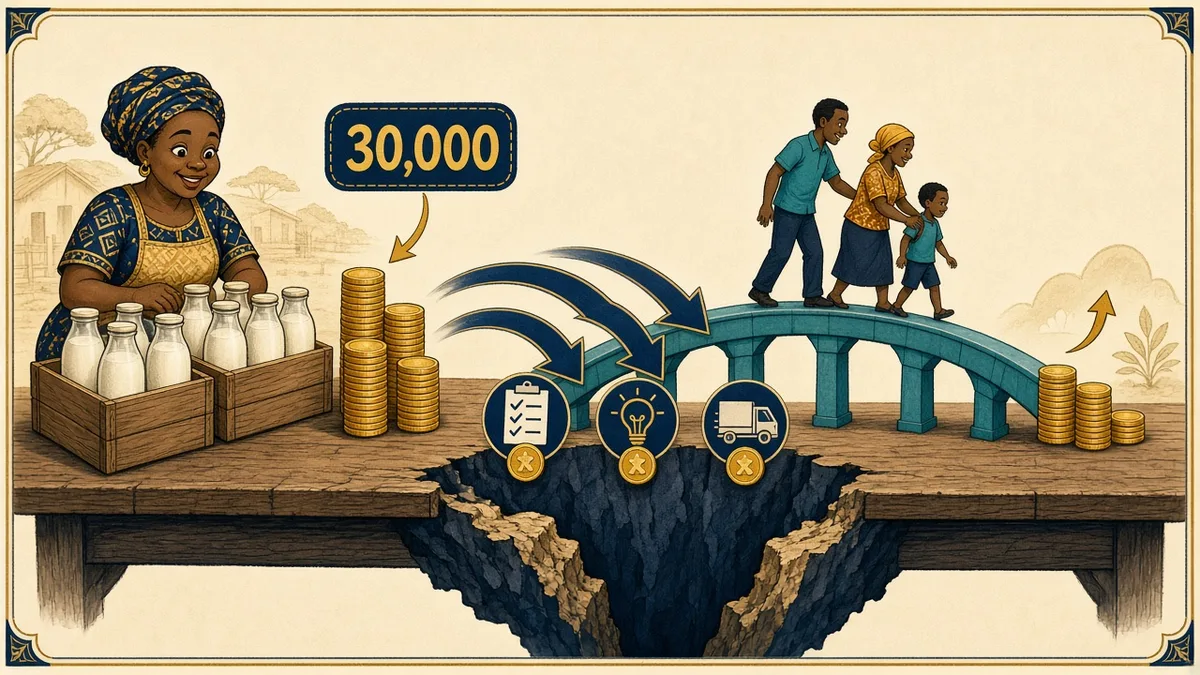
Consider one fictional monthly dairy example. It is a teaching illustration, not a profitability benchmark and not a claim about average Kenyan dairy returns.
- All milk sales listed are collected during the month.
- All listed operating costs are paid during the month.
- Capital purchases, debt repayments, interest and tax are excluded to keep the illustration narrow.
- Unpaid labour, depreciation and other omitted costs would be needed for a fuller profitability assessment.
- Household milk consumption and gifts are kept in a separate quantity-and-benefit record. They are not added to cash receipts, and the same milk is not counted twice.
| Monthly cash item | KES |
|---|---|
| Opening cash | 0 |
| Cash received from milk sales | 30,000 |
| Family funding received | 20,000 |
| Direct operating cash payments | 42,000 |
| Closing cash | 8,000 |
Total cash available after payments: 30,000 + 20,000 − 42,000 = KES 8,000
Operating cash shortfall before family funding: 30,000 − 42,000 = negative KES 12,000
The positive closing cash balance does not establish profitability or self-sufficiency. Family funding covers the operating shortfall.
Do not call family funding sales revenue. Its treatment depends on the agreed arrangement and on the entity’s circumstances. This article does not give definitive tax, ownership or legal advice.
Two legitimate decisions remain available. The family may continue an agreed, affordable household-support arrangement. Or it may change the enterprise if commercial self-sufficiency is the objective. Clarity begins when those aims are named rather than implied.
Suggested separate record: litres produced, litres sold, litres consumed at home, litres shared or lost. Keep that record beside the cash book, not inside it as invented sales.
For the wider distinction between cash and profit, see Profit Is an Achievement. Cash Keeps the Doors Open.
Evidence, then money
What ShambaBoy describes, and what financial clarity still asks
Activity evidence → reconciled financial records → shared understanding → next decision
According to ShambaBoy’s public materials, the platform presents itself as agricultural verification infrastructure for commercial farming in Kenya. Public pages describe task evidence that can include photographs, GPS, timestamps, worker identity and supervisor approvals. They also describe offline capture with later sync, portable worker work histories, and a farm-level ShambaScore.
ShambaBoy’s ShambaScore page describes ShambaScore as an operational performance measure built from verified field activity. It states that ShambaScore is not a credit score and is not used for lending decisions. This article preserves that distinction. Public marketing elsewhere may speak about farms becoming more legible to finance, buyers or partners. That is ShambaBoy’s published positioning. It is not independent verification, and it is not a promise of financing, certification, fraud prevention or profitability.
The capabilities above are attributed to ShambaBoy’s published website descriptions. This article does not claim hands-on testing or independently verified results.
Operational records can help establish what happened in the field. Financial clarity helps the family understand what it cost, who benefited, what support remains necessary and what to do next.
ClariFi’s financial-intelligence perspective asks what records imply for cash, margins, funding needs and priorities. That is decision support for business finances. It is not a strategic pivot into farm management software, and it is not agronomic advice.
There is no claimed ShambaBoy-ClariFi partnership or integration in this article. There is no automatic data exchange, no assumed export compatibility, and no existing ClariFi family-farming module being announced here. Shared records are first a practical discipline. Families can begin with a notebook or spreadsheet. Any proposed software feature mentioned below is a suggestion, not a shipped product claim.
Suggestion only: a shared monthly pack that places verified task summaries beside cash received, cash spent, quantities produced and outstanding payments. The value is the conversation that pack makes possible, not a promise that software dissolves disagreement.
- Neither platform resolves family disputes by itself.
- Neither replaces agronomic expertise.
- Neither guarantees that a farm becomes profitable because records improve.
Related reading on evidence discipline in agribusiness: Josh’s agribusiness reverse-invoicing case. On household-business blur in trading: Mama Mboga cash flow.
A practical rhythm
A short monthly family review

Better records should help families discuss farming with greater fairness and clarity. Accountability here means agreed visibility, not constant surveillance of relatives. Consent, proportionate records and agreed access matter.
- What did each person contribute?
- What was produced, sold, consumed, shared or lost?
- What money was received, spent or remains outstanding?
- What support is needed next, and when?
- What one action has been agreed, by whom and by what date?
Where the money question is household support rather than commercial farm P&L, ClariFi’s Family toolkit can help separate household budget, school fees, events and goals from the farm cash notes. It does not replace the farm conversation above.
Open the Family toolkit for household budget, school fees, events and goals, then return to the farm cash notes with clearer boundaries.
Telephone farming will remain part of Kenyan family life for as long as land, labour and urban wages remain connected.
The fairer question is not whether love should stop at the farm gate. It is whether the family can say, without shame or accusation, what the money is for and how success will be recognised.
Sources
References
Sources reviewed on 2026-10-02.
- ShambaBoy, Agricultural verification infrastructure (public site) · accessed 2026-10-02
- ShambaBoy, Frequently Asked Questions · accessed 2026-10-02
- ShambaBoy, ShambaScore (operational performance score) · accessed 2026-10-02
- E. Ontita, Creativity in everyday practice: resources and livelihoods in Nyamira, Kenya (Wageningen University, 2007) · accessed 2026-10-02
- Samuel O. Owuor, Migrants, urban poverty and the changing nature of urban-rural linkages in Kenya (Development Southern Africa, 2007) · accessed 2026-10-02
- Sibel Kusimba, Yang Yang and Nitesh V. Chawla, Hearthholds of mobile money in western Kenya (Economic Anthropology, 2016) · accessed 2026-10-02
This article is educational commentary. It is not legal, tax, accounting, agronomic or investment advice. Ownership, funding treatment and tax consequences depend on facts, agreements and current law. Confirm material decisions with qualified professionals where needed.
ClariFi provides financial intelligence and decision support. It does not manage farms, certify agricultural practice, file tax returns, guarantee compliance or produce statutory financial statements. ShambaBoy capabilities are described from that platform’s public materials and are not independently verified here.
Older studies provide historical and interpretive context from particular research settings. They are not current nationwide prevalence estimates for telephone farming or remittance patterns.
ONE CLEARER NEXT STEP
Start with a clearer picture of your business finances.
ClariFi is financial intelligence and decision support for Kenyan MSMEs. It helps organise what money came in, what left, and what decision comes next. It does not measure family relationships or deliver a specialised farm assessment.
If your pressure is cash timing, collections or funding need, begin with the free Financial Decision Check. If the money question is household support, school fees or shared goals, open the Family toolkit.
A business-finance starting point, not a family-relationship score or agronomic audit.