ClariFi
Financial intelligence and decision support for Kenyan MSMEs.
- Educational commentary
- MSME Strategy
- Cost & Margin
- Kenya
Direct answer
Is cost-cutting a business strategy?
No. Cost-cutting is a tactic. Strategy decides where you compete, how you create value, and which capabilities you must protect or build. Cost discipline matters, but expenditure has a mathematical floor of zero, while revenue, capability and customer value have no equivalent predetermined ceiling.
Educational commentary
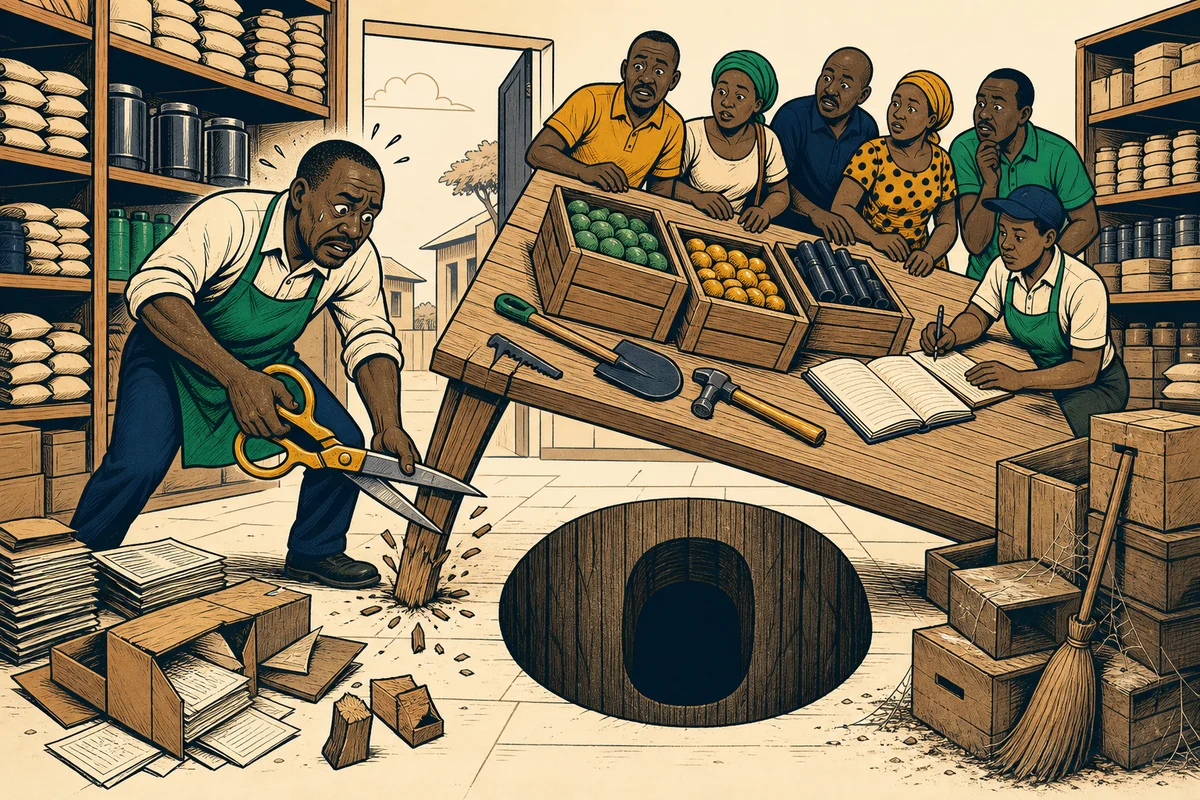
Opening scene: the lighter till, the thinner business
Late one evening in a Nairobi workshop, the owner stares at a thin till balance and begins the familiar arithmetic of survival: switch off one machine, shorten staff hours, buy cheaper inputs, pause customer acquisition. By month-end the expense line looks lighter. The business feels thinner too.
Composite scene based on common Kenyan MSME cash-pressure responses; not a verified ClariFi customer case.
Managers under pressure often attack costs first because costs are visible, internally controllable, and move the accounts faster than winning a new customer or rebuilding a distribution habit. The arithmetic is familiar: Profit = Revenue − Costs. The strategic incompleteness is less obvious.
Reduce the cost line and profit can rise on paper, even while the enterprise loses the ability to earn. That is the fallacy of treating cost-cutting as strategy: confusing a controllable input with a theory of how the business creates value.
A business can become cheaper and still become weaker.
The comforting arithmetic
Why the cost line feels like the only lever
Revenue growth requires customers, capability and time. Cost reduction can appear on the next statement. Under cash pressure, the faster lever wins attention, even when it is the wrong primary strategy.
The familiar equation
Profit = Revenue − Costs
The profit equation is mathematically correct: Profit = Revenue − Costs. Nothing in this essay argues against disciplined spending. Waste drains cash. Vanity subscriptions, idle stock and duplicated processes deserve removal.
The trap is different. When every hard month is answered with another indiscriminate cut, management begins treating the cost floor as a destination. Costs can theoretically approach zero. A functioning enterprise cannot. Productive capability, service quality, reliable inputs, sales capacity, employee knowledge, supplier resilience, customer trust, operating data, innovation, and basic controls, has a practical floor that arrives long before the accounting line hits zero.
The floor of expenditure is zero. The floor of capability may arrive much sooner.
- A business can become cheaper and still become weaker.
- The floor of expenditure is zero. The floor of capability may arrive much sooner.
- You cannot shrink your way into a compelling customer proposition.
The zero-cost trap
When cutting begins to consume the earning engine
Repeated cuts eventually consume the capabilities that produce revenue. Once waste is gone, further cutting is no longer hygiene, it is amputation.

Emergency reductions can buy time in a liquidity crisis. Persistent inefficiency should not be protected in the name of growth. Those truths coexist with another: indiscriminate cuts can destroy customer experience, employee capability, innovation, distribution, data quality and future revenue.
A reinforcing decline is easy to recognise after the fact. Revenue pressure triggers indiscriminate cuts. Cuts reduce capability. Reduced capability weakens the customer experience. Customers leave or buy less. Revenue falls further. Management responds with another round of cuts.
Capability at risk
- Service quality and response times
- Product reliability and input standards
- Sales capacity and customer acquisition
- Employee knowledge and coverage
- Supplier resilience and payment discipline
- Customer trust and repeat purchase
- Operational data and control hygiene
- Innovation and process improvement
- Compliance and internal controls
The reinforcing decline
- Revenue pressure triggers indiscriminate cuts
- Cuts reduce capability
- Reduced capability weakens the customer experience
- Customers leave or buy less
- Revenue falls further
- Management answers with another round of cuts
Language that keeps decisions honest
Cost-cutting is not the same as cost control, or strategy
Serious operators separate tactics from strategy. Mixing the words produces mixed decisions.
- Cost-cutting
- Removing expenditure, often quickly, sometimes indiscriminately.
- Cost control
- Keeping necessary spend within rules, budgets and visibility.
- Cost optimization
- Redesigning how outcomes are achieved so the same (or better) result costs less.
- Productivity improvement
- Raising output or quality per shilling or per hour without hollowing capability.
- Capital allocation
- Choosing where scarce cash and attention go, including what to protect.
- Growth investment
- Deliberate spend expected to create measurable future revenue, learning or differentiation.
The Cost-to-Capability Test
Not every cost deserves the same decision
Classify expenditure before you cut it. The same line item can be leakage in one business and growth infrastructure in another.
| Cost category | Strategic question | Likely action |
|---|---|---|
| Leakage and waste | Does this create any customer, control or strategic value? | Eliminate |
| Inefficient activity | Can the same outcome be achieved more effectively? | Redesign or automate |
| Operating hygiene | Is this necessary for reliable and compliant operations? | Control |
| Core capability | Does this protect the customer promise or earning engine? | Defend |
| Growth investment | Can this create measurable future revenue, learning or differentiation? | Test and selectively increase |
Marketing with no measurement may be leakage; a tracked acquisition channel may be a growth capability. Technology no one uses may be waste; reliable transaction data may be essential infrastructure.
Leakage and waste
Question: Does this create any customer, control or strategic value?
Action: Eliminate
Inefficient activity
Question: Can the same outcome be achieved more effectively?
Action: Redesign or automate
Operating hygiene
Question: Is this necessary for reliable and compliant operations?
Action: Control
Core capability
Question: Does this protect the customer promise or earning engine?
Action: Defend
Growth investment
Question: Can this create measurable future revenue, learning or differentiation?
Action: Test and selectively increase
- Marketing with no measurement may be leakage; a tracked acquisition channel may be a growth capability. Technology no one uses may be waste; reliable transaction data may be essential infrastructure.
From scissors to lens
Five actions for every material expense
Financial intelligence replaces the oversized scissors with a clearer decision: eliminate, redesign, control, defend, or invest.

Exchange the scissors for a decision lens
- 1
Eliminate
No value to customer, control or strategy.
- 2
Redesign
Same outcome, better method or lower cost.
- 3
Control
Necessary hygiene, keep visible and within rules.
- 4
Defend
Protect the customer promise and earning engine.
- 5
Invest
Test spend that creates measurable future value.
Illustrative scenario
Kamau Distributors, Industrial Area
Two responses to the same margin pressure can both “reduce costs” and still produce opposite businesses.
Illustrative scenario, not a verified customer case
Assume a fictional Nairobi distributor with monthly revenue of KES 2,400,000, cost of goods sold at 70% (KES 1,680,000), contribution of KES 720,000, operating expenses of KES 540,000, and operating profit of KES 180,000.
Pressure arrives from returns on one product line, slow-moving SKUs tying up cash, and a supplier term that quietly erodes margin. Management must respond within thirty days.
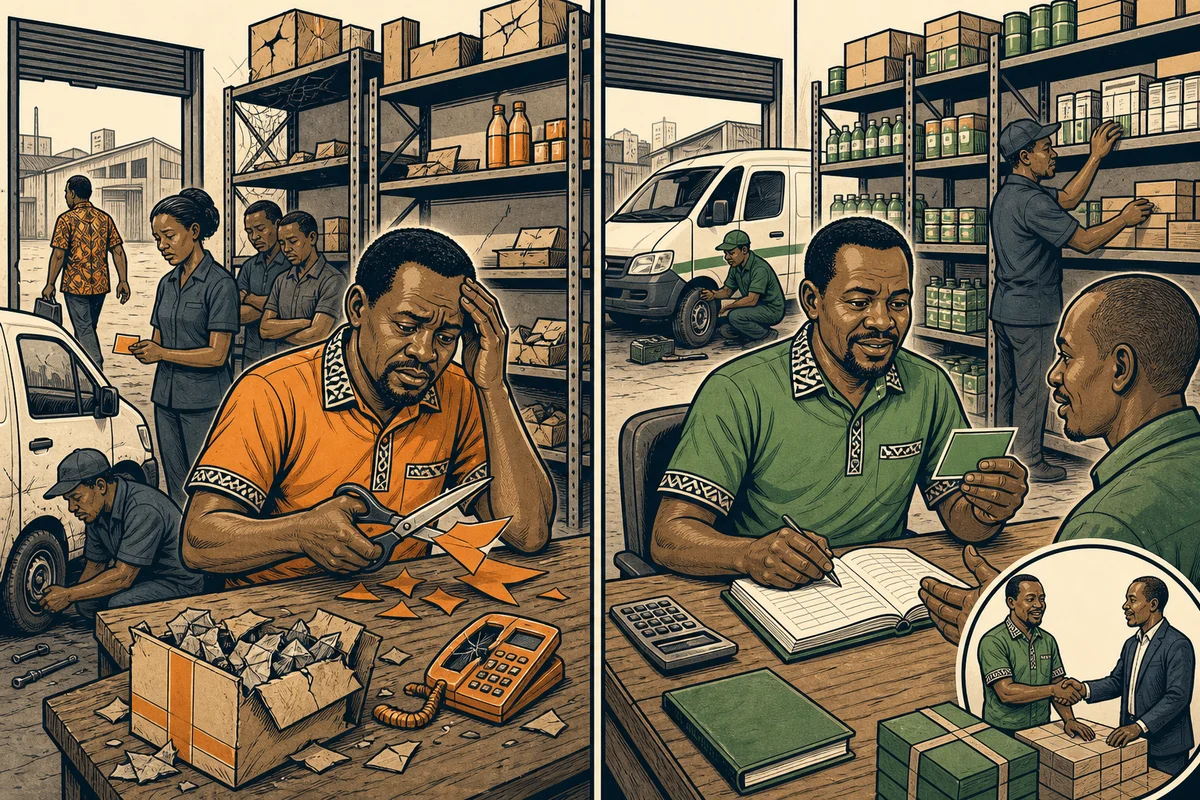
Blanket-cut response
- Cut frontline sales hours (−KES 70,000)
- Switch to cheaper, less reliable inputs (−KES 45,000 on paper)
- Cancel outbound sales activity (−KES 35,000)
- Defer van maintenance (−KES 30,000)
Immediate: Month-1 operating expenses fall by KES 180,000 to KES 360,000. If revenue held, operating profit would jump to KES 360,000.
Later: In months 2–3, assume revenue softens 12% to KES 2,112,000 as coverage and acquisition pause, while cheaper inputs lift the COGS ratio to 73% (KES 1,541,760). Contribution falls to KES 570,240. With opex still at KES 360,000, operating profit is KES 210,240, still above the original KES 180,000 on paper, yet the business is slower, less reliable, and harder to grow. The expense line improved; the earning engine did not.
Financial-intelligence response
- Renegotiate the uneconomic supplier term (estimated monthly margin recovery KES 35,000)
- Clear slow-moving inventory to free cash (one-time cash release; ongoing holding-cost relief ~KES 15,000/month)
- Correct underpricing on two SKUs (estimated monthly contribution +KES 25,000)
- Tighten collections on overdue accounts (cash timing, not profit, but runway improves)
- Protect delivery reliability and frontline coverage
- Redeploy KES 40,000 of verified monthly savings into a measured acquisition test
Result: Verified structural savings of about KES 95,000 per month before redeployment; after investing KES 40,000 in a tracked acquisition test, net monthly cost relief is about KES 55,000 while the customer promise stays intact. Profit improves because leakage and underpricing were addressed, not because the earning engine was hollowed out.
The objective is not minimum expenditure. It is maximum sustainable value created per shilling deployed.
Before the next cut
Is your pressure cash, margin, working capital, or finance readiness?
A free Financial Decision Check helps separate a genuine cost leak from a productive expense, and cash-timing pressure from margin deterioration, so you cut the right thing.
When cutting is justified
Cost reduction has a place, inside a wider thesis
Respect owners under real financial pressure. Some cuts are necessary. Necessary cuts still need a theory of customers, revenue, cash, capability and future positioning.
- Immediate insolvency risk or a severe cash-runway problem
- A cost with no defensible link to customer value, compliance or capability
- Clear duplication, vanity spending or process waste
- Demand that has permanently changed
- A business model that must be simplified
- Technology or process redesign that preserves the outcome at lower cost
Even then, cutting is a tactic inside a turnaround, not a substitute for strategy. You cannot shrink your way into a compelling customer proposition.

From cutting to reallocation
Serious strategy asks more than “What can we remove?”
Released cash should be redeployed deliberately, toward protected capability, redesign, or measured growth, not merely celebrated as a thinner expense line.
- What must we protect?
- What should we redesign?
- Where are we underinvesting?
- Which customer problem can we solve better?
- Which expenditure generates measurable learning?
- Where should released cash be redeployed?
A practical weekly sequence
- Establish the cash and margin baseline
- Find the largest material leakage
- Test its relationship to customer value and operating capability
- Choose one action: eliminate, redesign, control, defend or invest
- Assign an owner and deadline
- Measure the financial and operational result
- Reinvest verified savings deliberately
The ClariFi perspective
Sense → Diagnose → Decide → Act → Learn
ClariFi is an MSME financial-intelligence and decision-support platform. It helps connect signals from sales, expenses, M-Pesa, POS, stock and bank data and turn them into prioritised decisions, one clear next move, not another unexplained dashboard.
A weekly decision rhythm helps an owner distinguish a genuine cost leak from a productive expense; falling sales from rising unit costs; margin deterioration from cash-timing pressure; slow stock from essential stock; and temporary savings from sustainable productivity improvement.
That rhythm is the product promise behind ClariFi Control: sense what is changing, diagnose the driver, decide one action, act, then learn from the result. Cost discipline becomes capital allocation, not a monthly amputation contest.
Related: Financial management for MSMEs, Cash-flow management solutions, ClariFi Control.
Growth requires a theory of value
Cut waste. Protect capability. Reallocate with intent.
Waste should be removed. Productive expenditure should be measured. Critical capability should be protected. Verified savings should be reallocated. Growth requires a theory of how the enterprise creates value.
You can only cut costs to zero. Long before reaching zero, however, you may cut away the capability that made customers choose you. The better question is not, “How little can we spend?” It is, “How intelligently can we convert each shilling into enduring value?”
FAQ
Frequently asked questions
Is cost-cutting a business strategy?
No. Cost-cutting is a tactic for changing the expense line. Strategy decides where the enterprise will compete, how it will create value, and which capabilities it must protect or build. Cost discipline supports strategy; it does not replace it.
When should a small business reduce costs?
When facing insolvency or a severe cash-runway problem; when a cost has no defensible link to customer value, compliance or capability; when duplication or vanity spend is clear; when demand has permanently changed; or when redesign can preserve the outcome at lower cost. Even then, cuts should sit inside a wider turnaround thesis.
Which costs should an MSME cut, protect or increase?
Use a Cost-to-Capability Test: eliminate leakage and waste; redesign inefficient activity; control operating hygiene; defend core capability that protects the customer promise; and selectively increase growth investments that create measurable future revenue or learning.
Why can lower expenditure still produce a weaker business?
Because costs can fall while capability falls faster. Cheaper inputs, thinner coverage and paused acquisition can improve the expense line and still weaken service, reliability, trust and future revenue. A business can become cheaper and still become weaker.
How can financial intelligence improve cost decisions?
By connecting sales, expenses, M-Pesa, POS, stock and bank signals so owners can separate genuine leaks from productive expenses, margin problems from cash-timing pressure, and temporary savings from sustainable productivity, then choose one prioritised next move.
ONE PRIORITISED NEXT MOVE
Find whether your pressure is cash, margin, working capital, or readiness.
ClariFi helps connect sales, expenses, M-Pesa, POS, stock and bank signals into a clearer weekly decision. It does not promise automatic profit.
Start with the free Financial Decision Check. If you want assisted structure for thirty days, explore a Fix Sprint. For an ongoing weekly rhythm, see ClariFi Control.
No checkout required, identify the pressure before you cut.