ClariFi
Financial intelligence and decision support for Kenyan MSMEs.
- SME Intelligence
- Kenya MSME
- From Data to Decisions
The Illusion of Entrepreneurship
Walk through any major town in Kenya and you will encounter thousands of entrepreneurs. Or so it seems.
Some own taxis. Some own boda bodas. Some own salons. Some own retail kiosks. Some own butcheries. Some own hardware stores.
Ask them what they do and almost everyone replies: “I run my own business.” But do they?
This question sits at the heart of one of the most influential business frameworks popularized by Robert Kiyosaki's Cashflow Quadrant. While the framework has inspired millions, the lived reality of entrepreneurship in Kenya reveals an important distinction: many people own assets, yet remain trapped in self-employment.
The issue is not effort. It is management.
Looking Through the Lens of Digital Ethnography
Traditional business research often relies on surveys and financial reports. At ClariFi, we complement these methods with digital ethnography and platform analytics.
Rather than asking entrepreneurs what they do, we observe how they actually operate through:
- Daily financial transactions
- Operational workflows
- Cash movement
- Customer interactions
- Decision patterns
- Digital platform behavior
These observations uncover what entrepreneurs experience in practice rather than what they aspire to achieve.
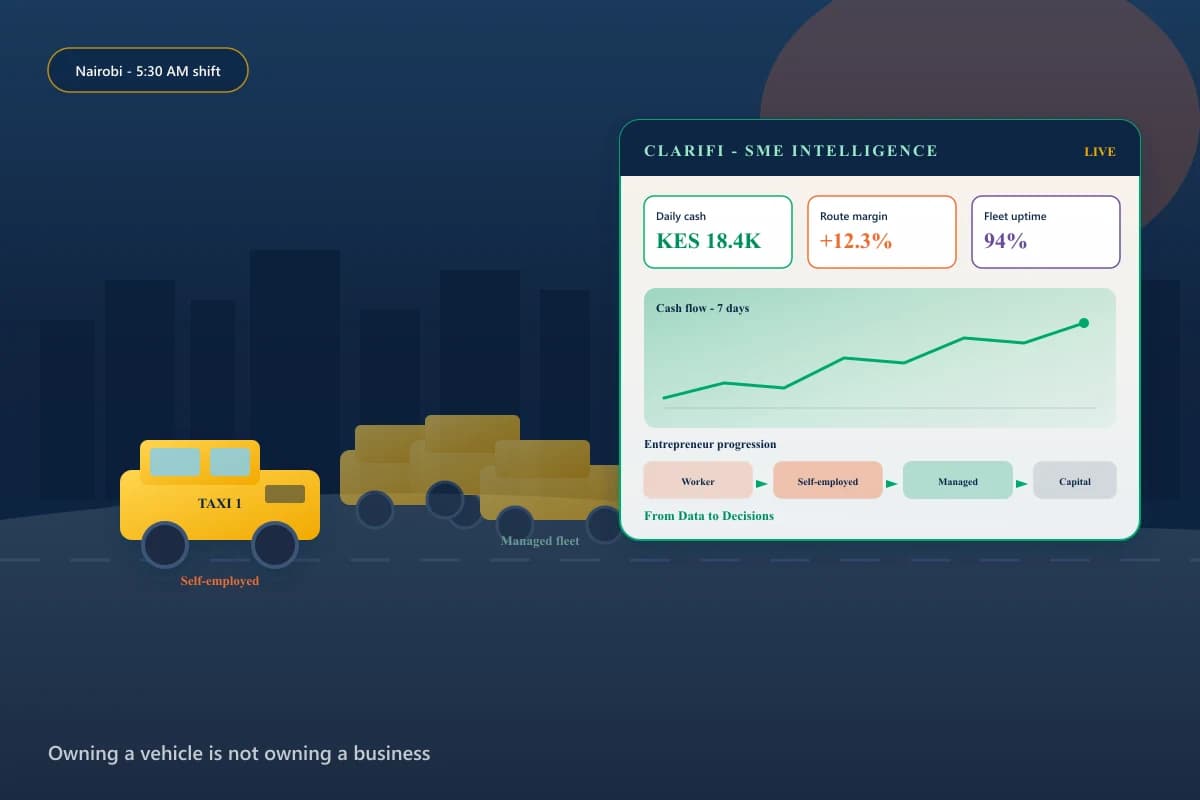
Meet David, a Nairobi Taxi Owner
David owns one taxi. He leaves home at 5:30 a.m. His day revolves around:
- Fueling the vehicle
- Finding customers
- Avoiding traffic
- Negotiating fares
- Servicing loan repayments
- Paying for repairs
- Supporting his family
- Hoping tomorrow is as good as today
If David takes a day off, the business earns nothing.
If he falls ill, revenue stops.
If the vehicle breaks down, cash flow collapses.
David owns a vehicle. But does he own a business?
Understanding the Cashflow Quadrant
Robert Kiyosaki divides income generation into four broad categories. In mature economies, entrepreneurs are often encouraged to move progressively from employee to investor — assuming access to affordable finance, structured markets, predictable regulation, insurance, reliable contracts, and scalable systems.
| Quadrant | Mindset | Primary Source of Income |
|---|---|---|
| Employee | Security | Salary |
| Self-Employed | Independence | Personal effort |
| Business Owner | Systems | Business operations |
| Investor | Wealth creation | Investments and assets |
The Kenyan Reality Is Different
For many Kenyan entrepreneurs, the journey looks more like a survival loop than a quadrant climb. Growth is continually interrupted by survival.
This is not because entrepreneurs lack ambition. It is because they lack management intelligence.
- 1Need Employment
- 2Buy One Asset
- 3Work Longer Hours
- 4Generate Daily Cash
- 5Meet Household Needs
- 6Unexpected Expense
- 7Business Capital Shrinks
- 8Repeat Tomorrow
The Difference Between Owning Work and Owning a Business
Imagine two taxi owners.
Owner A: The Self-Employed Taxi Owner
- Owns one vehicle
- Drives every day
- Keeps records mentally
- Measures success by daily cash collected
- If the owner stops working, income stops
This is self-employment.
Owner B: The Managed Enterprise Owner
Owner B owns twenty vehicles. The business has:
- Digital booking
- Route analytics
- Preventive maintenance
- Cash-flow forecasting
- Driver performance dashboards
- Customer retention programs
- Financial reporting
The owner focuses on strategy rather than daily operations. Income continues even when the owner is away.
This is a business.
The shift
From self-employment to managed enterprise
The difference is not simply the number of vehicles. It is the presence of systems.
Self-employed
Self-Employed Taxi Owner
Owns the vehicle and the shift. Income stops when the owner stops.
- Owns one vehicle
- Drives every day
- Keeps records mentally
- Measures success by daily cash collected
- If the owner stops working, income stops
Business owner
Managed Enterprise Owner
Systems run daily operations. Income continues when the owner is away.
- Digital booking and route analytics
- Preventive maintenance schedules
- Cash-flow forecasting
- Driver performance dashboards
- Customer retention programs
- Financial reporting — owner focuses on strategy
Investor mindset
Capital Owner
Owns scalable assets and investments — wealth compounds beyond daily labour.
- Portfolio of vehicles, routes, or mobility assets
- Capital allocation and risk management
- Partnerships, financing, and expansion strategy
- Returns measured on assets — not hours worked
“Owning an asset is not the same as owning a system.”
What Digital Ethnography Reveals
Through observing SMEs across sectors, several recurring patterns emerge. Across industries, the pattern is remarkably consistent.
| Behaviour Observed | Hidden Problem |
|---|---|
| Daily cash shortages | Poor cash-flow planning |
| Constant borrowing | Weak working capital management |
| High sales but low profits | No profitability analysis |
| Frequent breakdowns | Reactive maintenance |
| Owner overwhelmed | No operational systems |
| Growth stagnation | Decisions based on instinct rather than evidence |
The Missing Link: Management Intelligence
Many conversations about African entrepreneurship focus on financing. Finance matters — but financing poor decisions only accelerates failure. What SMEs need first is clarity.
Management intelligence answers questions such as:
- Which customers generate the highest margins?
- Which service routes are most profitable?
- Which assets consume excessive operating costs?
- When should maintenance occur?
- How much working capital is actually required?
- Is expansion financially sustainable?
These are management questions before they are financing questions.
From Data to Decisions
At ClariFi, we believe that sustainable business growth begins with better decisions. Every invoice, receipt, transaction, customer interaction, and operational activity is a piece of evidence. When connected, these data points become actionable intelligence.
Before
“How much money did I make today?”
After
- “Why did I make it?”
- “Can I repeat it?”
- “Can I scale it?”
That shift changes everything.
Rethinking progression
The African Cashflow Quadrant
Based on observations of SMEs across Kenya, a more representative entrepreneurial progression may look like this. The critical transition is not from owning one asset to owning many — it is from managing activities to managing intelligence.
Worker
Earn an income
Self-Employed
Create daily cash flow
Managed Enterprise
Build systems and processes
Capital Owner
Own scalable assets and investments
| Stage | Primary Focus |
|---|---|
| Worker | Earn an income |
| Self-Employed | Create daily cash flow |
| Managed Enterprise | Build systems and processes |
| Capital Owner | Own scalable assets and investments |
Lessons Beyond the Taxi Business
The taxi story is not really about taxis. It is about every entrepreneur who believes ownership alone creates wealth. Whether you operate a retail shop, medical practice, manufacturing business, consultancy, logistics company, restaurant, or online store, the same principle applies.
Without systems, your business depends on you.
With systems, your business begins to work for you.
The ClariFi Perspective
Digital Management Intelligence for SMEs
At ClariFi, we are building more than financial software. We are building a Digital Management Intelligence Platform that helps SMEs transform operational data into better decisions.
From Data to Decisions.
Because Africa does not simply need more entrepreneurs. Africa needs more businesses that can outlive their founders.
Final Thought
The next generation of African business success will not be determined solely by who has the most capital. It will be determined by who understands their business best.
The entrepreneur who learns to transform everyday operational data into strategic decisions will move beyond self-employment toward building resilient, scalable enterprises.
That is the journey from survival to sustainability — and from effort to enduring value.
Ready to move from daily survival to data-driven management?
ClariFi helps SMEs transform everyday transactions into management intelligence, cash-flow visibility, and better growth decisions.